


The Real Reason 87% of Real Estate Agents Fail (And Why Better Coaching Alone Won’t Fix It)
The 87% real estate agent failure rate inside two years is not, in Jennifer Staats’ experience, what most people assume. Motivation is rarely the missing piece. Talent is rarely the missing piece. Coaching is rarely the missing piece either, which is the part most people get wrong.
Here is what stood out from her recent conversation, why it matters, and what every brokerage owner, mortgage team leader, and sales-driven business owner should take away.
Our Chief of Staff at Sure Send, Jennifer Staats, joined Shannon O’Neill and Jen Kolde on a recent episode of the Home Guys podcast for a conversation that started with a single statistic and went somewhere most coaching content avoids. Jennifer has spent more than a decade inside dozens of brokerages, mortgage teams, and service businesses across the country as the founder of Staats Solutions, training agents and admins at scale and building the operating systems that let owners step out of the day-to-day. She is also a bestselling author. The full episode is embedded below.
Motivation is rarely the missing piece
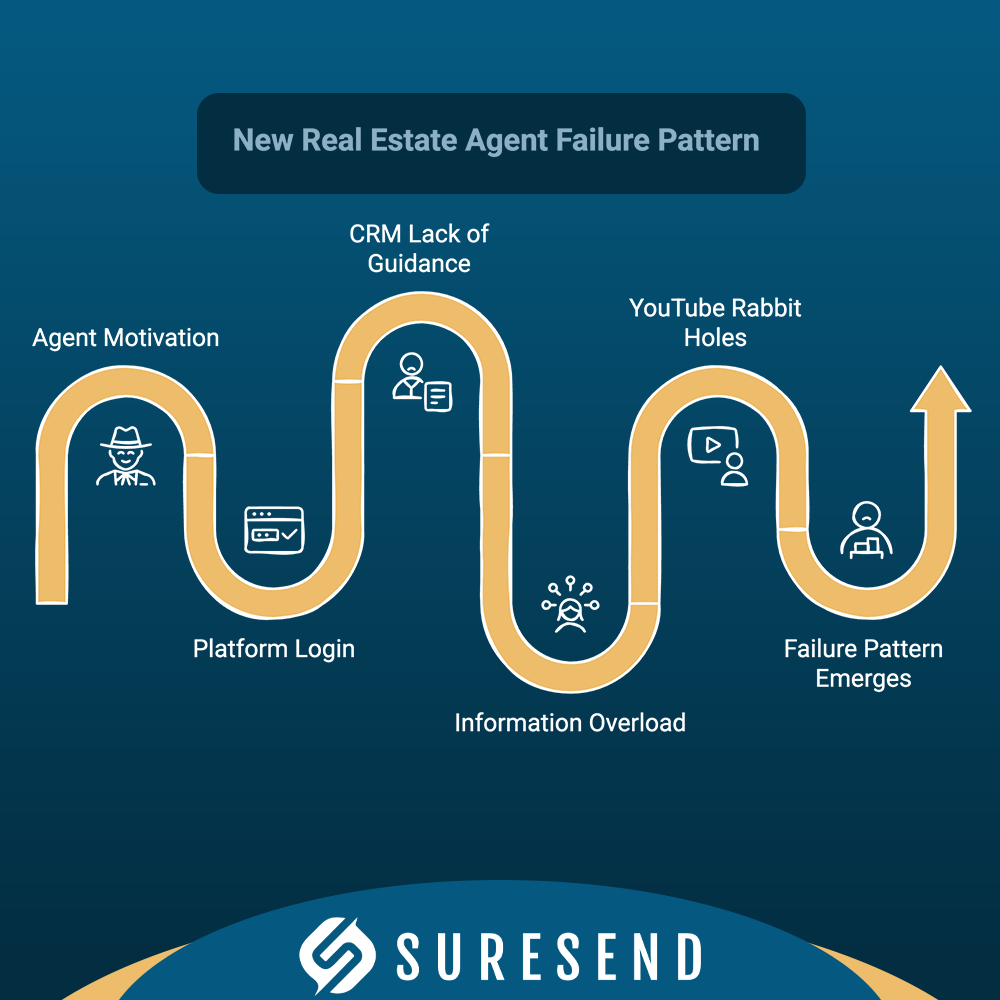
Ask ten people why most new real estate agents fail in their first two years and you will get the same three answers. They were not motivated enough. The market was tough. They did not get the training they needed.
Jennifer has watched all three explanations be present in agents who still failed. Motivated agents fail. Trained agents fail. Agents in good markets fail. The pattern she actually sees is different, and it shows up on day one.
“There is a large percentage of agents that don’t last. And really, it’s not because they weren’t motivated. They come in here, they pay their dues, they’re really excited. They’re like, I’m gonna be the next million dollar listing agent.”
Then they log in. The CRM does not tell them who to call. It does not tell them what to track. It does not tell them what comes next. So they start watching videos, going down YouTube rabbit holes, and trying to figure out which of the fifty things every coach and influencer says they should be doing actually matters today, before lunch, before their first call.
“You sign in and it doesn’t tell you what to do. And then you’re on videos, watching all of these things, and you’re like, oh my gosh, I don’t even know.”
This is the failure pattern. Not effort. Not talent. The gap between the day the agent shows up motivated and the day the platform actually tells them what to do.
This is the exact question Sure Send’s Win the Day dashboard answers the moment an agent logs in. Every overdue task, every appointment needing an outcome, every contact and conversation requirement, every personal goal the agent has set, all aggregated into one daily view. Clear it, and the agent has won the day. Win five days, win the week. Win twenty days, win the month. The platform is built around the question every rep wakes up asking, and it answers that question before the rep has to go looking for it.
The yellow pad technique
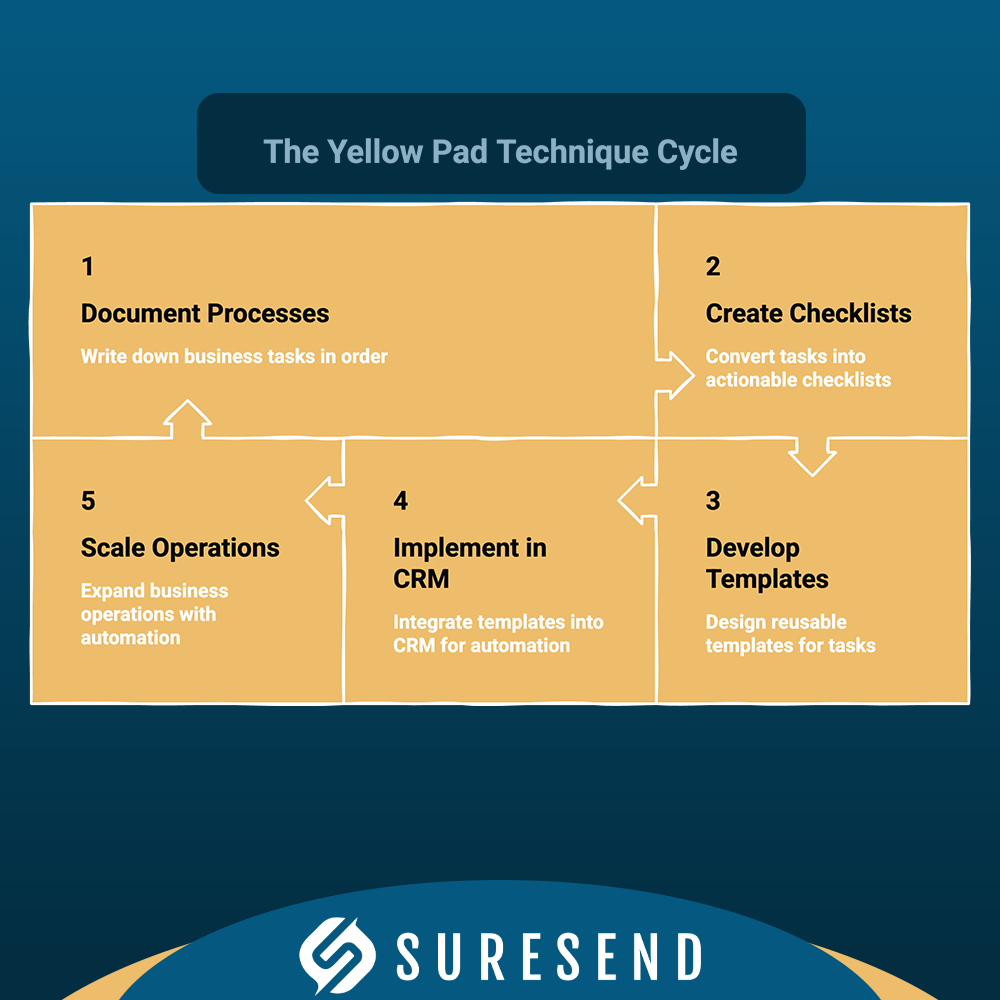
The most useful framework Jennifer shared in the episode is not new technology or fancy software. It is a yellow pad.
She calls it the yellow pad technique, and she has used it with every kind of business she has worked with. Solo agents. Mortgage teams. Investment companies. New brokerages. Her opening move is the same every time.
“I’ve always done this thing I call the yellow pad technique. And whether they actually write it down on a yellow pad or a Google sheet or whatever, I don’t care.”
The premise behind it is something most owners have never had named for them. The successful operators she works with already have a system. They just do not know it.
“They already have a system in their brain. They just don’t really know it. They’re just really good at something. They’re like, oh, this just comes naturally.”
Most owners are running their entire business out of their head. The follow-up sequence after a new lead. The welcome email when a contract is signed. The closing gift queued for the day after close. The review request the week after that. None of it is documented anywhere. All of it lives in the owner’s working memory, and that working memory is the actual operating system of the business.
Jennifer’s first move is to make them write it down. Not a manual. Not an SOP binder. A short list of what they actually do, in the order they do it. New contract comes in. Send the welcome email. Send the contract. Get the signed contract back. Send the next email. That is the yellow pad. Once it is on paper, it can be turned into a checklist. Once it is a checklist, it can be turned into templates. Once it is templates, it can move into a CRM with merge fields and automations, and the owner is no longer the system.
This is why the platform an agent or team works in matters more than most owners realize. A yellow pad on its own does not scale. A checklist taped to the desk does not survive a new hire. The work Jennifer is describing is the work of getting the system out of the owner’s head and into a place where the rest of the team can run it. Sure Send is built for exactly that handoff: visual automation builders, email and text templates, milestone-triggered tasks, and workflows that fire automatically once the steps are mapped. The yellow pad is where the system gets named. The platform is where it lives once it is named.
Most owners do not figure out they are the problem

The hardest moment in the conversation came when Shannon asked Jennifer how owners actually break out of the day-to-day. Jennifer’s answer was direct enough that it stopped the room.
“I think you have to be aware that you’re the bottleneck. And a lot of them don’t figure that out.”
Most owners come to her for one of three reasons. They want to start something else. They are burnt out. Or they cannot scale. Different surface problems, same root cause underneath. The owner became the system. They built the business in their head, ran it out of their head for years, and never moved it anywhere else. By the time they want their evenings back or want to grow past their personal capacity, they cannot, because nothing works without them.
“A lot of times when you’re working with me, it’s like, I’m giving you the heart to heart. I’m like, you are issue.”
Shannon agreed on the spot. She told the audience how she had been the catch-all in her own company, the person everyone defaulted to whenever something needed figuring out. When she finally hired an assistant and brought on a fractional COO, the handoff was harder than the work itself.
“I was the catch all. The boys were just like, oh, Jen will figure it out. And that was the culture we built.”
This is the part most articles about delegation skip. The work of getting things off your plate is not the hard part. The hard part is letting yourself stop being the person everyone goes to. Jennifer’s tactical advice for owners stuck in this loop is simple. Pick the one task you dread most and hand off only that. Not a department. Not a function. One task.
“Just take a small portion. Look at your day. I really hate sending out contracts. I delegate that to someone else.”
The compounding effect kicks in faster than most owners expect. An hour back this week, two hours back next month, ten hours back a quarter from now. Not because the owner trained anyone harder, but because the system finally lives somewhere other than their head.
A platform built for the individual rep changes the math here. When every team member has a daily view that tells them exactly what they need to do, when high-priority contacts who have not been reached automatically surface in a Take Action queue on the rep’s own dashboard, and when any rep can build a real-time call list with a plain-language Smart List request, the owner is no longer the routing layer between the work and the people doing it. The platform does that job. The owner gets to lead instead.
Why coaching alone does not keep agents in the game
Real estate has no shortage of coaching. Tom Ferry, Mike Ferry, Buffini & Company, Jon Cheplak, EOS-style frameworks. The behaviors that separate top producers from the 87% have been documented and taught for decades. Owners invest in these programs because they work. The question worth asking is not whether the coaching is good. The question is what happens between sessions, when an agent is alone with their CRM at 8:30 on a Tuesday morning.
That is where the gap lives. And Jennifer named it precisely on the episode.
“There’s not a lot of out of the box stuff that tells an agent how to do that. You’re this brand new agent with a brand new license and you’re becoming an operator of your business by trying to figure out who to call and what to do.”
Read that again. The agent is not failing because they were never taught the right behaviors. The agent is failing because the platform underneath those behaviors does not show them their own activity in real terms, and does not show their coach what is actually happening on their calendar and call list. Coaching teaches what to do. The CRM, the dialer, the inbox, and the calendar are where it either gets done or does not. When those two layers do not connect, the behaviors do not stick. Actions are the only proof that coaching is changing anything.
This is the gap Sure Send was built to close, and it operates on both sides of the coaching relationship.
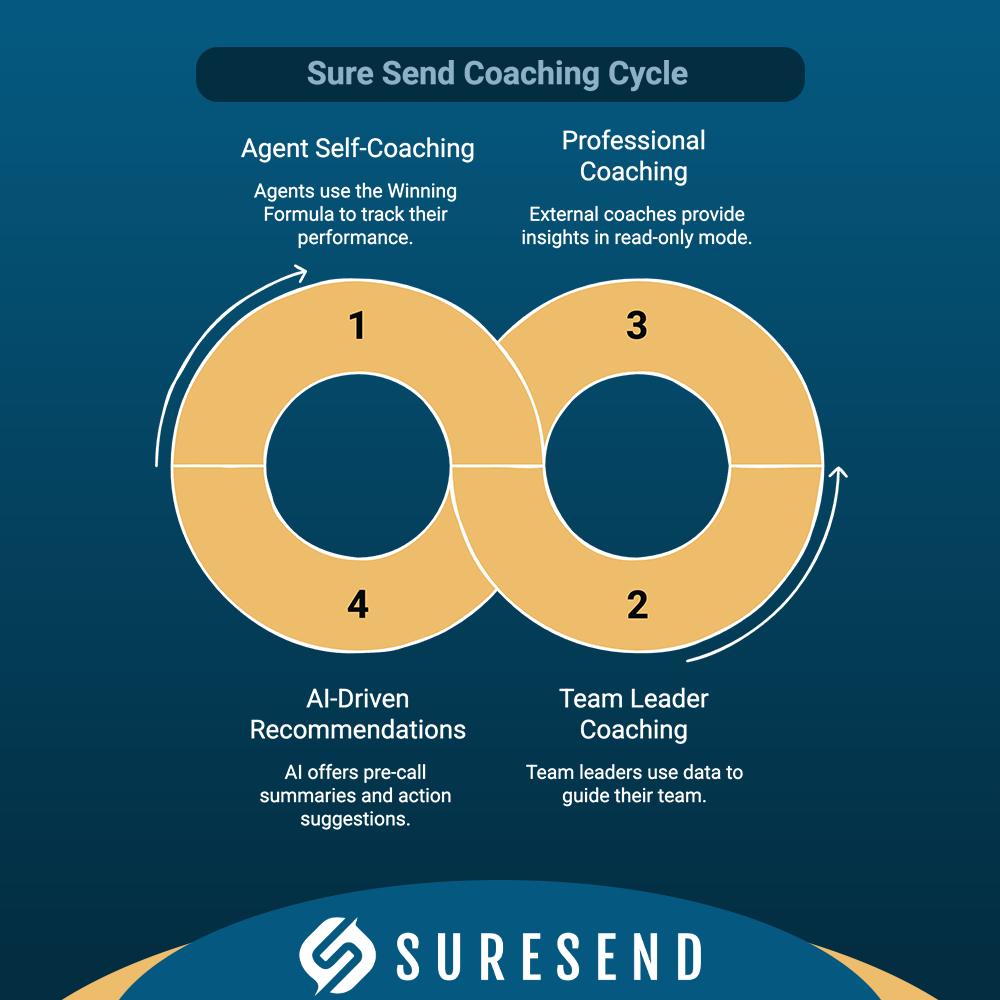
On the agent side, the Winning Formula puts a real dollar value on every call, conversation, and appointment, in real time, based on the agent’s own six-month rolling conversion history. The agent does not have to wait sixty or ninety days to feel the value of today’s activity. They see it the moment the call ends. The Winning Formula is self-coaching infrastructure built into the daily workflow, not a separate report the agent has to remember to look at.
On the coach side, the same live data feeds a four-level coaching loop. The agent self-coaches through the Winning Formula and Win the Day dashboard. The team leader coaches through the same data, organized for oversight. External professional coaches can be added in read-only mode at no cost, no paid seat required, which makes Sure Send the only CRM built to welcome a professional coaching relationship instead of working around it. The platform’s AI layer adds pre-call summaries, post-call action suggestions, and proactive next-best-action recommendations throughout the workflow.
Four levels of coaching, all operating off the same live data, all inside the same daily workflow. That is structural. It cannot be replicated by connecting an external coaching tool to a CRM that was never designed for it.
Better coaching alone will not fix the 87% number. Better coaching plus a platform where the coaching has somewhere to land will.
Accountability is a system question, not a people question
Every business that grows past its first few hires runs into the same moment. Something important does not get done. A follow-up gets missed. A document does not get sent. A handoff falls through the cracks. The owner’s instinct is to figure out who is responsible.
Jennifer’s instinct is different. And it is the instinct that builds teams that actually scale.
“If it wasn’t done, I don’t necessarily blame the person. I look at: did I train them properly? Was the system correct? I look at that first.”
The reframe is small but the consequences are large. When the first question is “was the system clear,” the team learns that mistakes are diagnostic data, not personal failures. People stop hiding small breakdowns. The owner stops chasing fires. The system gets better because the team trusts that surfacing problems will not get them blamed for them.
Jennifer connected the same principle to what people actually want from their roles.
“They want to know what their job is. They want to know when they show up tomorrow, what they’re supposed to work on. They don’t want to show up every Monday and just be delegated to. They want to know, this is my thing. I want to own it.”
Most accountability problems are role-clarity problems wearing a costume. People who know exactly what they own do the work. People who show up Monday waiting to be told what matters do not. The question is whether the platform supports that clarity or undermines it.
This is where the platform layer earns its place. Sure Send’s roles and permissions give every team member a defined scope of access and ownership. The non-deletable change log records every change to a contact or contract with the user and timestamp, so accountability is visible without being punitive. The team leader can see what got done, when, and by whom, without anyone having to file a report. People know what they own. The system knows what happened. Mistakes become diagnostic, not personal.
That is the version of accountability that builds teams who stay.
The shiny object trap
Jennifer’s reaction to conference season is one of the most quotable moments of the episode, and one of the most useful for any owner who has ever come back from a mastermind with a notebook full of new ideas.
“Conferences give me nightmares. Like, when I know a bunch of our clients are all going to go to conferences all at the same time, I tell them: you’re going to take notes the entire time, but only bring 10 things back that you might want to do. You do, two.”
Shannon recognized the pattern in her own business. James and Jaden, the company’s founders, joined every mastermind they could in their first couple of years. Each one came with a different recommended tool, a different system, a different idea of what was working in someone else’s market. They would come back from one event in one direction, then come back from the next event going the opposite way. Shannon eventually had to put a stop to it. Jen Kolde added that her team built an actual physical board, which they call the shiny object board, where new ideas land and wait. The team can implement two of them. The rest go on the board until the team has bandwidth, budget, and a real reason to move forward.
This is more than a productivity hack. It is an organizational discipline. New ideas have to earn their place against current goals, current capacity, current budget, and current seasonality. Most ideas that look exciting at a conference do not survive that test. The ones that do are the ones worth implementing.
There is a related trap one level up from this one. Most teams running a CRM are also running between three and eight other tools, each one a shiny object that earned its place at some point and never got reconsidered. Sure Send replaces that disconnected stack with one platform built around the operator, often at a fraction of the combined cost.
Build the business the way you want it to run

Near the end of the episode, Jen Kolde asked Jennifer the question she has been getting on every podcast she has appeared on lately. What is the one message you want every listener to walk away with?
Jennifer’s answer was not about systems or coaching or technology. It was about ownership.
“You can build a business the way you want it to run. It doesn’t have to be one cookie cutter thing. You can create this amazing life and business that can work together.”
That answer is easy to nod at and easy to skip past. It is also the through-line for everything else she said in the episode. The yellow pad technique only works if the owner is willing to write down their own version of the system instead of copying someone else’s. Getting out from being the bottleneck only works if the owner trusts their own judgment about what to delegate. The shiny object discipline only works if the owner has clear goals to filter ideas against. Coaching only sticks when the owner has built a daily operating model their team actually wants to run inside.
Every framework in the episode points back to the same belief. The owner gets to decide how the business runs. The platform either supports that decision or fights it.
Sure Send is built on that belief. The platform is industry-agnostic at its foundation, with the deepest out-of-the-box capability for real estate agents, teams, brokerages, and residential mortgage loan officers. It adapts to how the team actually sells, not the other way around. Customizable pipeline stages, custom fields, custom points systems, custom daily check-in items the rep sets for themselves. The platform’s job is to make the owner’s vision of the business easier to execute, not to impose someone else’s version of it.
That is what is behind the tagline. The CRM your team will actually use.
Watch the full conversation. Then go build.
Jennifer’s full conversation with Shannon O’Neill and Jen Kolde on the Home Guys podcast is embedded at the top of this article. You can also listen on [Apple Podcasts], [Spotify], and [YouTube]. If a section here resonated with where your business or team is right now, the full episode is worth the time. Jennifer goes deeper on several of these threads than this article had room for, including the practical mechanics of getting started with virtual assistants and the role-clarity discipline that makes remote teams work.
Follow the Sure Send blog for more on operations, accountability systems, and the work of building businesses that run without the owner in the room.
If you lead a team where any of this landed, where good people are leaving before they hit their stride, where coaching is not sticking the way you expected, or where the gap between what you teach and what your platform supports is starting to cost you deals.
See how Sure Send’s Win the Day dashboard, the Winning Formula, and the four-level coaching loop work together.
The CRM your team will actually use.
Shannon O’Neill:
On today’s episode of the Home Guys podcast.
Jennifer Staats:
They already have a system in their brain.
Jen Kolde:
But yeah, you’re getting them to get, that’s one of the hardest pieces, right? Like getting them to get everything out of their head.
Jennifer Staats:
I think you have to be aware, I think you need to be aware that you’re the bottleneck.
Shannon O’Neill:
The boys were just like, oh, Jenna figured out and they just, that was the culture we built.
Jen Kolde:
Kind of like almost like kind of putting a mirror up in front of people too and being like, hey, like you need to take a little bit look at yourself, be a little vulnerable.
Shannon O’Neill:
Enjoy the show. So hey everybody, welcome back to our Home Guys podcast. Home Guys Nation. Shannon and I are on today. I know you’re usually used to seeing James and Jaden, but we’ve taken over and we have Jennifer Staats with us who is, we’re super excited because she’s an operations minded, systems minded person in with real estate experience and she’s, she’s been behind the scenes. She’s the founder of Stat Solutions, chief of staff at Easy Home Search and a best selling author. She’s built her entire career around a single stat. 87% of new agents leave the industry within two years.
Shannon O’Neill:
And that’s not because they lacked motivation. Usually, you know, real estate agents are very motivated. It’s because nobody built the systems and accountability around them. You know, they, as we know with a lot of this, you’re just kind of thrown out there and need to figure it out. So this really speaks to something about how you can be successful when you’ve got the support and the systems behind you. And today we’re going to dig into why good people leave good companies and how to build operations also that run without you in the day to day when you put those systems in place, allow for your success. So Jennifer, thank you so much for being here. We’re super excited.
Jennifer Staats:
Thanks for having me. I’m excited too.
Shannon O’Neill:
Yeah. So tell us a little bit kind of about your background, how this evolved and what you’re doing today.
Jennifer Staats:
So I got my real estate license at 20. I don’t know why everyone asked me why I did that. I don’t know what, I don’t know what made me make that decision, but I got it at 20. I had an opportunity to work in an office while I was also selling and figured out that I was really good at the office stuff. You know, I kind of like came in, I think I was supposed to be a receptionist. I instantly was like got switched to being an office Manager and I was also selling, so selling at night and then I was managing the office during the day and that kind of transitioned into director of operations roles. And long story short, we wanted to move from California and there was like, there’s no way I’m just going to get my license, start knocking on doors. I also didn’t really want a full time job with that exact moment.
Jennifer Staats:
And so I started my company called Stat Solutions about eight years ago. I, about six months ago I had the opportunity to join Easy Home Search and kind of made that plan to kind of back out of my current role or my business and have other people run it while I’m doing something I’m really passionate about. And now I’m chief of staff at Suresend. So it’s been ride, but it’s been fun.
Shannon O’Neill:
Yeah. And that’s usually how that happens. Like especially once people realize that you’ve kind of got that operations mind. And I know Shannon’s. This has happened to Shannon too. They’re like, oh, here you can just organize all the things and you know, build, build this out, the SOPs and the systems and the, you know, manuals and all the stuff. And because it is, it’s a different mindset, it’s a different skill set that you need for that.
Jennifer Staats:
And yeah, it really is. I mean, and we’ve worked mostly in the real estate industry. That’s kind of where my focus has been. And I just love being able to see what like an agent is struggling with. And I can see this like simple path. Like I just see it. Oh, this is. How do you not see that? Like, let’s do that for you.
Jennifer Staats:
And they’re like, wait a second, what? Like I overthought it. I overthought everything about it. And I think it’s a lot to do with like us in the real estate industry. We’re always watching other people doing things. We’re always watching social media and videos and all of these things that tell. You’ve got to do all of these millions of things.
Shannon O’Neill:
Yeah.
Jennifer Staats:
When really sometimes there’s a simple way to just start to do it and then you can add on more complicated things later. Right.
Shannon O’Neill:
As it evolves. Yeah.
Jennifer Staats:
I just think that’s where a lot of us get stuck. And then I tell people, let’s just start out real simple. Let’s execute on the real simple to where we know we can repeat things and then we can make it fancy. So it’s like, yeah, it’s like a one agent thing or a big company to me, it’s all the same thing.
Shannon O’Neill:
Absolutely. And we actually, we talked about that last night where, you know, it doesn’t matter what industry or, you know, when we started this company, I was pulling pieces from all my different jobs that I’d ever had. I’m like, oh, actually this will help me organize this. And this fits here. And I think it’s hard, especially in the real estate industry and especially for us in the investment side of things to really have those systems because everything, you’re constantly pivoting, like the market is pivoting. You’ve got staff coming in and out, the technology is changing. So keeping up with all that and having a consistent system and maintaining that as all the shiny objects are flying around, and especially with, you know, a lot of agents or visionaries or entrepreneur minded people. So getting them also to follow a system, I guess that would lead me into how do you, how do you do that? Because that is, that’s a struggle.
Shannon O’Neill:
But how do you get them to buy into the, the systems that, hey, this is important, this is gonna help you. And I like keeping it simple. We have to keep things simple with,
Jennifer Staats:
with any of our clients across the board. I mean, this is how I start any company. This is how I help people build out their sure Send accounts. Like all of it just starts with like, okay, you’re very successful for a reason. Right. Okay, you sell X amount of houses and this is where they usually come from. And this is how you do it. They already have a system in their brain.
Jennifer Staats:
They just don’t really know it. They’re just really good at something. They’re like, oh, this just comes naturally, that I have to call and follow up with them and I’ve got you. That’s a system. But they just don’t look that right. So generally like I always, I’ve always done this thing I call the yellow pad technique. And whether they actually write it down on a yellow pad or a Google sheet or whatever, I don’t care. But I just have them start by, okay, what does your day look like? You get a new contract or you buy a new property or you start a new company.
Jennifer Staats:
What it just write down the brief. I don’t need anything crazy. Just write down what you did. Okay, that’s, I mean, that’s kind of simple, right? If you get them to do that.
Jen Kolde:
Yep.
Jennifer Staats:
They go, okay, we can just put that into a checklist. And a lot of that’s repeatable. So if you’re doing social media for the week or you’re selling A house, or you’re buying a house, or you have a new client intake. Usually there’s a checklist that goes with that. I send them any. A welcome email, I get them a contract, I get this signed contract back. This is the contract I send them. This is the email I send them.
Jennifer Staats:
You now have a full checklist that they’ve already been doing. They just don’t realize it. And then you all of a sudden have. There’s your draft contract, there’s your email template. All of a sudden you have a system. It’s nothing crazy fancy, but if we’re trying to get that into anything, right? If we’re trying to get that into a CRM or we’re trying to get whatever that system looks like, we can easily do that. We start out small and then we make it so you can repeat it over and over again, the exact same thing. Now, to get the owner to buy into a new piece of tech or a new system, it depends on the person, right? I mean, it just depends.
Jennifer Staats:
Oftentimes I just remove them from it altogether. Like, I’m like, hey, if we have enough staff or whatever, you just make sure they’ve there. If you were cc’d on that email, you check off the box or whatever, we can take it out of their thing altogether. I mean, if we have a CRM, I can make the email go from them, right? Like, they don’t have to send the email anymore. I can put like merge fields and I can all of those fancy. Some, some owners are different than others. But the, the how I get them to really buy in and say we’ve got to do it this way is that I can show them like, okay, you sell 30 homes this year by yourself. You, your goal is you want to get to 100.
Jennifer Staats:
You don’t just do that if you’ve already been working full time. You don’t just magically have three times the amount of time. Like, we have to create systems around it, we have to create leverage. We need tech. How can we do that? I don’t necessarily always need another two people. We can leverage a lot of it by having email templates, a CRM, all of those things, and all of a sudden, what used to take you an hour because you had to go through your cell phone, you had to find their email address, you had to find the address now all in one place, and it’s more automated, Great. Now we can even do more with less people, and then we can start layering on the fancier stuff. So like with me, most of our clients have been residential.
Jennifer Staats:
So it’s like mainly I hear like two things always get dropped. I always forget to ask people to leave me reviews. I always forget to send the gift. You know, I always want to do the closing gift or something like that. Well, now you can add those two steps on the end of a closing workflow. And now you know you’re going to do it because the tasks are going to pop up or it’s going to pop up for whoever. And now you can’t clear out your stuff until it’s done. So you, or now you know who you didn’t do it for.
Jennifer Staats:
And now you’re really spotting where the gaps are. So there’s a couple of different ways I can get owners to kind of see the light.
Jen Kolde:
Creative accountability. But yeah, you’re getting them to get. That’s one of the hardest pieces, right? Like getting them to get everything out of their head. So yeah, they’ve been using like oral processes and systems or like the storytelling ones, like where they just get passed like verbally from person to person. So now you’re like creating that system around it to make it so it’s efficient and there’s accountability behind it.
Jennifer Staats:
Love it.
Shannon O’Neill:
Absolutely. So our audience is a lot of investment entrepreneurs. And one thing we always hear, we, we go to these mastermind meetup groups and one in particular, everybody, they get up and they kind of present about their business and where they are. And it’s kind of a peer coaching thing. And more often than not, people are like, I’m stuck in the day to day. So that’s a good, for our audience. That’s a, you know, a good easy way to kind of get them to transition out of that. Like just pick those little pieces or pick a few things because they, they constantly, they’re like, I can’t, I’m stuck.
Shannon O’Neill:
Like, I’m in the business. I can’t get out. I mean, Shannon, you know, I can think of like five people that they
Jen Kolde:
create their own bottleneck.
Shannon O’Neill:
Yeah, yeah. So, and I saw on Jennifer, on some of your talking points, like how to avoid and get them out of that bottleneck. So those are some, the ones you just talked about, some good tips. What, what else, how else would you recommend people to kind of clear that hurdle?
Jennifer Staats:
I think you have to be aware. I think you need to be aware that you’re the bottleneck. And a lot of them don’t figure that out.
Shannon O’Neill:
Sometimes they, yeah, they, they don’t even see it.
Jennifer Staats:
You just don’t even see it. And There’s a variety of reasons, right? Why? So like, a lot of people that I work with, they come to me for a variety of reasons. They either want to start something else or they’re burnt out, or they’re just not able to scale. Scale. And it’s all the same. If we create system and leverage, we can get more time back for whatever you want. And that’s. You can do with that chunk of time with whatever you want.
Jennifer Staats:
You can either scale the company to do some, to do more, you can do something else. You can just get back more time to be with your family and friends, maybe take a weekend off. I mean, that, that’s like one of like the basis. And that’s like why I get so excited about operations, because I’m like, I can just make this so simple that now we don’t need as much of you. And now you can spend your time in your zone of genius or doing whatever you want. So if you want to go buy more houses, you want to do more deals, you can. But sometimes we have to. Almost like sometimes when I’m growing companies, we learn more about ourselves than we do about people around us because we realize how we’re reacting to specific situations.
Jennifer Staats:
And you have to really look internally for like, why am, why am I having a hard time with this? I’m maybe not letting go. I’m being the issue here. And a lot of times when you’re working with me, it’s like, I’m giving you the heart to heart. I’m like, you are Issue, like. But I think that’s true with any business. All of us entrepreneurs, like, you are getting in your own way in a variety of reasons. So if you can, you know, streamline even just little portions of your business, it doesn’t have to be huge because most of us, like, overthink it. And you’re like, oh, I’ve got to like, you know, leverage the whole thing.
Jennifer Staats:
No, just take a small portion. Look at your day. I really hate sending out contracts. I don’t know why. I can’t explain it to you. I hate negotiating contracts, hate sending them out, I hate putting them in DocuSign. Like, it is the worst part of my day when I have new clients coming on. So, like, for that, even though it’s small, you know, could be an hour to a week, I delegate that to someone else.
Jennifer Staats:
They can do that perfectly fine. I don’t need to put stuff in DocuSign. They can follow up on signed contracts, etc. I can now spend another couple hours Doing something different. And then you just little small chunks of that, and all of a sudden you’re like, I have 10 hours free every week. What can I do with this? Do I go to the gym or do I build another company? It’s up to you.
Shannon O’Neill:
Yeah, exactly. And it’s. And that’s where we find it gets overwhelming to they. They know they need help. And some of it’s a trust issue. You know, a lot of entrepreneurs, it’s like, I built this. This is my baby. Nobody’s going to have the passion and do it the way I want it done.
Shannon O’Neill:
Well, no, they’re not. But through the hiring process, and we’ve really dialed that in over the 10 years. But through that process, you can get somebody pretty close. You can find somebody with the skill set, and that buys into your culture and the vision. And then, yeah, like you said, just start handing off small pieces. You don’t have to hand off an entire department. Like, here, take it all. Just start handing off those smaller tasks that.
Shannon O’Neill:
You know what? I just really don’t want to do this. And Shannon, who are we talking to? That we were telling exactly that. But someone. We just said that yesterday to somebody. It’s like, just give them this little piece.
Jen Kolde:
Yeah. Just to give them a piece of something. You should be doing the higher dollar revenue things anyway. You’re in that position. And a lot of times we end up. Because sometimes as entrepreneurs, I’ll just put myself in that bucket, too. But we don’t want to delegate because we know we can do it, like, really fast and quick and we can get it done and we trust ourselves, and then we get stuck on that, and then you can’t scale, then you can’t multiply when you’re the only person doing the things. So Jen.
Jen Kolde:
Jen had to work on delegation last year. Right, Jen? And you got really good at it.
Shannon O’Neill:
I was the catch. All, like, we started this company and the boys were just. I say the boys. My husband and his friend. But the boys were just like, oh, general figured out, and they just. That was the culture we built. And so even though, you know, I hired an assistant and Shannon. We brought Shannon on as a fractional COO to kind of help us transition into scale and to take that next step.
Shannon O’Neill:
But she was like, okay, you can give that to Anna and I can take care of that. I’m like, oh, yeah, Yeah, I can do that. And then it became kind of a. I kept telling Anna that I felt like the Devil wears Prada when close. Every time I would Ask her to do something. I felt so just. And it was a. It was an adjustment for me, but
Jennifer Staats:
to lean into that.
Shannon O’Neill:
Yeah, to lean. Lean into that. And she’s like, it’s. It’s okay. I. I got it. So I think, yeah, it’s. It’s definitely a mindset shift.
Jen Kolde:
I think what Jennifer said before is, like, really important, too. And this is why sometimes we have to be like the CEO whisperer when you’re working on, like, trying to manage operations. Because, like, what you said, Jennifer, about kind of, like, almost like kind of putting a mirror up in front of people, too, and being like, hey, like, you need to take a little bit look at yourself, be a little vulnerable, like, realize that maybe, just maybe you’re causing some of these issues or that you’re causing the bottleneck. And, like, those are some of the most delicate, like, conversations. Because sometimes as entrepreneurs, we let our ego get in the way. And so, like, trying to figure out that balance between, like, I really want this to work and I really want that time freedom that, like, you and Jen both were talking about and how to balance, like, this is my company with. I really want to be able to go to my kids, you know, vacation.
Shannon O’Neill:
Yeah.
Jennifer Staats:
You can’t do that if everything’s on you. Right. Like, you need. You either need people or you need technology that you can trust that are going to, like, keep some things running. I mean, I know I wouldn’t be able to do anything that I’ve been able to do without tech and the right people. I mean, there’s people on my team that 100% they can do things better than me now. Like, I’m, like, shocked sometimes. I wouldn’t have ever thought about that.
Jennifer Staats:
They’re like, yeah, this took me five minutes. It’s like, I mess with that for 30 minutes. Why did I even. Just not. Because I did the same thing. I feel bad asking them for help. Cause it feels like such a silly thing.
Shannon O’Neill:
Yep.
Jennifer Staats:
Then all of a sudden, you know, I’m spending all this wasted time. I mean, the people we hire at sure Send are some of the most, you know, genius people I’ve ever worked with. And I. I just spent. I mean, I still do it. Like, yesterday, I spent the entire day just looking through everything and delegating things out, because I was like, I can’t feasibly do all this stuff on my list and do it at the level I want to do it unless I’m delegating things out. And it’s like, I just delegate. We’ve got A big team.
Jennifer Staats:
So I just spent the entire team like day. Just, can you help me with this? Can you start this? All time consuming things that they’re capable of doing and then better yet, they’re learning things they weren’t able to before because I was just holding everything to do it myself. Absolutely. There’s so many layers to it where you just have to be like, why am I, why am I stressing myself out with this? I’ve got tech to do this, I’ve got people to do this. Get it off your plate. Now you’re like, ah, okay, now I can work on higher level things.
Jen Kolde:
Well. And empowering them to like be able to learn it, like what you’re talking about. Like, then that builds trust in you that they can take it over for you and you don’t have. So it’s okay to not complain completely hand something and just be like, can you start this? And then like you said a lot of times you’ll learn that like, oh, they can do it better than me or you can get it done faster than me because they can focus on it and they have this, you know, focused time that maybe I don’t have.
Shannon O’Neill:
Yeah, well, and that’s you, you mentioned, you know, having teams of people and we’ve just in the past year really leaned into having VAs. We tried it in the past, we didn’t have. And you, you do need to have your systems dialed in. You know, you need to have those roles and those expectations and then you can, you know, we found, you can see in my area, okay, I can hand this off. If you’ve got five hands and a bucket and everybody’s kind of just diving in. You know, it’s hard to, to delegate. It’s hard to adjust those roles and those tasks. But just in the past year we’ve added what, five maybe virtual assistants.
Jen Kolde:
Yeah.
Shannon O’Neill:
And it’s an international team and it’s been amazing. Like we had specific job descriptions
Jen Kolde:
we built out.
Shannon O’Neill:
Yeah. And they’re part of our team. So they, they are constantly in. I think you can, I don’t know if you guys can see down here. Dee, her name popped up. But so she’s one of our virtual assistants in the Philippines and I met with her this morning. We have a little morning huddle and then, you know, using WhatsApp, we’re able to stay connected and I think that’s been important for us is really dialing
Jennifer Staats:
in
Shannon O’Neill:
that what the management is doing, what everybody’s role is. And then that allows you to scale, that allows you to kind of take that next step because then you can see what you can hand off.
Jennifer Staats:
Yeah. Trust in the accountability. Right. Like, you can see, okay, this is what’s supposed to happen. This is who’s doing it. Is it done? Is it not done? Why? And like, I’m always the type person that I look at it. Like, if it wasn’t done, I don’t necessarily blame the person I look at. Like, did I train them properly? Did.
Jennifer Staats:
Was the system correct? I look at that first and then I’m like, wait a second. Okay, we’ve talked about this three times. Like, now, you know, this is your responsibility. Like, it wasn’t done. Let’s talk about it. But it’s. That’s important, especially when you’re growing, like, with people, like, everyone. And they want to know that too.
Jennifer Staats:
Right? They want to know what their job is. They want to know when they show up tomorrow, what they’re supposed to work on. They don’t want to, like, show up every Monday and literally just have no idea and just be like, you know, delegated to. Right. They want to know, like, this is my thing. I want to own it. People like that.
Shannon O’Neill:
Absolutely. And then, yeah, encouraging them and that, that feedback and that coaching. Shannon, what. What other questions do you have?
Jen Kolde:
Tell me about, like, what we talked about, the agents, like, not staying. Like, can you talk a little bit about what you see? Like, that does work to get people to stay and, like, kind of building that out.
Jennifer Staats:
I think there’s a couple different layers to that because you’re. We could be talking about, like, agents on a team, and we could be talking about, like, an individual agent. So, like, I’ll start off with, like, an individual agent. Like, okay, there is a large percentage of agents that don’t last. Right. And really, it’s not because they weren’t motivated. They come in here, they pay their dues, they’re really excited. They’re like, I’m gonna be the next million dollar listing agent.
Jennifer Staats:
I’ve got this.
Jen Kolde:
Yeah.
Jennifer Staats:
And then they log in day one. And depending on where you’re at in the world, you might be at a brokerage with systems they provided you. You might just be, like, off on your own, signing up for your own CRM and etc. And then you sign in and it doesn’t tell you what to do. And then you’re on videos, watching all of these things, and you’re like, oh, my gosh, I don’t even know. Okay. Like, yeah, I put my contacts in the CRM, but it’s not telling me who I should call. Like, I don’t have any tracking on that.
Jennifer Staats:
I just don’t know. Right. And then you go down the YouTube rabbit hole and you’re now you’re thinking that you need to deals and you need to do all of these things, but you’re not really sure like what direction to go in. And so I think it’s kind of like what we talked earlier. It’s just like the basics. Right? Okay. Agents need to be just doing some of the basics, maybe working on like a couple different sources of income and stay focused on like who their person, like what their personality is. Right.
Jennifer Staats:
I have different agents that we work with that are like, I would never cold call anyone. Okay. There’s other methods of making money. Right. You could do door knocking, you do Popeyes. You know, a lot of people have like, you know, a good sphere of influence. Like look at that. And I think the basis of a lot of what agents are doing is your CRM, that’s your contact management system.
Jennifer Staats:
Where are you putting all these people and are you setting certain expectations with yourself to put a number of contacts in there? Are you reaching out to those people? Are you keeping it up to date? And then, okay, once you start doing deals, do you have a consistent system to do those deals with those people? And then afterwards do you have consistent follow up? There’s not a lot of like out of the box stuff that tells an agent how to do that. So then you’re this brand new agent with a brand new license and you’re becoming an operator of your business by trying to figure out who to call and what to do and what systems to set up. And it’s hard, it’s just not, it’s not easy. The same thing on the team side, you know, if you’re, if you’re a team and you’re bringing in all of these agents and you’re making it so difficult for them to show up and do their job. I have single handedly seen a million times where agents, you know, the team leads, change a bunch of tech and all that stuff and they burn these agents out because truly they’re still learning how to sell real estate. And now you’re telling them, I’ve got to learn how to, you know, do this and do that and this techie thing and blah, blah, and it’s like just making it simple.
Jen Kolde:
Things are strengths too.
Jennifer Staats:
Yeah. Like one system. Try to condense it into one system if you possibly can. My husband’s in construction and he always gets so Shocked. He’s like, I just don’t understand how you have like 50 tabs open right now to do your job. And I’m like, it’s just how real estate is. You have so many things open. You’re doing all the things because you’re the content creator, video editor, and all these things.
Jennifer Staats:
So simplify it right until you start selling. And then you can make things a little fancier, like, you know, if you need. If you want to go do Popeyes and stuff like that, start with your list in your CRM with everyone’s addresses, start tracking those things you’re doing, and then do that, and then start on the next thing and then track your results by what. What happened there. But you don’t need to have 50 tabs in a million programs and spend $20,000 on tech. Like, keep it simple.
Jen Kolde:
Yeah, I see that a lot. Where, not, not just in the agent world, but in, like, CEOs and entrepreneurs too, that they buy all the programs, buy all the education, sign up for multiple masterminds, and there’s no way they could even possibly watch everything that they signed up for, much less actually implement it. So, like, I think that that’s a big piece there too, is like the connection between having someone that is the operator and having implementers, like people that are actually going to take and make the systems, or people that are going to take the tech and make it so that it automatically does the system for you and connecting those two pieces so that, like you said, the people that are not great at operations or even administration stuff can stay in their genius zone. And then the people that are great at that are pushing forward those things every day.
Jennifer Staats:
Conferences give me nightmares, like, when I know a bunch of our clients are all going to go to conferences all at the same time. I tell them, like, you’re going to take notes the entire time, but only bring 10 things back that you might want to do. You do, too. Okay.
Shannon O’Neill:
Yeah. We had to limit James and Jaden. They, the first couple years, they joined every mastermind out there and they. Once a month they were going to a different one and everybody had different ideas, different tools. Like, this is working really well here and this is working really well over here. So they would come back and go in one direction, and then next month they’d go to another one and come back and, okay, we’re going to go this way. Well, no, last month you said so I had to. I had to kind of put the kibosh on.
Jen Kolde:
Okay, yeah, to your point, like Jennifer, like, that yeah, we talk, okay, go bring back 10 things. But like eight of those things go on the shiny object board. We put them on this, like we have an actual board in our sauna that’s like shiny object board and that’s where everything goes. And then you can, you can try to implement two and. But that comparison thing that you mentioned earlier is like the biggest thing there, right? Like, people hear so and so is doing well and so they’re like, I got to do whatever they’re doing, but that’s just not the case. Like their business is probably very different from yours even if you’re in the same industry. Like, each market is different. There are things that transfer over, but there’s some things that don’t.
Jen Kolde:
It all depends on like your makeup of your team and what you’re doing. So how do you, how do you combat some of that? Like where you’re saying like, don’t, don’t let comparison steal your be the thief of joy. Right?
Jennifer Staats:
Yeah. I mean, it’s hard, right, because I, I’m totally like an innovator. Innovator. I want to like look at everything that’s out there. But then we also have to say, okay, let’s say we already have a tool that’s working really well for us and it might be our website, it might be our CRM, whatever’s working really well for you, maybe we don’t want to change that. So if you’re coming to me and you’re like, oh, I have this really amazing new website provider, but it doesn’t integrate with our CRM, I’m like, okay, let’s just hold on one second, take a look at it. Let’s see how this is going to affect everything else. So I’m looking at any idea like that, right? Is it tech, is it a new person, whatever, how is that going to affect everything? Do we have the budget for it, all of those things, what is it going to take to implement that? Do we have the bandwidth with everything we’ve got going on? I usually take a couple different step approach to looking at anything and then say, okay, that does sound like it would make sense.
Jennifer Staats:
That might fix this problem we have, or that might get us to the goal we have for this year. But a lot of times we just call it the vision Board. So we move all of those tasks onto the vision board into Asana and we just leave them there unassigned until we have a little more bandwidth later. But it’s with anyone, we all get excited. Look at what this person did. It was so cool. Okay. It’s going to take 10 people to run that system.
Jennifer Staats:
It doesn’t make sense for our workflows, all the things. Let’s maybe table that and maybe come back to it once we switch xyz.
Jen Kolde:
Yeah, I like to always, I like to say, especially because you don’t want to like, discourage that visionary or the innovator attitude like you’re talking about too. Like, so I always say, that’s such a great idea. Let me take it back and take a look at it. Because that way their excitement that they had, like, we get to keep the excitement. Yes. You learn some new fun things while you’re at your thing. And then when we go back, then I list all those things like, you’re talking about, like, how does it impact other people? Which I think is like a big thing people miss a lot is that they don’t. They think about how it affects them and their bottom line.
Jen Kolde:
They don’t think about all the employees that are always already doing all these different pieces and how whatever we’re about to implement is going to affect those people that are actually in the trenches doing all this stuff every day. So. So, like, go back, list like, okay, here’s what, who it would impact. Here’s how it would impact our bottom line. Here’s what it would help with and good things that it would do. And then are they outweighing each other? And then come back and be like, okay, I think this is something we should pause for right now because we’re. This is our main focus. Right? Is this still our main focus? Okay, then we have to do these things to work to that.
Jen Kolde:
And that’s hard because, like, they. There’s not a lot of patience in the visionary mindset. And that’s part of why they’re so good at it. But it’s like, it’s. But taking the integrator or the implementer side, you got to be like, let’s slow down a little bit and see if it matches where. Where we’re all supposed to be.
Shannon O’Neill:
Well, and someone pointed out to me too, like, to the visionaries, and this was really cool, but, you know, they bring you an idea and it is our job to go, okay, wait a minute, like, what does this look like? And to them, they hear that and this was a good conversation that James and I had. And to them, it’s like, you’re trying to stop me. You’re trying to slow me down. You’re trying to. Yeah. And in fact, it’s the opposite. Is what what we’re trying to do is figure out, okay, is this really something that’s going to help? Is this something we really need? How can we get it done? How. How can we support you in, in this initiative if this is something that we want to move forward with? It’s like we’re actually trying to help them accomplish that goal by asking those questions.
Shannon O’Neill:
But to them, it’s like, no, I can’t do that. Like, no, I’m not saying you can’t do it. I’m trying to figure out how we can do it.
Jennifer Staats:
Yeah.
Shannon O’Neill:
And he, he kind of a little light bulb went off. He was like, oh, said, yeah, that’s. And if it is, you know, that brings us to also why it’s important to have those goals every year. Like, to have those conversations about what are our steps, where do we want to be that strategic planning piece, because it keeps your focus, and then when the shiny objects come up, how does that tie in, like Shannon said, to our goals? And then, you know, is this, does it build on what we already have? If this, Is this a whole new thing we need to dive into? Do we have the resources to do that? So it’s. Yeah, it, it’s a, an interesting.
Jen Kolde:
Is it a whole nother company?
Jennifer Staats:
Like, what’s. What problems is it solving? You know, is it a fancy thing? Or is it solving, like a major thing within the company? And then it’s maybe something to look at, but I think. And then it’s like a lot of it’s seasonality, too. Is this the right time of the year for us to be diving into whatever we’re looking at? Or are we going to mess with production? You know, are we going to mess with buying properties? Are we going to buy. Mess with, you know, selling properties? So I look at some of that too, where I’m like, okay, well, if our slow time is winter, let’s start implementing that in September, October. So we have a couple months during the slow time. So then when we ramp up, we’re all not just like on fire.
Shannon O’Neill:
Absolutely. And, and some of those things too. It’s like, do we have the budget for that? Like, some of these bigger ticket items that are coming to us? And it’s like, okay, well, yeah, we did not budget for that right now. Like, so let’s put that in the calendar later this year. Or, hey, that’s just gonna have to. We’re gonna have to put that for next year. And we can look at. Because, for instance, this year we had two ambassador program or sponsors, brand Ambassadors, that’s the word I’m looking for that we were looking at working with one.
Shannon O’Neill:
They, they’re both higher ticket items that going into this year. They kind of came up last summer and through the fall and looking at like, okay, we can only pick one. What’s the better fit for us at this time? You know, and so we put the other one on the agenda for next year when we come into September, October Q4 and we’re doing more of that, diving into that budgeting. Okay, is this here. Here are all the things. Whether it’s technology or, you know, different marketing strategies. Here’s here are all the things we had on the shiny object board. What, what do we want to move forward? So you know, and I think I know as far as James and Jane go, they appreciate keeping those front and center so they feel heard and, and they have, hey, we still have these out there.
Shannon O’Neill:
I know you guys threw it out randomly, but it’s still here. We just need to see where it fits in.
Jennifer Staats:
Yeah, love it.
Shannon O’Neill:
So well, anything, anything else you can think of if people have questions or you know, interested in picking your brain more about systems operations, your, your different businesses.
Jennifer Staats:
Yeah, you.
Shannon O’Neill:
How can they reach out?
Jennifer Staats:
And yeah, the easiest place to find me is either just going to be Facebook or LinkedIn. Just my name, Jennifer SA. My Instagram’s really easy to find. It’s Jennifer the realtor I’ve clearly had. And then if you want to check out SureSend, we have monthly options at SureSend AI. It’s a tech driven CRM platform that’s built by agents and operators. So it’s completely customizable. So we’re building it for really any industry so you can come in and sell the way you want to sell.
Shannon O’Neill:
Okay, that’s. Yeah, that’s awesome. That might be a whole other conversation about that. Maybe we’ll have you back on to talk about that because AI is, I mean it’s a, it’s a hot topic right now and how we can utilize that. That is one of the things talking about for, you know, keeping things on strategic planning. It was a big push this year. How can we utilize and implement AI into our business? So yeah, that, that’ll be a whole conversation.
Jennifer Staats:
Yeah, anytime.
Jen Kolde:
As you’re going on. I know you’re going to some different podcasts and stuff right now, Jennifer, but as you’re doing that, like what’s the one message like you would like, like everyone to be able to hear from you?
Jennifer Staats:
I think just given like my background and my passion is that you can build a business the way any business the way that you want it to run. Like, it doesn’t have to be one cookie cutter thing. You can create this, like, amazing life and business that can work together would probably be the thing that I would leave with everybody.
Jen Kolde:
I love that it fits right into what we do because, like, the home guys nation, like, as we help people, like, set up home guys in their local market, like, it’s very customizable. And, like, while we’re giving them all the tools of, like, everything that the home guys have built up in Minnesota, we’re also, like, helping them figure out how to make it their own in
Shannon O’Neill:
their market of it and how to, you know, we call it doing life together. Everybody that we, you know, partner with or bring into the family, I guess, is, you know, there are people that we, we want to spend time with. They’re people that we believe in. And so we call it doing life. And yeah, it’s been a roller coaster of a ride, but, you know, it’s. It’s a. It’s a great time. So if anybody’s interested and more information about home guys, it’s homeguys.com you can find us on most of the socials, Facebook, Home Guys USA, YouTube.
Shannon O’Neill:
James and Jaden are usually the faces out there. So you can go to YouTube Home Guys USA and find what James and Jaden are talking about and reach out. I know Brady will put our contact info somewhere on the screen here when he puts it together. And we will see you next time. Thank you. Jennifer, it was great chatting with you.
Jennifer Staats:
Thanks. Nice meeting you both.

Kurt UhlirChief Marketing Officer
Kurt Uhlir is a recognized leader in marketing, growth, and innovation, having helped scale companies and technologies used by millions every day—including at brands like AGNT, Sideqik, Vitrue, Oracle, Garmin, Facebook, Meta, Apple, and more. He’s trained tens of thousands of professionals on how to build trust, lead with service, and help clients make wise, informed decisions. At ez Home Search and Sure Send, his focus is on helping high-performing business owners, team leaders, and individual sales leaders grow their businesses through exclusive market access, privacy-first lead systems, and conversion-focused enablement tools.