

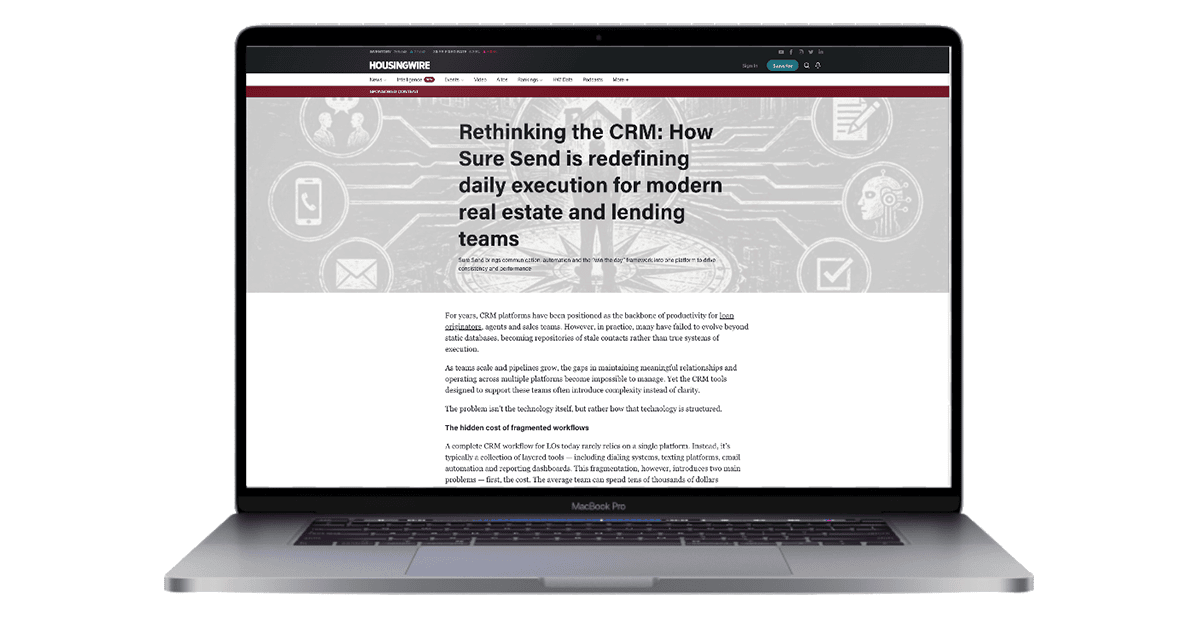
HousingWire on Sure Send: Why Daily Execution Is the Next Chapter in CRM
HousingWire profiled Sure Send’s Win the Day framework and the shift from CRM as database to CRM as daily execution system. Read the takeaways.
A shift HousingWire saw worth writing about
Most CRMs were never built for the people using them. They were built to give managers a window into what their teams were doing, with features for individual reps layered on top over time.
HousingWire put the result of that design choice plainly in their recent profile of Sure Send: most CRMs have “failed to evolve beyond static databases, becoming repositories of stale contacts rather than true systems of execution.” Read the full HousingWire article here.
That sentence is the through-line of the entire piece. It’s also the design problem Sure Send was built to solve.
The article didn’t come together in a week. Sure Send CEO Preston Guyton and the HousingWire team had been in conversation for several weeks before publication, with both teams collaborating on a longer engagement. That work culminated in Preston speaking on stage at The Gathering, HousingWire’s invitation-only convening for “housing leaders, executives and rising stars.” Before the article was written, Preston also walked the HousingWire team through a live demo of the platform. The piece reflects that. It reads like a feature written by people who actually saw the product, not a recap of marketing copy.

The hidden cost of a CRM that doesn’t actually work
Ask any sales leader what their CRM stack looks like and you’ll hear a familiar list. Dialer here. Texting platform there. Email automation in a third tool. Reporting dashboard pulling from all of them. HousingWire described this exact picture for traditional real estate and lending CRMs as: “a collection of layered tools, including dialing systems, texting platforms, email automation and reporting dashboards,” with teams routinely spending “tens of thousands of dollars configuring systems, integrating vendors and maintaining functionality that should be built in.”
The dollars are bad enough. The execution problem is worse. As HousingWire framed it: “execution suffers when workflows are spread across systems, and prioritization becomes unclear. Important context gets lost, and follow-up becomes generic.”
This is the structural condition Sure Send was designed to remove. A typical mid-sized team running a competing CRM is also running three to eight other tools alongside it, at $1,500 to $2,000 a month or more in aggregate cost. Sure Send replaces that stack. Native communication, native automation, native AI, and direct integrations with the platforms teams want to keep, all running off a single system rather than middleware connectors that break when an API updates.
Win the Day: turning daily activity into measurable performance
The HousingWire profile spends most of its word count on Sure Send’s Win the Day framework, and for good reason. It’s the most distinctive feature of the platform, and the article explains why: “Using a rolling average of past performance, Sure Send assigns a value to each activity. A call or conversation is no longer just a task. It represents a measurable contribution to future revenue.”
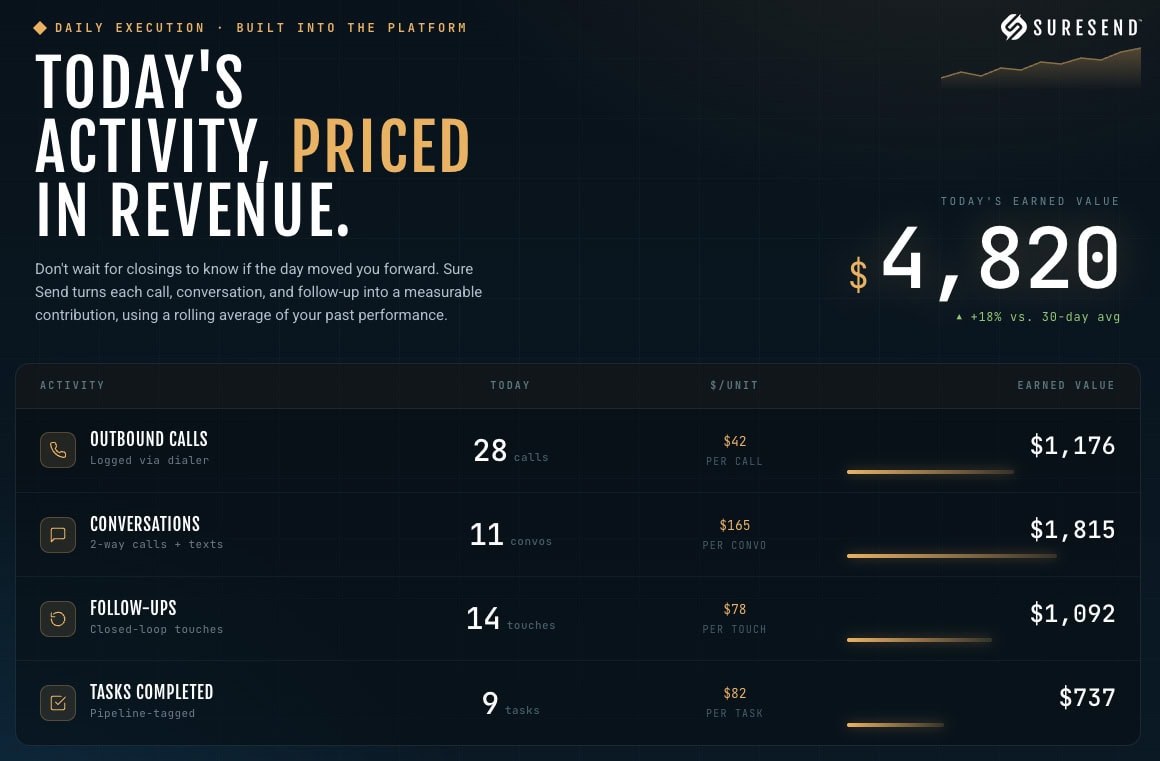
The mechanism behind that is the Winning Formula. It runs on a six-month rolling average of the individual rep’s own conversion history. Their calls, their conversations, their appointments, their contracts. The platform calculates exactly what each activity is worth in pipeline terms based on that rep’s own performance, not industry averages. At the end of every week, the rep sees a Weekly Activity Pipeline Value: a real dollar figure showing what their work that week will translate to.
Then there’s the accountability layer.
HousingWire described it this way:
“Completing a week requires winning five days, and winning 20 days completes a month. Streaks and rankings are updated regularly, providing visibility into performance.”
What makes the framework work is who it was built for.
Most CRMs serve the org chart. Sure Send serves the rep.
Kasey Jorgenson, a broker featured in the article, described how Sure Send listens to and implements feedback from those using the platform:
“We’re one of the first brokerages to go all-in on Sure Send, which means we’ve also become their most enthusiastic bug reporters. But here’s the thing, they respond, they fix it, and they actually care. Fresh platform, good humans, and we’re building something together. That’s the partnership I wanted.”

AI in the workflow, not bolted on
HousingWire didn’t pull punches on how AI is implemented by legacy CRMs versus one built on AI.
The article noted that “AI is becoming a core component of modern CRM platforms, but its value depends on how it is applied,” and observed that Sure Send “integrates AI directly into everyday workflows rather than positioning it as a separate feature.”
In practice, that means three things.
- Pre-call AI summaries pull context from the contact record, prior call history, and property activity before the agent dials.
- Post-call action suggestions capture outcomes and surface follow-ups for the agent to approve.
- Smart Insights run continuously, recommending the next best action without waiting to be prompted.
Here’s what the article didn’t have room to say. The same AI architecture also runs the email intelligence layer that learns how each contact engages and the property data triggers that fire personalized outreach when a contact’s situation changes. It’s not a bunch of separate AI tools sitting on top of a non-AI, legacy CRM. It’s one architecture that was designed with AI from the ground up, working at every layer simultaneously.
The takeaway
HousingWire closed the article with a line worth reading twice:
“As market conditions continue to evolve, consistency will become one of the most important differentiators for real estate, mortgage lending and service-based teams. The platforms that succeed will not be those with the most features, but those that make execution easier, clearer and more measurable.”
That’s the proposition Sure Send was built around. Companies and teams win when their individual reps win. Every layer of the platform exists to make that possible.
Read the full HousingWire article for the complete article, including their case for new execution-driven platforms and the broader discussion of communication-first CRM design.
To see Win the Day in action, explore the Sure Send platform overview.

Kurt UhlirChief Marketing Officer
Kurt Uhlir is a recognized leader in marketing, growth, and innovation, having helped scale companies and technologies used by millions every day—including at brands like AGNT, Sideqik, Vitrue, Oracle, Garmin, Facebook, Meta, Apple, and more. He’s trained tens of thousands of professionals on how to build trust, lead with service, and help clients make wise, informed decisions. At ez Home Search and Sure Send, his focus is on helping high-performing business owners, team leaders, and individual sales leaders grow their businesses through exclusive market access, privacy-first lead systems, and conversion-focused enablement tools.