

10 Best Real Estate CRM Platforms for Agents (2026)
Choosing the best real estate CRM for a team or a solo agent directly affects how many deals actually close. Teams need shared pipelines and coaching visibility, while individual agents need a simple daily system they will open every morning. Pick wrong, and adoption, speed to lead, and referral business all take a hit.
The best tools for teams tend to be Sure Send, Follow Up Boss, Sierra Interactive, CINC, and Real Geeks, because they handle high-volume pipelines and complex routing. Solo agents usually get more value from Sure Send, Lone Wolf Relationships, Wise Agent, iHomeFinder, or Pipedrive, which are easier to run alone. This guide compares ten leading platforms so you can match the best real estate CRM to your size, budget, and workflow.
You will see how each tool handles AI, integrations, email deliverability, and post-close follow-up, plus honest limitations. By the end, you will know which two or three systems deserve a trial and how to avoid the adoption traps that sink most CRM rollouts.
Key Takeaways
This guide highlights a few themes that matter more than any single feature list.
Most agents do not fail because the software is weak. They fail because there is no clear daily workflow before the CRM shows up, so the tool exposes that gap. The best platforms replace that blank screen with a simple, repeatable action plan.
AI-native platforms like Sure Send behave very differently from older systems that bolt on chatbots or writers. Middleware-heavy integrations also add hidden cost, fragility, and data loss over time, especially when Zapier-style connectors sit between IDX sites and your CRM.
Data ownership and post-sale retention matter as much as lead capture. If your brokerage controls the CRM, or your system ignores repeat and referral business, you are building income on ground that can quietly disappear.
“The fortune is in the follow-up.” — Traditional sales saying
What Makes a Real Estate CRM Actually Worth Using?

A real estate CRM is worth using when it turns your existing follow-up process into a clear, repeatable daily plan instead of another inbox. The best real estate CRM platforms for both teams and solo agents line up with how you already work and remove guesswork from your next move. Without that fit, even great software turns into an expensive contact list.
Most CRM failures come from trying to fix a broken or undefined workflow with new tech, and research on the effect of real estate brokerage service quality confirms that trust and satisfaction hinge on consistent, well-managed client communication rather than the tool itself. A CRM only amplifies what already exists, so a random mix of spreadsheets, sticky notes, and half-finished automations will just get louder. Research from Nucleus Research found that CRM systems return an average of $8.71 for every dollar spent, but that payoff only appears when people actually use the tool.
For this guide, every platform is judged on the same five structural criteria that matter in daily use.
Pipeline Depth And Visibility
A strong CRM shows every stage from new lead through post-close nurture, with separate views for buyers, sellers, and past clients. Leaders can see where money waits in the pipeline, and agents see exactly which deals need action today. Tools like Sure Send, Follow Up Boss, and Pipedrive do this well for both teams and individuals.AI Capability, Native Or Bolted On
AI-native systems such as Sure Send weave intelligence into smart lists, next-best-action suggestions, email analysis, and call transcription. Older platforms that added AI later often limit it to a chatbot or writer that sits on the edge of the workflow. For teams, that difference shows up in coaching quality and speed to lead.Integration Model, Direct Or Middleware
Direct API integrations, like Sure Send has with Sierra Interactive, Ylopo, and IDX Broker, keep data in sync in real time. Middleware connectors like Zapier introduce delays, missing fields, and brittle automations that break when an API changes. Over a year or two, that adds real cost in support time and lost leads.Email And Text Deliverability Infrastructure
If emails land in spam, the best real estate CRM on paper still fails. Most platforms rent the same email infrastructure, so they cannot fix deliverability beyond a point. Sure Send runs its own proprietary email engine with DNS, authentication, and reputation managed in-house, which matters a lot for heavy drip campaigns.Post-Sale Retention And Referral Tooling
New leads feel exciting, but repeat and referral business pay the bills. CRMs that include birthday, home anniversary, and equity-milestone automation help you stay present for years. Systems that treat retention as an afterthought quietly leak the most profitable deals out of your database.
The 10 Best Real Estate CRM Platforms in 2026
Using those five criteria, these ten platforms stand out for real estate teams and individual agents. Each balances pipeline depth, AI, integrations, deliverability, and retention differently, so there is no single “best” choice for everyone. Instead, the right best real estate CRM is the one that matches your size, tech stack, and appetite for change.
According to Salesforce, top-performing sales teams are more than twice as likely to use a CRM extensively as underperformers. That gap shows up clearly in real estate: the agents and teams who treat one of these tools as their daily operating system build compounding advantages over those who bounce between systems.
Sure Send — Best AI-Native CRM Built Specifically for Real Estate and Mortgage Teams

Sure Send sits at the top of this list because it was built by real estate and mortgage insiders at ez Home Search, Inc., rather than adapted from a generic sales tool. Everything in the platform reflects life inside a high-volume pipeline, from rate-sensitive mortgage leads to listing clients who need consistent follow-up. For both solo agents and teams, Sure Send behaves like a daily operating system, not just a database.
The architecture is AI-first, and recent research on AI-Enhanced CRM With Chatbots for real estate lead optimization confirms that systems built with AI at the core outperform those where automation is added as an afterthought. Natural Language Smart Lists let you type instructions like “show me everyone I have not talked to in 30 days” and get a live, auto-updating list. Take Action automation pushes neglected but valuable contacts into a dedicated queue so they cannot quietly age out. Smart Insights, AI Email Analysis, and Call Transcription all feed back into that loop, suggesting the next best call, text, or email based on your own history instead of generic models.
Sure Send’s Win the Day scoreboard and Winning Formula convert activity into real dollar values using each rep’s six-month conversion data. When an agent can see that each completed call is worth a specific amount based on their own results, daily prospecting targets feel concrete instead of random. According to McKinsey & Company, companies that embed AI in sales can raise leads and appointments by more than 50 percent while cutting call time, and this type of design lines up with that reality.
On the delivery side, Sure Send runs a fully proprietary email engine. DNS, authentication, reputation, and carrier registration for texting are all handled by an in-house deliverability team, so campaigns actually reach inboxes. Sure Send Connect adds real estate-specific landing pages, home value tools, and a CMA builder that feed leads straight into the CRM, with Sure Send AI handling first response without any connectors. Direct integrations with Sierra Interactive, Ylopo, and IDX Broker, a RESTful Open API, webhooks, and Model Context Protocol support make it a future-ready hub for AI assistants.
One documented customer removed roughly $39,000 per year in CRM-stack costs after replacing a tangle of tools with Sure Send. The platform fits solo agents, teams, and broader SMB sales operations that want one system for email, pipeline, lead capture, and automation. The only real limitation is that someone looking for a very light, contacts-only app may find the full feature set more than they need right now.
“You can’t manage what you don’t measure.” — Peter Drucker
Follow Up Boss — Best Integration Hub for Agents Running Multiple Tools
Follow Up Boss works best as the control center for agents and teams already running several tools. It connects with more than 250 real estate apps, including Zillow, Ylopo, Realtor.com, and Dotloop, so you can keep your preferred stack and still have one live view of the pipeline. For many teams, it becomes the shared scoreboard while specialized tools handle marketing or websites.
Pre-built Action Plans combine emails, texts, and tasks into proven follow-up sequences contributed by top agents, and Smart Lists float the right contacts to the top of each rep’s daily view. A website pixel tracks what leads do on your IDX site and triggers outreach based on behavior, not just time. On team plans, AI-powered call recording, transcription, and speed-to-lead analysis give leaders strong coaching insight.
Pricing starts with the Grow plan at $58 per month, with Pro and Platform tiers for larger teams and a 14-day free trial. Follow Up Boss fits teams that want the best real estate CRM as an integration hub instead of an all-in-one platform. The main tradeoffs are the lack of a native AI writing assistant, some dependence on middleware partners for less-common integrations, and a mobile app that feels more limited than the desktop experience.
Lone Wolf Relationships — Best Budget Option for AI Email Marketing
Lone Wolf Relationships, the CRM formerly known as Propertybase, focuses on giving budget-conscious agents serious email automation without a steep learning curve. Its AI-powered email writing assistant helps you move past the blank-screen problem and send consistent, relevant follow-up. For many solo agents, that alone can revive a neglected database.
Automation templates blend drip campaigns, task reminders, and EZ Texting SMS outreach, so new online leads and referral contacts get the right touches over time. The platform syncs with Gmail and Outlook calendars and plugs into other Lone Wolf tools like CloudCMA, eSignature, and transaction management, which is handy for brokerages already using that suite.
Pricing starts at $33.25 per month on annual billing, with a 14-day free trial. Lone Wolf Relationships suits solo agents or small teams that want simple automations and AI-assisted emails more than advanced AI analytics or complex routing. Limitations include the lack of a built-in dialer, no direct MLS connection, and relying on a third-party for texting.
CINC — Best for Top-Producing Teams Who Need Leads Included
CINC takes an all-in-one, high-commitment approach: IDX website, CRM, marketing automation, and a steady stream of buyer leads arrive in one package. Its Autotracks feature builds drip campaigns that respond to each lead’s behavior on the website, mixing emails, texts, and tasks so the right message hits at the right time. For top teams, this can feel like having an extra ISA desk running around the clock.
The optional AI chatbot, trained on real estate scripts, handles front-end lead conversations without human help and can be worth the extra monthly cost for large databases. All plans include buyer leads, which changes the math on the higher base price for serious producers.
Solo agents start around $899 per month, and team plans begin near $1,500 per month, with no free trial. CINC is best for top-producing teams ready to lean into one tightly controlled stack and a steady paid lead budget. The main downsides are the steep learning curve, the additional cost for the chatbot, and a smaller peer community than Follow Up Boss for shared workflows.
Top Producer — Best for Buyer Agents Who Live in the MLS
Top Producer is built for agents who live and breathe the MLS. Its direct integration with more than 320 MLS boards lets you send automated property alerts, price-change notifications, and just-listed or just-sold updates straight from the CRM. For active buyers, that kind of speed and relevance can keep you ahead of portal alerts.
The platform includes an AI-powered email and text composer, a built-in dialer, and a large library of drip campaigns. Contact enrichment pulls in headshots and career changes from social profiles so records stay current without extra data entry. An optional Smart Targeting upgrade adds predictive analytics to surface likely sellers inside your database.
Pro plans start around $179 per month, with higher tiers that add leads and farming tools, plus team pricing. Top Producer fits experienced buyer agents who rely heavily on MLS automation and want that workflow in one place. Tradeoffs include higher pricing than some mid-tier CRMs, a modest number of third-party integrations compared to Follow Up Boss, and basic IDX websites that cost extra.
Sierra Interactive — Best for High-Volume Teams Using Behavior-Based Automation
Sierra Interactive shines when you manage a large database and care about behavior-driven follow-up. Its CRM and IDX website pair up so that every search, saved listing, and return visit feeds automated campaigns. Those campaigns mix emails, texts, and ringless voicemail drops, triggered by what people actually do online instead of a fixed timer.
The Lead Engage AI texting assistant keeps working long after many teams would have given up. It qualifies and re-engages leads for up to a year, routing hot conversations back to agents in real time. An integrated auto-dialer, smart lead routing, and detailed ROI and agent performance reports make it attractive for brokerages that want to coach from data, not hunches.
Pricing starts near $299.95 per month for one user. Sierra Interactive is a fit for teams that generate lots of online leads and need serious automation to keep up. For solo agents, the cost and complexity can feel heavy, and there are fewer direct integrations than platforms like Follow Up Boss. Website customization also has limits compared to standalone web builders.
Wise Agent — Best Affordable All-in-One With Built-In Marketing Tools
Wise Agent aims to give budget-minded agents many tools in one subscription. A Facebook and Google ad creation feature lets you spin up campaigns in a few clicks and sends leads to included landing pages. A sizable content library supplies ready-made blog posts, postcards, and other marketing pieces you can customize and send from inside the CRM.
The platform includes an AI writing assistant, an AI chatbot for around-the-clock lead nurture, a built-in dialer, and transaction management. New users get one-on-one onboarding, which helps shorten the setup period that derails so many CRM launches, and the role of digital CRM tools in enhancing customer engagement shows that hands-on implementation support is one of the strongest predictors of long-term adoption. According to HubSpot, more than one in five sales pros say a lack of a defined sales process is their top challenge, so that live help matters.
Wise Agent costs about $49 per month, with extra seats at $20 and a 14-day free trial. It serves agents who want an affordable all-in-one system more than cutting-edge AI or deep analytics. Limitations include extra monthly charges for texting, an interface that feels older than rivals, and marketing templates that may need freshening to match modern branding styles.
Real Geeks — Best Budget All-in-One CRM and IDX Website
Real Geeks blends a capable CRM with an IDX website in one contract and includes two user logins on every plan. That makes cost-sharing easy for partners or small teams. Its websites track lead behavior and feed multi-channel drip campaigns that use email, text, and even simple video clips to stay in front of prospects.
Home valuation landing pages and a built-in Facebook ads tool support seller lead generation without a separate platform. A one-click buyer agency agreement feature and a 13,000-member mastermind community round out the picture. That community can be especially helpful for newer agents trying to shape their first version of a daily plan.
The Establish plan starts around $399 per month on a 12-month agreement, with higher tiers for bigger operations and no free trial. Real Geeks is best for agents or agent pairs who want CRM plus IDX in one payment and are willing to sign a contract. Downsides include a noticeable learning curve, a separate fee for the optional AI chatbot, and the lack of a month-to-month option.
iHomeFinder — Best for Agents Who Want to Purchase Verified Seller Leads
iHomeFinder operates as both a CRM and a lead generation system centered on its IDX websites. Leads that register on those sites are automatically added to email and text nurture campaigns that adjust based on search behavior, saved listings, and price-drop alerts. For agents heavy on online lead gen, that tight loop keeps follow-up consistent.
A standout feature is the seller lead add-on. For about $50 per month, you can receive 50 verified seller leads with contact and property details, which can jump-start a listing-focused pipeline. The mobile app keeps alerts and tasks handy between appointments.
Pricing starts with Lead Essentials at $169 per month plus a setup fee, scaling to higher plans with more features. iHomeFinder fits buyer agents who want to move into listings and prefer a steady flow of seller opportunities over building complex campaigns themselves. The tradeoff is less flexibility than pairing a separate best real estate CRM with a custom website.
Pipedrive — Best Visual Pipeline CRM for Teams Crossing Over From Other Industries
Pipedrive is not real-estate-specific, yet many teams use it because of its clean, visual pipelines. You can set up separate boards for buyers, sellers, investors, and even commercial prospects, then drag deals through stages with a click. For teams used to generic sales CRMs, that familiarity shortens the adjustment period.
Built-in meeting scheduling, VoIP integration, and AI-assisted follow-up emails give it more power than a simple kanban board. Automation rules can move deals, assign tasks, and send messages based on stage changes or activity. For budget-sensitive teams, the Essential plan starts around $14 per seat with a 14-day free trial, and higher plans add more automation and reporting.
Pipedrive works well for teams and solo agents crossing over from other sales roles who care most about visual pipeline control. It falls short for agents who need MLS integration, IDX-driven behavior triggers, or real estate-specific reporting without heavy customization. Basic drip campaigns and more advanced automations also require stepping up from the entry tier.
How to Choose the Right Real Estate CRM Without Getting It Wrong

Choosing the right best real estate CRM starts with your workflow, not with a feature checklist. A system pays off when it fits how your team already works, clarifies what to do each day, and protects your data long term. Anything else becomes expensive shelfware.
Before comparing logos, write down how a lead should move from first contact to closed deal and then into long-term nurture. Note who owns each step, which channels you use, and where follow-up breaks now. That simple map will reveal whether you need heavy automation, advanced reporting, or just a clean action list for each morning.
As you map, it helps to define a few non-negotiables:
How quickly new leads must be contacted
How often active clients should hear from you
How long past clients should stay on structured touch plans
Data ownership should sit near the top of your filter list, and research on markers of a real estate agent’s value-add shows that the long-term depth of your client database is one of the clearest differentiators between top producers and average performers. If your brokerage controls the CRM, get clarity in writing about exporting contacts, notes, and history if you change companies. For teams that want an independent system, platforms like Sure Send, Follow Up Boss, and Pipedrive keep control in your hands instead of tying it to a franchise. According to HubSpot, nearly half of sales teams say their CRM is “difficult to use,” so ease of use and training also matter more than another page of features.
“Simple scales, fancy fails.” — Common coaching advice in real estate
The Five Questions to Ask Before You Sign
Once you narrow your list, these five questions will keep you out of trouble on demo calls.
Does It Integrate Natively Or Depend On Middleware Connectors?
Direct API integrations, like the ones Sure Send has with Sierra Interactive and IDX Broker, give you live, two-way sync and richer automation triggers. Middleware tools such as Zapier are fine for edge cases, but they break more often and cannot carry every field you care about.What Is the True Monthly Cost at Your Real Usage Level?
Ask about texting bundles, dialer seats, AI features, storage, and extra users before you commit. A platform that looks cheap on the homepage can end up more expensive than Sure Send or CINC once you add everything a real team needs.Who Owns Your Data If You Leave the Platform or Brokerage?
Confirm that you can export all contacts, notes, tags, and communication history in a usable format. For brokerage-provided tools, check whether they keep a copy of your database or limit which fields you can take with you.Is AI Woven Into the Architecture or Just Bolted On Later?
AI-native systems like Sure Send can look across email, calls, property data, and behavior at once to suggest next actions. Older tools often limit AI to a chatbot or writer that never touches core workflows, which caps the benefit.What Does Onboarding and Daily Coaching Look Like Inside the Tool?
Ask to see the screen an agent lands on each morning. Platforms that show a clear priority list or Win the Day-style scoreboard reduce hesitation and increase adoption. Those that show an empty dashboard push agents back to memory, notebooks, and scattered habits.
The Real Reason Most Agents Stop Using Their CRM

Most agents do not quit their CRM because the software is bad. They quit because they open it in the morning and see a blank screen or a cluttered dashboard that gives them no clear starting point. When that happens, they default back to phones, inboxes, and memory, and the CRM becomes a place to occasionally log a note.
The systems that stick behave more like a coach than a filing cabinet, and research applying Six Sigma in the call center context demonstrates that structured daily workflows and clear performance feedback loops are the primary drivers of sustained technology adoption. They tell you who to call, why now, and what that call is worth based on your own pipeline math. Sure Send’s Win the Day system and Winning Formula do this by turning conversion history into live dollar values for daily activity, which many teams never see from generic tools.
For leaders, the problem is magnified. If there is no shared view of what good activity looks like, coaching turns into opinion instead of data. According to Salesforce, high-performing sales teams are far more likely to track performance metrics in detail, and CRMs that lack clear action layers make that tracking much harder in real estate.
Common warning signs that a CRM roll-out is going sideways include:
Agents logging in only to add notes after calls
Leads sitting untouched for days in “New” status
Managers coaching from anecdotes rather than reports
Addressing those signs early—often by simplifying daily views and expectations—can save an implementation.
What the Data Says About Repeat and Referral Business

The adoption problem shows up clearly in repeat and referral numbers. According to the National Association of Realtors, about 76 percent of buyers say they would use their agent again, yet only around 12 percent actually do. That gap exists mainly because agents fall out of touch after closing, not because clients were unhappy, and studies on heterogeneous real estate agents and the housing cycle confirm that client retention rates vary sharply based on how consistently agents maintain post-transaction communication.
NAR also reports that a large share of sellers find their agent through a referral or past experience, which means your database should be a long-term asset. When a CRM lacks home-anniversary touches, equity or home-value triggers, and simple sphere-of-influence segments, that asset slowly goes cold. Platforms like Sure Send that treat retention as a first-class workflow help turn those NAR statistics into repeat income instead of lost opportunity.
A simple retention plan can include:
Annual home valuation or equity check-ins
Birthday and home-anniversary messages
Quarterly local market updates for your sphere
Those small, steady contacts keep your name top of mind when someone is ready to move—or recommend you.
Quick Comparison: Pricing and Best-Fit Summary
Here is a quick side-by-side view of pricing and fit so you can short-list the best real estate CRM options for your situation. Remember, these are starting prices, not full-stack totals with texting, dialers, and AI added.
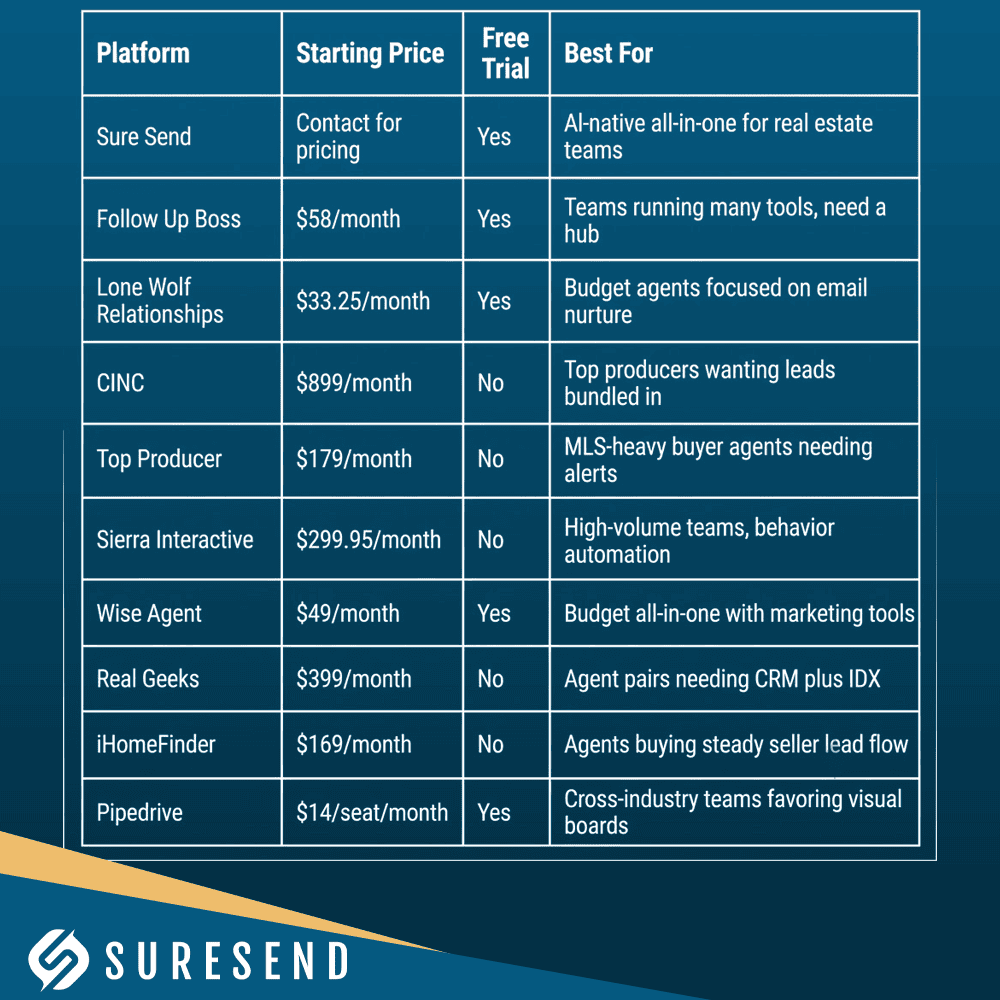
Starting prices can mislead. Always price your real plan, including the number of users, expected messages, and any add-ons, before you compare it to a more complete platform like Sure Send.
The Takeaway
The best real estate CRM for your business is the one that your team, or you as a solo agent, will actually live in every day. That means a clear daily workflow, dependable deliverability, solid integrations, and real support for repeat and referral business, not just flashy lead capture forms.
For many operations, Sure Send stands out because it wraps those pieces into one AI-native stack: pipeline depth, proprietary email and text delivery, Win the Day coaching, Sure Send Connect landing pages, and direct integrations backed by an open API. That combination makes it easier to replace three to eight disconnected tools and run everything from a single screen.
Conclusion
If you remember nothing else, remember this: software will not fix a broken process, but the right CRM will multiply a good one. Start by mapping how you want leads, clients, and past clients handled, then match that map to the platforms in this list. For teams and solo agents ready to put AI, coaching, and deliverability on the same page, Sure Send deserves a serious look as the backbone of the next stage of growth.
Frequently Asked Questions
Do I Need a Real Estate-Specific CRM, or Will a General Sales CRM Work?
You can run a business on a general sales CRM, but it takes more setup. Real estate-specific tools already handle MLS feeds, property data triggers, listing pipelines, and IDX behavior tracking. With generic platforms like HubSpot or Pipedrive, you will likely add plugins, middleware, and custom fields to match that behavior, so always compare total cost and effort, not just subscription price.
What Is the Best CRM for a Solo Real Estate Agent on a Budget?
For strict budgets, Lone Wolf Relationships and Wise Agent give the most automation for the least money. Lone Wolf shines for AI-assisted email nurture, while Wise Agent adds simple ads and content tools. If you want an AI-native system that can grow from solo agent to team without rebuilding your stack, Sure Send is built to start small and expand without bolt-on tools.
How Do I Migrate My Contacts From One CRM to Another Without Losing Data?
The safest path is a full export and a staged import:
Export every contact, tag, custom field, and activity log as CSV before canceling your old CRM.
Work with your new vendor’s support team to map fields correctly and test with a small sample file.
Run both systems in parallel for a few weeks so you can spot missing data or broken workflows.
Once you are confident everything matches, set a firm cutover date and turn off the old system.
That overlap gives you time to catch issues before shutting the old one off.
What Should I Look for in a CRM If I Manage Both Buyers and Sellers?
You need clear separation plus a shared view. Look for multiple pipelines with distinct stages for buyers, sellers, and past clients, along with automation that matches each path. Post-sale retention tools matter just as much: home anniversaries, equity alerts, and market updates for your sphere. Systems like Sure Send, Top Producer, and Sierra Interactive handle those mixed needs particularly well.
Is AI in Real Estate CRMs Actually Useful, or Is It Mostly Marketing?
AI is genuinely useful when it touches real workflows instead of just writing text. Predictive lead scoring, behavior-based follow-up, and call transcription for coaching can change results, especially at team scale. Research from McKinsey & Company links AI in sales to higher lead volume and better conversion. AI-native platforms like Sure Send get more value here than tools that added AI as an afterthought.

Kurt UhlirChief Marketing Officer
Kurt Uhlir is a recognized leader in marketing, growth, and innovation, having helped scale companies and technologies used by millions every day—including at brands like AGNT, Sideqik, Vitrue, Oracle, Garmin, Facebook, Meta, Apple, and more. He’s trained tens of thousands of professionals on how to build trust, lead with service, and help clients make wise, informed decisions. At ez Home Search and Sure Send, his focus is on helping high-performing business owners, team leaders, and individual sales leaders grow their businesses through exclusive market access, privacy-first lead systems, and conversion-focused enablement tools.