


Get Paid for Vendor Referrals You Already Send: Tactics from Grant Wise at Comarketing.com
The referral you made last week
A client asked you last week who to call about the roof. Maybe it was the movers, or the painter, or someone who could swap out a water heater before closing. You gave a name without hesitating, because you have spent years building a list of people who show up and do the work right.
The roofer booked the job. Nothing came back to your office.
Grant Wise said it plainly in a Sure Send™ Marketplace Spotlight conversation with Jennifer Staats.
“Everybody in real estate is doing this. They’re just not getting paid for it.”
Grant Wise, Founder of Comarketing.com
None of that is a discipline failure. Your agents make the introduction at the exact moment the client is ready to act on it, and it works. What is missing runs underneath the introduction: a written agreement with the business on the receiving end, and a record that moves money when the job books.
Three and a half years inside these vendor lists is what convinced Grant of the line underneath all of it: every team in the country already runs a preferred partner program, and almost all of them run it for free.
What a vendor referral is actually worth
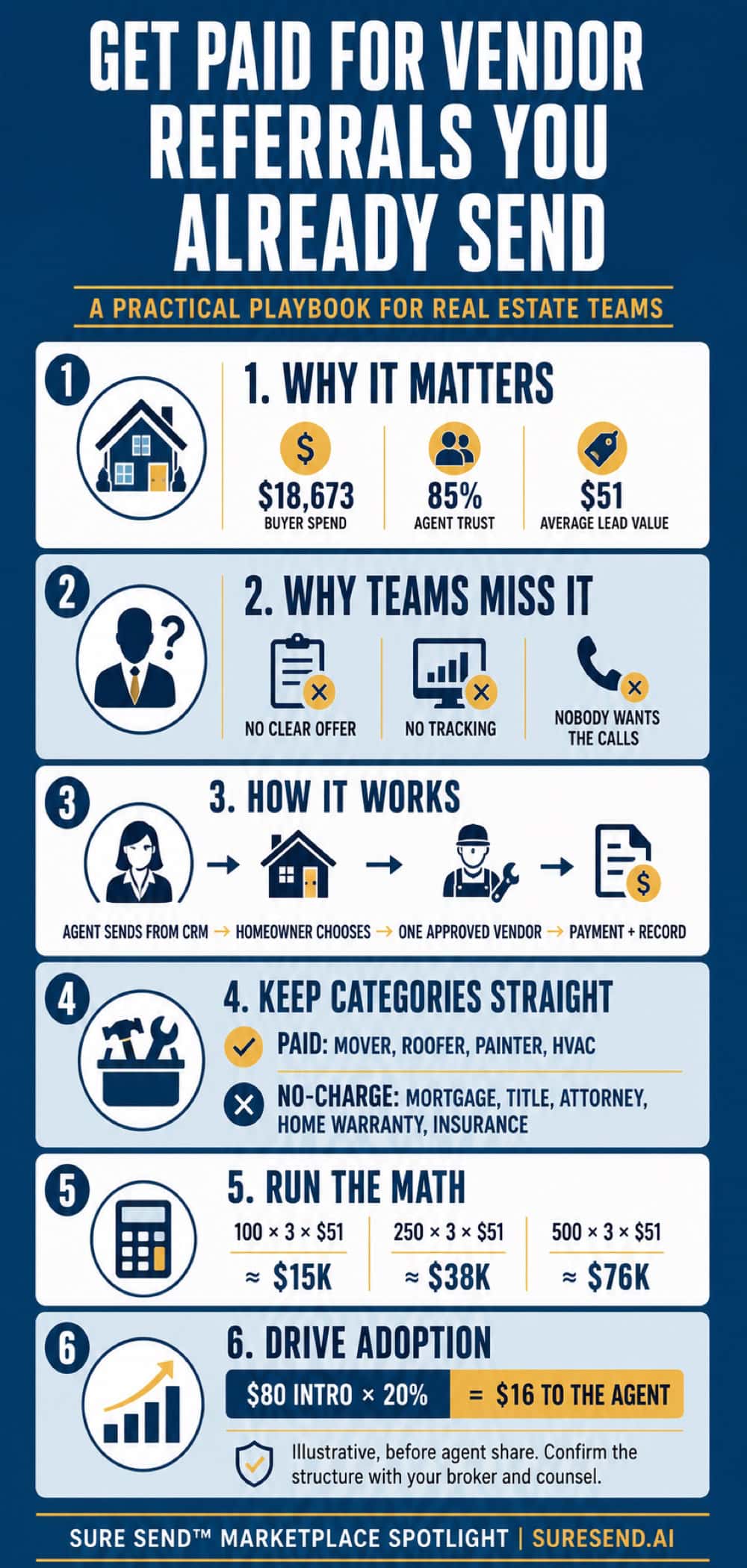
Start with the household on the other end. The NAHB Housing Economics PLUS special study, published on Eye on Housing in 2026, “What Do Home Buyers Purchase After They Move In,” found that buyers of existing homes spend an average of $18,673 on appliances, furnishings, remodeling and repairs in the first year after they close. An otherwise comparable owner who stayed put spends $9,457 over the same twelve months. Buyers of newly built homes average $26,882.
The household you just handed to a roofer is spending close to double what a settled owner spends, and it is spending inside that first year, while the paint colors, the appliance brands, and the trades who get called back again are all still being decided.
Now add who they listen to while they decide. The National Association of REALTORS® 2025 Profile of Home Buyers and Sellers reports that 88% of buyers purchased through an agent or broker, and that 85% of recent buyers ranked agents the most useful information source they used. That ranking does not go to a search engine or a review site. It goes to the person they trusted with the largest transaction of their life.
Put those two findings together and the picture gets concrete. When your agent names an HVAC company, she is opening a door to a household in its highest-spending year, at the one moment that household ranks her judgment above every other source available to it. For the business on the other side of that door, that is a customer arriving pre-vetted by the one source the household ranks first, and it currently costs them nothing.
There is a price on it, and one platform publishes theirs. Comarketing.com prices that hand-off on behalf of the businesses making it, and Grant gave the current figure on the recording.
“The average lead is worth approximately $51 right now.”
Grant Wise
That is his platform’s average across the United States and Canada, not an industry number, and it moves with what each company decides the work is worth against their own job values.
Fifty-one dollars is easy to wave off once. Several hundred times a year, it is one platform’s price sheet telling you what your recommendation has been worth all along.
For anyone who wants to see how that price gets set before reading further, the full walkthrough is on Comarketing.com’s profile on the Sure Send Marketplace.

Why most real estate teams never get paid for referrals
Grant has spent those years putting these arrangements together, and he names three reasons the practice stays informal.
The first is not knowing what to offer. Sending a mover more work sounds like a favor, not a deal, until you know what the mover really wants, which is exclusivity.
Grant’s read on marketplaces that resell the same homeowner to several competitors is blunt. “If you look at a company like Angie’s List, their market caps declined 90% last 5 years. They went from a $5 billion company to a $500 million company,” he said, offering it as evidence of how tired home service businesses have grown of that model. An offer that goes to a single company is worth paying for, and most leaders have never been told that.
The second is tracking. Somebody has to know which vendor received what, whether the job closed, what it was worth, and who owes whom at the end of the month. That work belongs in a CRM built to track referral relationships, and most offices are running it out of a group text. Jennifer Staats, who hosts these conversations for Sure Send, hears the same thing from team leaders: “How do I track this? Is there a way to do it?”
The third reason is the phone call itself. It stops most programs before they start. Grant’s version: “If real estate agents would call their leads, they probably wouldn’t need to call their service providers.” Ten paid agreements means ten conversations with owners who are not expecting the call, and that task lands on the person recruiting agents and closing deals.
The pattern I have watched across 60+ funding rounds and exits is simple: work with no owner and no record does not get done, regardless of how much money is waiting on the other side of it. None of the three reasons has anything to do with how hard anyone is working.
The willingness was always there. The plumbing was not.
How a paid preferred partner program works
The method begins with the list your office keeps: the mover, the roofer, the painter, the electrician, the handyman. Comarketing.com puts paid agreements in place with those businesses, one per category, and the offer running the other direction is specific.
The trade gets your clients exclusively in its category. It also gets the kind of visibility a local operator wants: the team posts about the company on social and brings it into a team meeting. Your agents meet the owner, so the relationship has a face on it.
Grant Wise built the first version of this by hand. A team leader handed over a vendor list and told him to go. “I got the list, made a few phone calls, and I put $7,000 in the bank in 7 days,” Grant said. That first client, by his account: “they’ve just crossed $200,000 in extra revenue that we brought in for the team, all from stuff that they were already doing, but they weren’t yet monetizing.”
The consumer-facing piece is a white-labeled site carrying the team’s logo and the businesses they have approved, organized by category. A homeowner who needs heating and air clicks that category, sees the company, sees whatever offer that company is running, describes the work, and submits.
Submitting is where money moves. The company’s card is charged the price set for that introduction, the homeowner goes to that one business instead of being sold to a handful of companies at once, and the office is paid. Grant describes the speed as programmatic, at the snap of a finger.
Nothing changes for the agent. A client asks who to call, and the agent sends the link.
Behind all of it sits a dashboard. It shows how each company performs, which ones receive the most work, the status of everything sent, and the job value once work closes. When an arrangement stops earning its place, one click cancels it. Nobody has to make the awkward phone call.
Grant pulled up a live account on the recording. It belongs to the Justin Havre Real Estate Team in Calgary, Alberta, an operation Comarketing.com publishes as selling more than 1,000 homes a year with 84 or more agents. Walking the screen, Grant read off totals covering the last year to year and a half: “they brought in an extra $90 grand, which is a lot of extra revenue. It’s free cash flow. They’ve got 48 partners. They’ve sent 470 leads.”
The obvious worry is what happens when one of those businesses does poor work with your name attached to the recommendation. Grant’s own count across the whole run: “We put together thousands of partnerships and we’re seeing like literally like 1 or 2 of those have turned into problems.”
Terms and a record now travel with work that used to leave the building unattended. Whether a real estate business is permitted to be paid when it does is the question that comes next.

RESPA and referral fees: what real estate agents can be paid for
The legality question comes up more than any other, and Grant answers it in one sentence.
“RESPA only regulates settlement services, does not regulate the mover, the roofer, the painter.”
Grant Wise
The statute behind that sentence is the Real Estate Settlement Procedures Act. Section 8, implemented through Regulation X at 12 CFR 1024.14 and enforced by the Consumer Financial Protection Bureau, prohibits kickbacks and unearned fees tied to settlement services on federally related mortgage loans.
Settlement services are the ones attached to the closing itself, including the loan and the title work. A moving company is not a settlement service. Neither is a contractor or a landscaper.
Comarketing.com handles the regulated categories with no-charge agreements, which do exactly what the name says. A team lists its mortgage, title, attorney, home warranty, and insurance relationships on the same site with no fee attached to any of them. The homeowner still sees one complete list of everyone the office stands behind, and every priced category on that list sits outside the federal rule.
Disclosure lives on the page, not in a filing cabinet. An affiliated business disclosure appears on the partner site, and Grant notes it is typically an addendum a client signs anyway. When a homeowner opts in to work with one of the trades, the platform stores the consent data and handles TCPA compliance on the outreach that follows.
This is general information and not legal advice. Section 8 is a federal rule, and state statutes and your brokerage’s own policy layer on top of it, both varying by market. Run the structure past your broker and your own counsel before you turn anything on.
That leaves a much smaller decision on the table. Pick which categories carry a price and which get listed at no charge, then put the structure in front of your broker and your counsel before the site goes live.
How Partner Finder sets up vendor partnerships with AI
Nobody wants to call the vendors. That was the third thing stalling these programs, and it is the wall Grant hit himself long before he had a product. “I was manually doing this 2.5 to 3 years on the phone every day, putting partnerships together. Uh, very good at it, not super scalable solution,” he said of the stretch that came first.
The answer he built is Partner Finder. The AI agent inside it, named Alex, calls, texts, and emails the businesses a team works with today and sets the arrangements up on the team’s behalf.
When a category is empty, say the team has no painter, Alex searches the team’s own market, identifies the highest rated and highest reviewed operators, and starts contacting them cold.
A team has two ways to get its vendors into Partner Finder. It uploads the full list with name, email, phone, industry, and address, or it adds one business at a time and flags whether that business is expecting the call.
The team watches every conversation Alex has. Every email thread, text thread, and call thread is readable, and the recorded calls can be played back, so a leader sees exactly what is being said in their name. Grant’s own summary of what that bought him:
“Alex was able to get me fired. I didn’t want to be on the phones all day every day, and he helped me take care of that.”
Grant Wise
This is outreach, and it goes out under the team’s name. A leader should read the first threads before the volume picks up, set the categories deliberately rather than accepting whatever the search returns, and treat the approved list as something they are personally standing behind. The homeowner on the other end will experience it exactly that way.
Sure Send treats AI as foundational architecture rather than a layer added on later, wired into the dialer, the contact record, and the daily workflow from the start. A vetted company running AI outreach fits how the platform is built. The Comarketing.com Marketplace profile covers Partner Finder end to end.
The phone call that killed these programs still gets made, just not by anyone on your payroll.
How to get agents to actually send the referrals
Everything above depends on one behavior change at the agent level, and it is a small one.
The mechanism is sub-users. A team adds its agents to the Comarketing.com account and shares the money from each introduction with whoever made it. Grant walks through the math with round numbers: an introduction that sells for $80, with 20% of that, $16, going to the agent who sent it.
An agent doing this consistently could add a few hundred dollars a month. That is not a second income and Grant does not sell it as one. It is a reason to open the system instead of texting a name from memory.
He raises the team leader’s objection before anyone else can: the leader paid for all of this, so why pay the agent on top of it? His answer is that agents who get nothing keep sending work to their own favorite mover or painter, outside the program, where the team collects nothing and the trade goes untracked. He has watched exactly that happen, and watched it reverse once the split started landing.
“If you can get somebody to make money off something, they’ll use it. If you can get somebody to save time from something, they’ll use it.”
Grant Wise
The retention argument follows from the same place, and it deserves an honest ceiling. An agent earning beyond the closing table has one more thing tying them to the team. Grant allows the obvious limit himself: agents leave for plenty of reasons a few hundred dollars a month will not touch. Call it a reason to stay, not a lock on the door.
Sure Send was built on the belief that companies and teams win when their individual reps win, which is why every feature serves the rep before it serves the org chart. A split that pays the person who did the work follows the identical logic.
Across the CRM and martech rollouts I have specified as a CMO, adoption never tracked how good the system was. It tracked what the person using it stood to gain.
Pay the agent who makes the introduction, and the introduction actually gets made.
How Comarketing.com works inside Sure Send
Sure Send keeps the record straight on its own: the contact, the stage of the transaction, the full history behind both, and an internal system for handing a client to another user inside the platform. The gap every team still has is outward facing.
Sending one client to one specific outside business, on terms, with money attached, has never lived inside a CRM. So it happens by text, nothing gets recorded, and the money attached to it leaks out with nobody counting it.
What is live today is the hand-off itself. A team creates a Comarketing.com account, then connects it once from inside the Sure Send dashboard. From any contact record after that, the user scrolls to “refer with Comarketing.com,” picks the business, enters the service address and the intent, and sends. Grant walked through it on his own contact card during the recording.
“now I take a lead that, um, you know, I wasn’t going to get anything from, and I can monetize it right straight from the CRM,” Grant said.
The contact record is the right home for it because everything the receiving business needs is stored there. The address is on file, along with where the deal stands and what has happened so far. The street address the CRM has held since the listing appointment never gets retyped. The work goes out from where the work lives, instead of from a second tab somebody has to remember to open.
The repair estimator inside Sure Send is still being built. Comarketing.com runs an estimator that turns photos and inspection reports into AI-generated cost estimates, and the company’s own research found that agents average 5.5 hours per transaction gathering those numbers by hand.
“We are, we are also working on the widget for this inside of Sure Send. It’s not done just yet,” Grant said on the recording. When it ships, an inspection report attached to a contact would produce line-item estimates, and those line items would become work the team could send out. Until then, the estimator runs on Comarketing.com’s own site.
Every business in the Sure Send Marketplace qualifies on insurance, company history, and client references, and profiles are reviewed on an ongoing basis, with companies removed when they stop meeting the standard. Comarketing.com cleared the same bar as every other partner in the network.
An open directory tells you who exists. A vetted network tells you who is still worth recommending.
What referral revenue adds up to in a year
Comarketing.com’s platform data across the US and Canada puts the average hand-off at about $51, and puts the number of times one household gets sent out across a transaction at 3 to 5. Those go to movers, cleaners, HVAC companies, painters, and whoever else the house turns out to need.
Grant ran his example at 500 closings a year and multiplied by 3 rather than 5. Five hundred times $51 is $25,500. Times three is roughly $76,000.
“you could easily add an extra $76,000 worth of free cash flow”
Grant Wise
He worked it on a calculator during the recording, and he took the low end of his own range on purpose, which is the reason the figure is worth taking seriously. Pricing work a team performs anyway is the same move as translating daily activity into pipeline dollars: the behavior does not change, the accounting does.
Most teams reading this do not close 500 homes a year, so run it at your own count. A hundred closings at the same 3x lands near $15,000. At 250 it is closer to $38,000. These are illustrative figures, not projections.
What a team collects depends on how many categories get filled, how many agents send work through the system and not around it, and what each business is willing to pay for a name it does not have to share. No team reaches the ceiling in month one, and a team that fills six categories will not see what a team that fills twenty sees.
Subtract the agent share while you are at it. With the split from the last section running, part of every dollar goes to the person who made the introduction, which is exactly what keeps them making it.
Then hold the figure against the market it sits in. The National Association of REALTORS® reported in January 2026 that 2025 existing-home sales totaled roughly 4.06 million, the lowest annual total since 1995 and a fourth straight year of decline.
No team leader manufactures closings in a market that has produced fewer of them four years running. Transaction count is the constraint. Revenue per transaction is the variable still within reach.
This is where the figure stops resembling every other revenue idea a team leader gets pitched. Nothing here asks a team to add a service line, open an office, or hire. None of it requires selling one more house. It is the price of work the team is already doing.

Deciding whether this fits your team
There are three honest ways to handle the work a team sends out anyway. Keep making recommendations the way they have always been made, which costs nothing to maintain and collects nothing either. Run them through a system built for exactly this, which is what Comarketing.com sells.
Or build the whole apparatus in house: the written terms, the card processing, the affiliated business disclosure, the consent records, and the tracking that shows which local business did what. That third path is real legal and operational work, and it lands well outside what a real estate team is in business to do.
The trade-offs are worth naming before you find them yourself. Your logo goes on a short list of local businesses, so the vetting has to be real and it has to stay real. Those businesses are paying, which means they expect actual work to show up, and a program with no volume behind it will not hold. And none of it produces a dollar unless your agents send the work through the system instead of around it, which is exactly why the sub-user split exists.
Grant calls it “the easiest new revenue stream in real estate, hands down.” That is his characterization of his own platform, and his data stands behind it. Jennifer Staats, reacting on camera after watching the full walkthrough, said: “I think this to me this is a no-brainer. I mean personally.”
A Comarketing.com account is free to create, with paid options for sourcing the businesses and for the repair estimator. The full walkthrough and the company’s contact details are on Comarketing.com’s Sure Send Marketplace profile. Teams running Sure Send today connect the account from the dashboard, and the work goes out from the contact record after that.
The name you give out next week is the same name you were always going to give. Whether anything comes back with it is the only part that was ever up to you.
Frequently asked questions
Is it legal for a real estate agent to be paid for referring a home service provider?
For the trades most teams recommend, yes. RESPA Section 8 and Regulation X (12 CFR 1024.14, Consumer Financial Protection Bureau) prohibit kickbacks and unearned fees tied to settlement services on federally related mortgage loans. A mover, a roofer, a painter, and a landscaper are not settlement services, so compensation in those categories falls outside that prohibition.
Comarketing.com places an affiliated business disclosure on every white-labeled site and stores consent records for the homeowners who opt in. State rules and brokerage policy still vary, and none of this is legal advice. Confirm your own setup with your broker and your attorney before you turn anything on.
What about mortgage, title, and other regulated categories?
Those go on the site under no-charge agreements. The company is listed, the homeowner can find it, and no fee is attached. The roster your clients see stays complete without touching anything RESPA regulates.
How much does one of these recommendations actually pay?
Per Comarketing.com’s platform data across the US and Canada, the current average lands at about $51. That is an average, not a rate card. Each receiving business sets its own price against what a won job is worth to it and what it is willing to pay to acquire one, so a roofer and a cleaning company will land in different places.
What happens if one of the businesses does poor work?
You cancel from the dashboard in one click, with no phone call and no negotiation. On Grant’s numbers, thousands of arrangements over roughly three and a half years have produced one or two real problems, and the Justin Havre Real Estate Team saw issues on 3 of 470 sent.
He credits the money for most of that. In his words, “the home service providers put so much more time, attention, energy into these partnerships because they’re paying for them.” A company getting free work treats it like free work.
Do agents have to change how they work?
No. The recommendation happens on its own. It now goes out through the platform or from the Sure Send contact record, with the service address and what the client needs. The sub-user split is what gives the agent a reason to use the link instead of texting a name from memory.
What does it cost to get started?
Grant’s framing on the recording: “anybody can create an account and you can do that for free. You don’t have to pay me to get going.” Sourcing the businesses for you and the repair estimator are the paid pieces. Pricing options live on the Comarketing.com Marketplace profile, where they stay accurate instead of going stale inside an article.

Kurt UhlirChief Marketing Officer
Kurt Uhlir is a recognized leader in marketing, growth, and innovation, having helped scale companies and technologies used by millions every day—including at brands like AGNT, Sideqik, Vitrue, Oracle, Garmin, Facebook, Meta, Apple, and more. He’s trained tens of thousands of professionals on how to build trust, lead with service, and help clients make wise, informed decisions. At ez Home Search and Sure Send, his focus is on helping high-performing business owners, team leaders, and individual sales leaders grow their businesses through exclusive market access, privacy-first lead systems, and conversion-focused enablement tools.