

Mortgage CRM Solutions Review: Top Platforms for 2026
Loan teams keep asking the same question: what is actually the best CRM for mortgage loan officers in 2026—and which of the 9 ranked platforms people will use every day, not just admire in a demo?
Every mortgage office has a familiar CRM story. Big promises in the sales call, a big invoice, then three months later everyone is back in spreadsheets and sticky notes while the CRM gathers dust.
When people search for mortgage CRM software reviews or the best CRM for mortgage loan officers, they want straight answers:
Why do CRM projects keep failing?
Which platforms help loan officers win more deals, not just fill in more fields?
How do you pick a system that fits your size and workflow?
A mortgage CRM is not just a contact list. It needs to act like a decision engine that can:
Handle lead routing from every source
Give clean pipeline visibility in real time
Track compliance without extra spreadsheets
Run AI-powered automation and outreach in one place
Deals take longer, regulations keep stacking up, and lead costs climb every quarter. If the system does not guide daily action and protect margin, it is just another line item.
This review cuts through the noise. You get:
A clear framework for what makes a mortgage CRM worth paying for
An honest look at the 9 leading platforms loan officers actually consider
A practical benchmark to compare them—especially if you want an AI-first, mortgage-aware option like Sure Send
You will also see why the old split between industry-specific and general-purpose now has a third player in the mix. AI-first, mortgage-aware platforms such as Sure Send sit in that middle ground, bringing modern tech and real mortgage workflows into one daily operating system for your team.
“The goal is to turn data into information, and information into insight.” — Carly Fiorina, former HP CEO
Key Takeaways
Modern mortgage CRMs must combine pipeline management, AI-driven automation, and integrated communication in a single platform. When those pieces live in separate tools, your team wastes time jumping between tabs and you lose track of where money is made.
Industry-specific platforms often handle compliance, loan milestones, and referral workflows well, while general platforms bring cleaner design and stronger automation. A newer AI-first group, including Sure Send, aims to give you both by mixing mortgage context with modern engineering.
The best CRM for mortgage loan officers is the one your team opens every day, not the one with the longest feature list. Adoption is the real scorecard, and it rises when the software makes loan officers faster, not just managers better informed.
Sure Send is built for mortgage professionals with AI at the core, a proprietary email delivery layer, trigger-based outreach, and coaching tools that tie activity to real revenue. It is designed as a daily command center, not a background database.
When reading any mortgage CRM review, evaluate platforms on five core criteria: lead routing, pipeline visibility, automation quality, integration depth, and ease of adoption. Put these ahead of fancy add-ons and one-off features.
How To Choose The Best CRM For Loan Officers
Before you compare logos, you need a buying checklist. Use these points to quickly sort strong contenders from “nice demos” when you shop for the best CRM for mortgage loan officers.
LOS Integration And Tech Stack Fit
Your CRM and LOS should behave like one system.
Confirm whether the CRM connects to your LOS (Encompass, LendingPad, Byte, Calyx Point, Arive, etc.) with direct connectors or only through middleware.
Ask how borrower data, milestones, and documents sync in both directions.
Check whether the CRM can also talk to your POS, e-sign, dialer, and marketing tools without a maze of fragile zaps.
If you already live in a specific LOS, treat clean integration as a must-have, not a bonus.
Referral Partner Tracking And Co‑Marketing
For most loan officers, agents and builders are the main lead source. Your CRM should:
Track production and engagement for each referral partner
Run partner-specific and co-branded campaigns
Give partners a simple way to see loan status for their clients
Look for separate pipelines or dashboards for agents so you can coach and grow that channel with the same focus you bring to borrowers.
Compliance And Security Automation
Mortgage work comes with heavy oversight. A serious mortgage CRM should:
Log every touchpoint (email, call, text) on a contact and loan record
Offer role-based permissions so processors, LOs, and partners see only what they should
Support document history and audit trails without extra spreadsheets
Ask how the platform supports audits and compliance and how easy it is to pull a full file history.
AI Follow-Up And Smart Automation
AI in a mortgage CRM should do more than summarize notes. For loan officers, the best CRM:
Flags at-risk loans and quiet leads that need attention
Suggests next steps based on your own win history
Uses triggers—rate changes, equity milestones, web activity, LOS status—to kick off useful outreach
Walk through concrete examples during the demo: “Show me how your AI tells a loan officer what to do at 9 a.m. Monday.”
Mobile Access And Ease Of Use
Loan officers live in email, text, and their phone. Your CRM must:
Work cleanly on mobile for calls, texts, and notes
Show a clear daily task list and pipeline view without 10 clicks
Let new users get productive in days, not months
If reps grumble during a 30‑minute demo, daily adoption will not magically improve later.
Pricing, Contracts, And Total Cost
Sticker price is only part of the cost. Ask about:
Per‑user vs. per‑account pricing
Required contract length and onboarding fees
Add-ons for automation, dialers, or additional databases
Admin or developer time needed to keep the system healthy
A slightly higher subscription cost can be cheaper in real life if the CRM shortens ramp time and cuts admin hours.
Analytics, Coaching, And Management View
Managers and owners need clear answers, not raw data dumps. Look for:
Conversion metrics across stages and lead sources
Loan officer scorecards that link activity to revenue
Forecasts based on current pipeline and historical close rates
For leaders, the best CRM for mortgage loan officers behaves like a coaching dashboard, not a static report.
Fit For Your Team Size And Model
Solo LOs, small brokerages, and national lenders need different levels of complexity.
Solo and small teams: speed, simplicity, and strong automation matter most.
Mid‑size teams: role-based views, accountability, and integration depth stand out.
Enterprise: data model flexibility, compliance tooling, and IT controls dominate.
Know which camp you are in before you fall in love with any feature.
What Makes A Mortgage CRM Actually Effective In 2026
A modern mortgage CRM has to be more than a digital Rolodex. It should capture every call, text, and email, line up the next best step, and keep a live picture of your pipeline without asking reps to become data entry clerks. The right platform turns a scattered database into a working engine that feeds your team with warm conversations instead of stalled files. That is the lens used throughout this mortgage CRM review.
The core ingredients to look for are:
Lead Routing And Management
A strong system captures leads from every source, scores them based on behavior, and routes them automatically to the right person. Rules around loan type, geography, and volume caps help you keep speed to lead high without burning out your top reps. When new leads just “show up” on a loan officer’s task list with clear context, adoption jumps.Pipeline Visibility
You need a clean, drag-and-drop board where every stage reflects how your team actually sells, from first touch through post-close nurture. At a glance, you should see where deals pile up, which reps are stuck, and how much revenue sits in each stage. If reps dread opening the pipeline screen, your data will never be trusted.Automation Quality
Automation quality may be the biggest divider between platforms. Timed drip emails that feel like spam do more harm than good, and research on transforming real estate sales with CRM demonstrates that trigger-based, contextually relevant outreach consistently outperforms generic scheduled campaigns in driving client engagement. Useful automation fires from real triggers such as document status, rate changes, or property events, and it keeps the loan officer in the loop. The system should act like an assistant, not a robot that nags your contacts.Integration Depth
Your CRM should plug into LOS, POS, e-sign tools, and lead sources without building a fragile web of connectors for basic tasks. When everything requires a Zapier bandage, you end up with a “Frankenstein” stack that breaks at the worst possible time.Adoption And Usability
Adoption and usability decide whether any of this matters. If the interface feels stuck in the past or takes months to set up, reps will fall back to email inboxes and text threads. The best tools feel like a sales engagement platform built for the way loan officers work right now, with AI woven into the workflow rather than bolted on later.
“What gets measured gets managed.” — Peter Drucker
A CRM that exposes real activity and results in plain view makes it far easier to coach, fix weak spots, and grow revenue.
Industry-Specific Vs. General-Purpose: The Core Trade-Off

Most teams start their CRM search by choosing between two camps. On one side sit industry-specific mortgage platforms that ship with loan milestones, compliance checks, and partner tools already built. On the other side are general-purpose CRMs that shine on design, automation, and scale but arrive blank when it comes to mortgage workflows.
Industry-specific options such as Surefire, Jungo, Insellerate, Total Expert, and Relcu offer clear advantages. You usually get templates for loan stages, built-in compliance tracking, and referral partner features without hiring an admin. For a team that wants something they recognize on day one, that can feel comforting. The trade-off is that many of these tools carry obvious “legacy vibes” with dated layouts, slow updates, and clunky navigation that reps quietly avoid.
General-purpose CRMs like Salesforce, HubSpot, monday.com, Pipedrive, and HighLevel flip that script. They bring modern interfaces, strong automation engines, and solid mobile apps. With the right setup, they can match or even exceed what industry tools do. The catch is that you pay for that power in time and expertise. Without a skilled admin or developer, those platforms often stay stuck at surface level and never feel truly tuned to mortgage work.
A newer third category sits between these two, and case study work on enterprise data centralization in mortgage operations shows how real-time integration platforms like Salesforce can bridge the gap between industry-specific depth and general-purpose flexibility. AI-first, mortgage-aware platforms combine modern tech with deep industry context. They are built by teams who have worked loans themselves and who also know how to ship fast, clean software. Sure Send lives in this space. It gives you pre-built mortgage workflows, AI-native automation, and coaching tools without the heavy admin burden that enterprise CRMs demand.
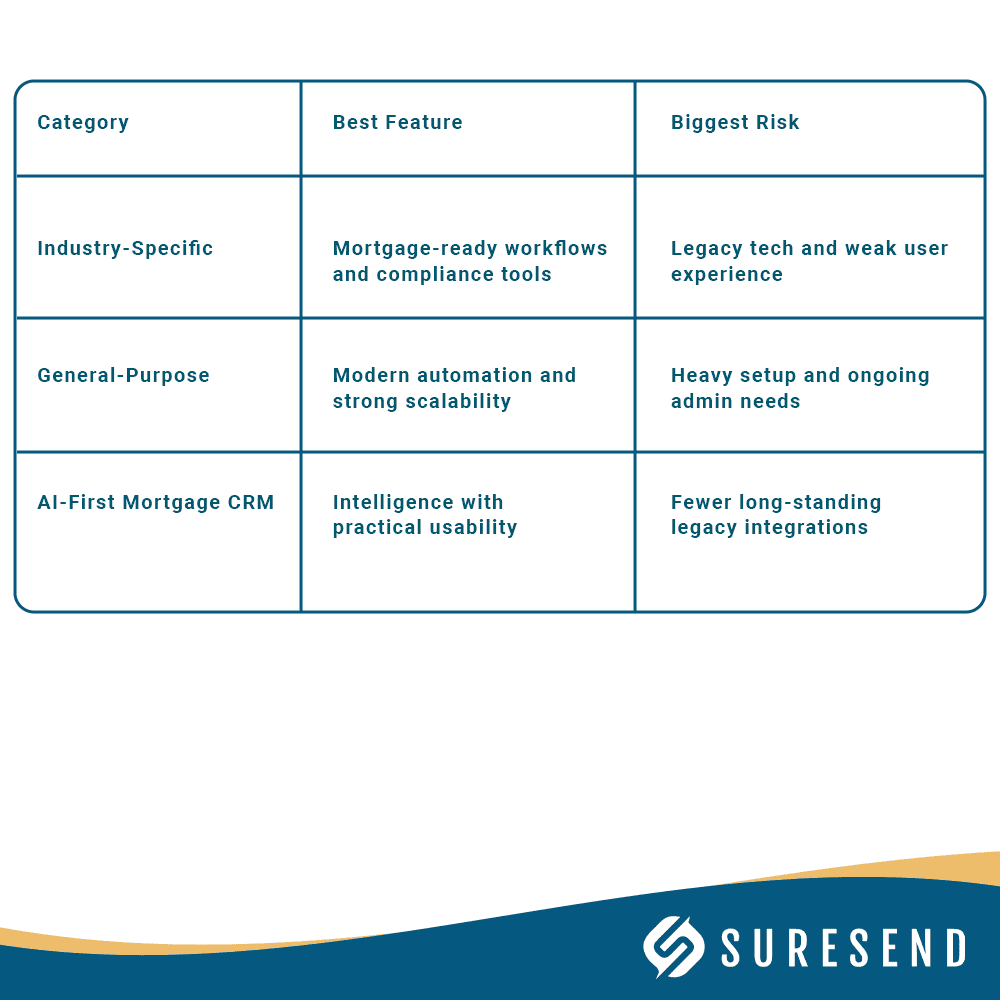
Knowing where your team fits on this grid keeps you from chasing the wrong kind of platform and helps you read any mortgage CRM review with a sharper eye.
Top Mortgage CRM Platforms For Loan Officers In 2026
With that context in place, it is easier to look at specific platforms and see where they shine and where they fall short. This section focuses on traits that matter for loan officers, sales leaders, and owners who care about daily usage and revenue.
These are the 9 platforms most often short-listed when people hunt for the best CRM for mortgage loan officers in 2026. They fall into the three groups we just covered: AI-first (Sure Send), industry-specific veterans, and general-purpose contenders.
1. Sure Send: AI-First CRM Built For Mortgage Professionals

Sure Send is built for mortgage sales teams, loan officers, and SMB lenders that want something they can put into play right away. The platform comes from founders who worked in real estate and mortgage, so the features feel like they were designed from inside the job, not from a distance. You do not need an admin army to get value in the first week.
Key strengths
AI-First Core CRM
AI does more than summarize notes. It flags at-risk clients, surfaces warm opportunities from quiet parts of your database, and lines up suggested actions based on your own history. The Take Action view highlights contacts who have slipped past your normal follow-up window, so you can bring them back before they go cold.In-House Email Delivery Engine
Sure Send runs an in-house email delivery layer. Instead of relying on third-party senders, it controls sender reputation, inbox placement, and reporting. That matters when your drip series, broadcasts, and newsletters are the main way you stay in front of past clients and referral partners. Poor deliverability wastes list size and ad spend.Trigger-Based Outreach
Sure Send watches property value shifts, equity milestones, and rate changes, then fires personalized campaigns the moment a client hits an important threshold. Calls are recorded and transcribed so you can search conversations and let AI suggest next steps or kick off workflows based on what was discussed.Performance Coaching And Revenue Insights
For leadership, the Win the Day system and Winning Formula show what each call, text, or appointment is worth in real dollars for each rep. That turns activity dashboards into a pay raise roadmap instead of a wall of metrics.
Add in drag-and-drop pipelines, renewal boards, a wide set of native integrations, full Open API with webhooks, and early support for Model Context Protocol, and you have a mortgage CRM that feels modern without extra complexity. For most SMB mortgage teams, it is the strongest fit in this mortgage CRM review.
Best for: SMB lenders, branch teams, and brokers that want an AI-first daily operating system tuned to mortgage work.
2. Surefire CRM: Compliance-Heavy Nurture For Larger Shops
Surefire CRM (Top of Mind) is one of the longest-running mortgage CRMs on the market. Many retail lenders and larger branches rely on it for long-term nurture and co-branded content with referral partners.
Large library of pre-built marketing campaigns, newsletters, and holiday touches
Strong compliance controls around marketing and borrower communication
Deep mortgage content catalog that marketing teams appreciate
The trade-off is a dated interface that many users describe as stuck in a past era, which hurts daily adoption by busy loan officers. Leaders like the compliance and content controls; frontline users often see it as “the marketing team’s system” rather than a daily work hub.
Best for: Mid‑size and large lenders that prioritize compliance-heavy, long-term nurture and have the resources to push adoption.
3. Jungo: Salesforce Power With Extra Complexity
Jungo is a mortgage CRM built on top of Salesforce. It inherits Salesforce’s power and flexibility, then adds mortgage-specific data structures and templates.
Built on Salesforce, so it connects to many tools and supports complex org charts
Strong reporting and dashboard options for management
Mature network of consultants and admins familiar with the stack
The price for that power is complexity. In practice, most shops need a dedicated Salesforce admin or outside consultant just to keep things running smoothly. For smaller lenders and brokers, the overhead can be hard to justify compared with lighter options like Sure Send or Pipedrive.
Best for: Larger mortgage companies already committed to Salesforce that want mortgage-flavored configuration on top of an enterprise CRM.
4. Insellerate: Speed-To-Lead Focused Call Center Platform
Insellerate centers on rapid response and call-heavy workflows.
Strong focus on speed-to-lead with call routing and lead distribution
Built-in dialer tools and scripting to support phone-heavy sales teams
AI assistant that predicts which borrowers are most likely to close
For big, phone-heavy teams that chase large volumes of internet leads, that focus can pay off. The platform still carries the feel of an older, mortgage-only system though, so it may not excite loan officers looking for a more modern UI or AI-native features.
Best for: Call center style mortgage teams that care most about lead response and phone productivity.
5. Total Expert: Enterprise Customer Experience Layer
Total Expert serves banks and credit unions that want a combined customer experience and CRM layer across multiple products.
Built to support mortgages, deposits, HELOCs, and other banking products
Strong campaigns around application completion and cross-sell
Enterprise features for multi-branch and multi-product organizations
For independent brokers or small teams, however, it often feels like more software than they really need—both in cost and complexity.
Across Surefire, Jungo, Insellerate, and Total Expert, you get vendors who know the mortgage space well. The main gap is a modern UX and AI-native design that keeps front-line users coming back every day.
Best for: Banks and credit unions that want a unified marketing and CRM layer across mortgage and other financial products.
6. HubSpot: Friendly General CRM With Strong Marketing Tools
HubSpot is one of the most user-friendly general CRMs and shows up in nearly every list of the best CRM for mortgage loan officers who want flexibility without heavy admin work.
Free core CRM with contact and deal tracking
Paid Sales and Marketing Hubs add sequences, campaigns, and deeper reporting
Clean interface that loan officers adopt quickly
Large integration ecosystem for email, calendars, and marketing tools
Mortgage teams can build solid workflows here, but they need time to wire in LOS or POS tools and to shape the deal stages around lending. Out of the box, HubSpot does not “speak mortgage,” so someone on the team has to design that structure.
Best for: Small to mid-size teams that want a friendly general CRM with strong marketing features and are willing to configure mortgage workflows.
7. Salesforce (Financial Services Cloud): Enterprise Workhorse
Salesforce with Financial Services Cloud delivers enterprise-level flexibility for lenders that have full IT support.
Pre-built objects for income, employment, and financial accounts
Einstein AI for scoring, recommendations, and analytics
Very deep integration story through AppExchange and tools like MuleSoft
For national lenders with in-house admins and developers, Salesforce can cover almost any requirement. For most SMB teams, the cost, setup time, and complexity are serious hurdles compared with an AI-first mortgage CRM like Sure Send.
Best for: National lenders, banks, and credit unions with IT staff and complex, multi-channel operations.
8. Pipedrive: Simple, Visual Pipeline For Brokers
Pipedrive is popular with small brokers who want a clean, visual pipeline and a simple way to manage calls and tasks.
Kanban-style board that makes stage movement obvious
Basic AI assistant that can suggest next steps
Solid mobile app and simple automation builder
Over 400 integrations, including email, calendars, and SMS tools
Mortgage-specific needs such as deep compliance tracking or complex document flows require extra tools. Pipedrive works best when someone on the team is willing to experiment with automations and integrations until the setup fits.
Best for: Solo loan officers and small brokerages that want an easy visual CRM and are comfortable shaping it to their process.
9. HighLevel (GHL): All-In-One Marketing Platform Adapted For Mortgage
HighLevel is an all-in-one marketing and sales platform originally built for agencies. Some mortgage teams use it as a CRM plus marketing engine.
Landing page builder, calendar booking, two-way SMS, and email
Workflow automation that covers marketing and basic sales tasks
White-labeling options for branch and marketing partners
Because it is not mortgage-specific, HighLevel demands solid technical comfort and a clear plan. It can feel like a blank canvas, which is powerful for advanced users but overwhelming for teams that want a mortgage-aware starting point.
Best for: Tech-comfortable teams and marketers who want a combined funnel builder and CRM and are ready to configure mortgage workflows from scratch.
Mortgage CRM And LOS Integration: What To Look For And How Platforms Compare
A common point of confusion in mortgage tech is the line between CRM and Loan Origination System (LOS).
The LOS (Encompass, LendingPad, Byte, Calyx Point, Arive, etc.) is the system of record for the loan file—from application through underwriting, closing, and funding.
The CRM manages relationships with borrowers and partners before, during, and after that process: outreach, follow-up, tasks, and coaching.
For the best CRM for mortgage loan officers, the connection between these two systems makes or breaks daily workflow.
What To Look For In A CRM–LOS Integration
When you evaluate integrations, ask vendors to show—not just tell—how they handle:
Contact And Application Sync
Does borrower data flow from LOS to CRM and back, or is it one-way only?Status And Milestone Updates
Can the CRM trigger workflows when the LOS moves a file from “Submitted” to “Conditional Approval” to “Cleared to Close”?Document Handling
Does the CRM show which documents are outstanding and who requested them, or is that view locked inside the LOS?Error Handling And Ownership
If something breaks, is support handled by the CRM vendor, the LOS vendor, or a third-party connector?Configuration Effort
Can a non-developer configure the connection, or does everything require custom code and consultants?
LOS Integration Snapshot For Reviewed CRMs
Integration details change often, but the table below summarizes the typical patterns for the 9 platforms in this review. Always confirm the latest integration list with each vendor.
| CRM | Encompass / Major LOS Support | LendingPad / Arive | Byte / Calyx Point | How Integration Usually Works |
|---|---|---|---|---|
| Sure Send | Focus on API-based connections and mortgage-aware integrations; LOS connectors are added based on demand—confirm current list with Sure Send. | Typically connected via API, webhooks, or iPaaS tools. | Often handled through middleware or custom API work. | Open API, webhooks, and native integrations; designed to sit in the middle of your stack without heavy custom code. |
| Surefire CRM | Well-known connections into Encompass and other major LOS platforms for marketing and milestone-based campaigns. | Often used alongside LendingPad via direct or partner-built connectors. | Common integrations into Byte and Calyx through vendor or partners. | Vendor- or partner-built LOS connectors targeted at mid-size and large lenders. |
| Jungo | Connects to Encompass and others through Salesforce AppExchange packages or custom Salesforce integration. | Often integrated through Salesforce middleware or API connectors. | Usually connected through Salesforce or third-party iPaaS. | Built on Salesforce, so LOS integration is handled via Salesforce tools and partners rather than Jungo alone. |
| Insellerate | Frequently paired with Encompass for speed-to-lead and call center workflows. | May connect to LendingPad or Arive through API or partners. | Byte / Calyx support varies by client setup. | LOS integration is part of many deployments; details depend on lender tech stack. |
| Total Expert | Strong enterprise integrations with Encompass and other major LOS platforms. | Often used with LendingPad and Arive in bank/credit union setups. | Byte / Calyx connections are usually available through partners. | Enterprise-focused integration strategy managed through Total Expert and IT teams. |
| HubSpot | No mortgage LOS built-in; often connected to Encompass or others via iPaaS tools (Zapier, Make, custom middleware). | Similar pattern—middleware or custom API work. | Same story: little direct LOS focus out of the box. | General-purpose CRM that depends on third-party tools or custom development for LOS links. |
| Salesforce | Deep Encompass and other LOS integrations available through AppExchange, MuleSoft, and custom projects. | Common enterprise choice for connecting multiple LOS platforms. | Frequently integrated with Byte and Calyx in complex shops. | Enterprise IT-led integrations using Salesforce’s data tools and partner connectors. |
| Pipedrive | No direct mortgage LOS connectors; usually connected to LOS platforms via Zapier, webhooks, or custom API. | Same pattern: middleware-based connections. | Middleware or manual import/export. | Best for lighter LOS sync or basic status updates rather than full LOS mirroring. |
| HighLevel (GHL) | Primarily integrates through webhooks, Zapier, and API; any LOS link is custom. | Same pattern for LendingPad and Arive. | Byte / Calyx integrations are almost always custom. | Built as a marketing platform; LOS integration requires technical setup. |
When you compare the best CRM for mortgage loan officers, treat LOS integration as a central buying question, not an afterthought. Poor integration is one of the fastest ways to push reps back into email and spreadsheets.
Referral Partner Management In A Mortgage CRM
For many loan officers, the best CRM for mortgage loan officers is the one that grows their referral network the fastest.
Residential mortgage pipelines live or die on relationships with:
Real estate agents
Builders and developers
Financial planners and CPAs
Past clients who send friends and family
A strong mortgage CRM turns these relationships into a visible, coachable pipeline instead of a pile of business cards.
What Good Referral Partner Management Looks Like
Look for CRM features that help you:
Track Partner Production
See exactly how many leads, applications, and closed loans come from each agent or partner.Run Co‑Branded Campaigns
Send co-branded emails, postcards, and event invites from one system instead of juggling multiple tools.Share Status Transparently
Give partners insight into where their clients stand in the process, either through automated updates or a simple portal view.Spot At-Risk Relationships
Identify partners who have gone quiet so you can reengage them with calls, lunches, or small events.Coach Your Team On Partner Strategy
Use dashboards to show loan officers which relationships are worth more focus and which are not producing.
How Sure Send Handles Partners
Sure Send treats referral partners as a first-class audience alongside borrowers.
Dedicated views and tags for agents, builders, and other influencers
Trigger-based outreach tied to partner behavior and borrower milestones
Account-style tracking so you can see the full value of each relationship
Combined with its AI engine, this lets leaders say, “Here are the five partners who moved the needle this quarter, and here is what the top loan officers did with them.”
The Five Features That Separate Good Mortgage CRMs From Great Ones

Brand names aside, you can test any platform with the same five questions. These features show up again and again in this mortgage CRM review as the line between “looks good in the demo” and “pays for itself in practice.”
Intelligent Lead Routing
A great CRM does more than collect new leads; it sends each one to the right person at the right moment. Rules based on loan type, geography, and rep capacity keep response times fast without turning your top producer into the catch-all. Service-level alerts help managers jump in when a lead sits untouched for more than a few minutes. In Sure Send, this kind of routing runs in the background while every call, email, and text is logged for clean reporting.Visual Drag-And-Drop Pipeline Management
Your team needs to see where money sits in a single glance. Clear stages, drag-and-drop moves, and simple filters cut through clutter and keep deals from hiding in the system. The best tools track not only new deals but also renewal dates and cross-sell chances, so you protect your book over time. Sure Send boards cover the full client life, from first contact through refinance and repeat business.Trigger-Based, Context-Aware Automation
Timed drips that ignore real behavior feel like noise. Strong automation fires when something meaningful happens, such as a rate shift, property value change, or key page view. Messages can reference that event so they feel like a human follow-up, not a script. Sure Send leans hard on these triggers, especially around equity and rate thresholds, so you stay in front of clients at the right moment.Native Integrations And Open API
A CRM should plug into your LOS, POS, e-sign tools, and lead sources without fragile workarounds. When every process depends on third-party connectors for basic tasks, support becomes a guessing game. An open API and webhooks give your developers room to extend the platform where needed. Sure Send combines dozens of direct integrations with a full RESTful API and Zapier support, plus early use of Model Context Protocol.Usability That Drives Real Adoption
If your reps hate the interface, the project is already lost. Fast onboarding, a clean mobile app, and clear next-step prompts keep the CRM part of the daily flow instead of an extra chore. Loan officers should feel like the tool saves them time every day. Sure Send was built around this idea, so teams can start working from it in days and see wins within the first week.
“The best CRM is the one your team actually uses.” — Common sales saying
Use that line as a filter. If you suspect your team will dodge the tool, look again.
Residential Vs. Commercial Mortgage CRM: Knowing Which Fits Your Workflow

Residential and commercial mortgage work share a name but not much else. The right CRM for a first-time homebuyer pipeline often feels wrong for a small-balance commercial shop, and the reverse is also true. Matching your workflow to the tool keeps you from fighting the system every day.
Residential mortgage teams live in high-volume, repeatable stages. Files move from pre-qualification to application, processing, underwriting, and closing in a pattern that looks similar from client to client. Referral partner management matters a lot, since agents and builders send much of the business. Automation that handles rate quotes, document reminders, and review requests at clear milestones gives these teams a real edge.
Commercial teams handle fewer but much larger deals over far longer timelines. Each file can involve multiple owners, investors, and decision makers, all with their own needs. Document packages include items such as rent rolls, detailed financial statements, and complex appraisals. Here, the CRM has to support multi-contact mapping, long-term task orchestration, and more flexible stages that can loop instead of flow in a straight line.
A quick view of the differences helps frame your choice:
| Factor | Residential Fit | Commercial Fit |
|---|---|---|
| Pipeline Volume | High | Low to medium |
| Stakeholders Per Deal | One to two | Three to ten plus |
| Automation Type | Milestone based | Task orchestration |
| Document Complexity | Standard loan files | Complex financial packages |
| Typical Close Timeline | 30–60 days | 60–180 days or longer |
If your world is mostly residential, lean toward platforms with strong referral tools and milestone automation. If you work commercial, make sure the system handles multi-stakeholder deals and long cycles without breaking your reports. In both cases, flexible pipelines such as those in Sure Send help you shape the tool to your real process instead of forcing a rigid template.
Mortgage CRM Pricing Comparison For Loan Officers
Pricing shifts over time, but the structure of pricing—per user vs. per account, free tier vs. contract—stays fairly stable. Use this table as a directional guide and always confirm current numbers on each vendor’s site.
| CRM | Typical Starting Point (High-Level) | Pricing Model | Free Trial / Free Plan | Best-Fit Use Case |
|---|---|---|---|---|
| Sure Send | Mid-range per-user pricing for loan officers and teams; quote-based. | Per user with volume tiers; contact Sure Send for a custom quote. | Demos and pilots available through sales. | SMB lenders and branches wanting an AI-first, mortgage-aware daily OS. |
| Surefire CRM | Contract-based pricing aimed at mid-size and large lenders. | Annual or multi-year contracts; per user and/or per loan volume. | Demo-based; usually no free plan. | Retail lenders needing compliance-heavy marketing and nurture. |
| Jungo | Requires Salesforce licenses plus Jungo package. | Per user for Salesforce + Jungo add-on; often annual contracts. | Salesforce trial; Jungo via demo. | Organizations already on Salesforce that want mortgage templates. |
| Insellerate | Quote-based; tends to scale with seat count and contact volume. | License + usage-based elements for call tools. | Demo-based. | Call center style teams focused on speed-to-lead and phone outreach. |
| Total Expert | Enterprise-level pricing for banks and credit unions. | Contracted platform fees, often multi-year. | Demo-based. | Institutions wanting a combined CX, marketing, and CRM layer. |
| HubSpot | Free core CRM; paid Sales and Marketing Hubs start at entry-level per-user plans. | Freemium plus per-user/per-hub pricing. | Free plan plus trials on paid tiers. | Teams wanting friendly general CRM with strong marketing features. |
| Salesforce | Per-user enterprise pricing; varies by edition and add-ons. | Per-user licenses plus add-ons; annual contracts common. | Trial orgs available. | Large lenders needing deep customization and IT control. |
| Pipedrive | Entry-level per-user monthly plan with a free trial. | Per-user, month-to-month or annual. | Free trial; no permanent free plan. | Solo LOs and small brokerages that want a simple visual CRM. |
| HighLevel (GHL) | Flat monthly fee per account; higher tiers for agencies and resellers. | Per-account subscription; unlimited users on many plans. | Time-limited free trial. | Tech-comfortable teams wanting an all-in-one marketing and CRM stack. |
When you weigh pricing, factor in:
Setup time and admin cost
Training and ramp time for loan officers
Any required third-party tools (dialers, middleware, support packages)
Sometimes the best CRM for mortgage loan officers is the one that costs a bit more on paper but pays for itself in saved effort and better conversion.
Conclusion: Pick A Mortgage CRM You Will Actually Use In 2026

Picking a mortgage CRM is not a side project. A platform that looks polished in a demo but fails in daily life costs more than its subscription; it hides deals, wastes leads, and pushes your best people back into manual work—a reality underscored by findings on AI’s influence on mortgage CRM adoption showing that platforms lacking intelligent automation see significantly lower utilization rates among frontline loan officers. The impact from this choice shows up in your closed units and your team’s energy every single month.
When you strip away marketing claims, five things matter most. You need smart lead routing, clear pipeline visibility, trigger-based automation, solid integrations (especially with your LOS), and a user experience that your reps like enough to open every morning. Industry-specific tools and general-purpose CRMs each cover parts of that list, but they often fall short in one area or another.
Sure Send brings those pieces together with an AI-first core, mortgage-aware workflows, strong deliverability, and real performance coaching. It is built for SMB lenders, brokers, and teams that want a daily operating system rather than another static database. If you are tired of wrestling with software that works for reports but not for real work, it is time to see what an AI-native mortgage CRM can do.
Stop wrestling with your CRM. Start using one that works as hard as you do.

FAQs
Q1. What Is The Best CRM For Mortgage Loan Officers In 2026?
There is no single platform that fits every team, but the top performers all mix AI-driven automation with clear mortgage pipelines and strong usability. For SMB mortgage teams, Sure Send stands out because it ships with AI-native workflows, trigger-based follow-up, a proprietary email engine, and fast onboarding. Larger enterprises with full IT staff often look at Salesforce Financial Services Cloud or Total Expert, while very small teams sometimes begin with HubSpot or Pipedrive and grow from there.
Q2. What Is The Difference Between A Mortgage CRM And A General CRM?
Academic work such as A Measurement Framework For e-CRM In Banking highlights the distinct functional requirements financial services firms need from customer relationship platforms compared to general-purpose tools.
A mortgage CRM usually includes pre-built stages for loan files, compliance tracking, and referral partner management, along with links to LOS and POS systems. It understands milestones like “application submitted,” “conditional approval,” and “clear to close.” A general CRM gives you contacts, deals, and automation tools but expects you to design the lending workflow yourself. General platforms often feel smoother to use, yet they demand more setup and custom work.
Your choice comes down to how much mortgage-specific structure you want on day one versus how much configuration you are willing to own.
Q3. How Can You Help Your Team Actually Adopt A New CRM?
To get real adoption:
Pick a tool with a simple, modern interface and a strong mobile app so loan officers can use it from anywhere.
Make sure the system takes annoying tasks off their plate, such as logging calls or chasing simple follow-ups, and shows clear next actions.
Roll out in stages with tight, practical training: one workflow at a time instead of a giant feature tour.
Tie CRM usage to outcomes they care about—faster closings, higher pull-through, and bigger paychecks—rather than framing it as a reporting tool for management.
When the CRM feels like a personal assistant instead of a surveillance system, adoption rises fast.
Q4. Can A Mortgage CRM Help With Compliance Tracking?
Yes, a well-chosen mortgage CRM plays a big role in keeping your files audit ready. It should:
Store documents in one place with version history
Record every client interaction across phone, email, and SMS
Limit access based on user roles so the right people see the right data
Provide clear timelines showing who did what and when on every file
Industry-focused platforms such as Surefire CRM and Total Expert offer many of these tools by default, while general CRMs need extra setup or add-ons. Whatever you use, make sure the system leaves a clear, searchable trail for every borrower and every file.
Q5. How Does A Mortgage CRM Support Referral Partner Relationships?
A strong mortgage CRM helps you turn referral partners into a structured growth channel. It should:
Track how many leads, applications, and closings each partner sends
Run regular check-ins, educational content, and co-branded campaigns
Share loan status updates automatically so agents do not have to chase you
Highlight which partners are most valuable and which relationships need attention
Platforms like Sure Send combine partner tracking, trigger-based outreach, and account-style views so you and your team can treat partners with the same focus you bring to borrowers.
Q6. How Important Is LOS Integration When Choosing The Best CRM For Mortgage Loan Officers?
LOS integration is one of the biggest deciding factors. Without it, loan officers end up double-entering data, missing status changes, and hopping between systems all day. With a solid connection:
New applications and borrower updates sync automatically
Milestone changes in the LOS can trigger CRM tasks and messages
Management gets a single source of truth for pipeline health
When you compare CRMs, ask each vendor to walk through exactly how they integrate with your LOS and who owns support if something breaks.

Kurt UhlirChief Marketing Officer
Kurt Uhlir is a recognized leader in marketing, growth, and innovation, having helped scale companies and technologies used by millions every day—including at brands like AGNT, Sideqik, Vitrue, Oracle, Garmin, Facebook, Meta, Apple, and more. He’s trained tens of thousands of professionals on how to build trust, lead with service, and help clients make wise, informed decisions. At ez Home Search and Sure Send, his focus is on helping high-performing business owners, team leaders, and individual sales leaders grow their businesses through exclusive market access, privacy-first lead systems, and conversion-focused enablement tools.