

Best HubSpot CRM Alternative Options for 2026
Many teams start looking for a HubSpot CRM alternative because costs keep climbing while results stay flat.
The pain comes from steep tier jumps, unused features, and reps who never build a daily habit inside the tool.
A strong HubSpot CRM alternative cuts software spend, increases revenue per rep, and keeps email out of spam. Sure Send, Salesflare, ActiveCampaign, EngageBay, and others offer more focused workflows, AI help where it matters, and simpler pricing. According to Salesforce research, companies that move off HubSpot report about 31 percent more revenue and 29 percent better ROI (Salesforce).
This guide walks through the best options, how Sure Send saves one team roughly thirty nine thousand dollars per year, and how to switch without losing momentum.
Ready to compare real choices before you renew another twelve month contract? Keep reading.
Key Takeaways
HubSpot’s pricing model often pushes small and midsize businesses toward paid tiers long before they see matching value. Teams move from a free starter into hundreds or thousands of dollars per month just to get access to automation and reporting their reps actually need. Over a year, that gap can block new hires, campaigns, or tools that would produce far better returns.
AI native CRMs like Sure Send feel very different from older systems with AI copied in later. Intelligence shows up inside every screen, from daily call lists to email writing and follow up reminders. That design keeps reps moving instead of forcing them to fight a control panel full of unused widgets.
Email deliverability should sit near the top of every CRM checklist, not the bottom. If sequences land in spam, no workflow or dashboard will save the quarter. Platforms that own their sending stack, like Sure Send, offer a real path to better inbox placement instead of hoping a third party sender fixes issues later.
Sure Send has documented savings of about thirty nine thousand dollars per year for one team that left HubSpot, with no loss of real capability. The gain came from stronger deliverability, better property data triggers, and a coaching layer that shows each rep the revenue value of every call. Similar teams often see both lower software costs and higher closed volume within months.
Before switching, it pays to review pricing transparency, AI depth, email reputation tools, integration coverage, and how fast a new platform gets your reps productive. Those same factors make it easier to justify a move to finance and to your sales floor.
Why Businesses Are Leaving HubSpot In 2026

Businesses are leaving HubSpot in 2026 because the cost curve rises faster than the value curve. Many small and midsize companies start on the free CRM, then hit a wall when they need real automation, reporting, or API access. The jump to Pro tiers, yearly contracts, and onboarding fees can feel like paying enterprise tax without an enterprise budget.
The numbers tell the story. Marketing Hub Professional sits near eight hundred ninety dollars per month, with Professional and Enterprise contracts locked for twelve months and paired with required onboarding. Reporting add ons alone often cost more per month than full CRM suites from competitors like Zoho CRM or EngageBay. Research from Salesforce shows that companies switching from HubSpot to other platforms report about 31 percent revenue growth and 29 percent ROI improvement (Salesforce).
Cost is not the only reason. Teams also run into:
Too much bloat across marketing, sales, service, CMS, and operations when they only need a lean sales CRM.
Partial feature access based on tier, which leaves reps confused about what they can and cannot do.
Workflows tuned for marketers, not for people on the phone each day closing deals.
Technical limits hit growing teams as well. Entry tiers restrict API access, automation depth, and detailed reporting. Developers must either upgrade far beyond what the team uses or bolt on extra tools through middleware. Over time many SMBs find themselves with HubSpot, three to eight supporting tools, and no clear picture of what they actually pay or which features drive revenue.
“What gets measured gets managed.”
— Peter Drucker
When you cannot easily see which activities move the needle, an expensive CRM becomes a tax instead of a growth engine.
What To Look For In A HubSpot CRM Alternative
The right HubSpot CRM alternative should match how your team sells, not how a vendor slices products into hubs and suites. Focus on four areas:
Pricing Clarity And Fair Limits
Look for plans that:Publish per seat and contact limits clearly.
Skip required onboarding fees for smaller teams.
Do not hide baseline automation or reporting behind only the top tiers.
That approach keeps budgets predictable as you add reps and avoids surprise upgrades when you start to scale.
Fast Time To Productivity
A good platform lets a new rep log in on Monday and start booking real appointments by Friday, without a full time administrator. Watch for:Clean, visual pipelines.
Obvious “do this next” guidance.
AI that supports daily work instead of living in a separate experimental section.
Serious Email Deliverability
Email deliverability deserves special focus. Most CRMs hand email sending to third party providers, which leaves you guessing when open rates drop. Sure Send stands out because it owns its entire sending stack and runs an intelligence layer that watches sender reputation. That design gives real estate teams, SaaS founders, and service firms a safer channel for newsletters, drips, and follow ups.Open Integrations And APIs
Integration depth and openness matter for long term fit. Platforms like Sure Send, Zoho CRM, and ActiveCampaign expose full REST APIs, webhooks, and direct connections to calendars, marketing tools, and industry systems. According to Zoho, its Zoho One suite spans more than forty business apps under one license (Zoho). When your CRM plugs into that many tools without surprise upgrades, you get a more complete operating system instead of another silo.
“If you can’t describe what you are doing as a process, you don’t know what you are doing.”
— W. Edwards Deming
Choosing a CRM with clear processes and reporting gives you far more control over how revenue is created.
The Best HubSpot CRM Alternatives In 2026
Sure Send — Best AI Native CRM For Relationship Driven Sales Teams

Sure Send sits at the top of this list because it was built as an AI first CRM from day one, not as marketing software with a CRM tab added later. The platform focuses on relationship driven sales teams in real estate, mortgage, SaaS, and service based businesses where every conversation matters. That focus shows up in the daily workflow, from the first screen reps see in the morning to how email deliverability is handled behind the scenes.
The Win the Day system is the heart of Sure Send. Each morning, reps land on a clear set of contacts and tasks already prioritized by the platform’s intelligence layer. The Winning Formula calculates a real dollar value for each call or follow up based on that rep’s historical conversion rates. Instead of guessing which lead to call, a rep sees which actions carry the highest expected revenue for that specific day.
Take Action automation closes the most common gap that sinks CRM adoption. When a warm prospect has not heard from your team within a set window, that contact automatically rises back to the top of the list. Managers no longer worry about leads going dark inside a forgotten stage. The platform acts like a coach that refuses to let good opportunities slip away quietly.
Sure Send’s email infrastructure is fully proprietary. Unlike HubSpot, Salesforce, or Pipedrive, it does not depend on a generic sending provider behind the curtain. The system watches inbox placement, opens, clicks, bounces, and UTM data, then adjusts sending behavior to protect your sender reputation. For list heavy industries, that level of control often matters more than another small feature on a dashboard.
Technical teams gain serious flexibility. Sure Send supports more than thirty native integrations across MLS feeds, transaction management tools, marketing platforms, lead vendors, and messaging apps. A full RESTful Open API, webhooks, and Zapier support cover edge cases and internal systems. On top of that, Sure Send is the first CRM to support Model Context Protocol, with forty five tools across eleven domains that let assistants like Claude work directly with your CRM data and automations.
One organization that replaced HubSpot with Sure Send cut annual CRM and related tool spend by about thirty nine thousand dollars while gaining better deliverability and property data triggers. They also gained a daily coaching loop that helped their reps see the real payoff from consistent activity. For sales managers who want a CRM their people actually open, Sure Send offers a very practical answer.
Best for sales managers, SDRs, and business owners in real estate, mortgage, SaaS, and service industries who want AI guided daily focus, dependable deliverability, and SMB friendly pricing without surprise fees.
Salesflare — Best For Automated B2B Data Logging
Salesflare positions itself as the CRM for B2B teams that hate manual data entry. It connects to Microsoft 365 and Google Workspace, then auto pulls contacts from emails, calendar events, phone logs, and even email signatures. That flow keeps pipelines current with almost no typing from your reps, which is a major contrast to the manual logging many teams face inside HubSpot’s lower tiers.
The platform keeps a tight focus on sales activity instead of branching into marketing or service hubs. Deals live on clean visual pipelines, and contact timelines show every interaction your team has had with a company. According to G2’s composite ratings, Salesflare holds a score near 9.7 out of 10 for overall experience and support quality (G2). That kind of feedback matters when you want a small vendor that still feels responsive.
Salesflare is not the cheapest option on this list, with plans near forty nine dollars per user per month on annual billing. The value comes from higher data quality and fewer leads slipping through cracks, not from a long list of extra modules. For B2B sales managers who care more about clean pipelines than landing pages or ticket desks, it remains a strong candidate.
Best for small and mid sized B2B sales teams that want clean, automated data and a pure sales CRM instead of a giant suite.
ActiveCampaign — Good For Marketing Automation And Email Workflows
ActiveCampaign serves teams that feel like they are paying HubSpot enterprise prices just to send email journeys. The platform combines a capable CRM with some of the most flexible marketing automation available to SMBs. Its visual builder lets you map flows with branching rules, ecommerce triggers, and multi channel sequences without hitting an artificial feature ceiling.
Reporting is a strong side of ActiveCampaign. You can see automation performance, contact behavior trends, goal completion, and ecommerce revenue paths without bolt on analytics. Calendar sync with Google, Outlook, and Apple helps keep tasks and follow ups visible where reps already work. According to G2 reviews, ActiveCampaign holds an overall score around 8.5 out of 10 with high marks for support (G2).
Pricing starts near fifteen dollars per user per month on annual plans for lighter setups, with higher tiers adding deeper automation and contact limits. When you compare that to HubSpot’s Pro Marketing Hub near eight hundred ninety dollars per month, the spread is obvious. For companies where email sequences, segmentation, and funnels drive most of the pipeline, ActiveCampaign often yields better economics.
Best for marketing heavy businesses and ecommerce brands that need strong automation without paying HubSpot Pro money.
EngageBay — Cheap All In One HubSpot Alternative
EngageBay looks and feels like a budget cousin to HubSpot. It splits features into bays for marketing, sales, support, and CRM, but keeps every piece under a single affordable subscription. The free tier offers basic contact management and campaigns, which is enough for early stage teams.
Paid plans are where the comparison becomes clear. EngageBay’s Pro tier often starts under fifty dollars per user per month and includes email marketing, landing pages, live chat, ticketing, and appointment scheduling. That bundle mirrors a large slice of what HubSpot offers at the Pro level at a fraction of the price. G2 reviewers give EngageBay an overall score near 8.6 out of 10 with especially strong marks for ease of use and support (G2).
The tradeoff comes in interface polish and integration depth. EngageBay can feel slightly rougher than HubSpot, and its marketplace is smaller. For teams that value savings over the latest design trends, though, EngageBay still gives them an all in one hub that covers most needs without locking the budget.
Best for startups and SMBs that want an all in one setup modeled on HubSpot but at a far more relaxed price point.
Salesforce — Best For Enterprises Needing Maximum Customization
Salesforce remains the standard choice for enterprises that want every knob and dial possible. It holds roughly twenty percent of the global CRM market, according to industry tracking from IDC and similar firms (Salesforce). The platform can model complex territories, multi step approvals, partner programs, and detailed forecasts that would strain simpler tools.
That power carries weight. Most companies that adopt Salesforce at scale also hire certified admins or outside consultants to design objects, flows, and reports. Marketing automation often requires a separate Marketing Cloud subscription, so full stack costs go higher than HubSpot in many cases. The Starter Suite near twenty five dollars per user per month eases entry, but Pro tiers quickly approach one hundred dollars per user.
Salesforce suits organizations with hundreds of users, dedicated IT staff, and many departments that need a shared data spine. It is rarely the right HubSpot CRM alternative for a ten person sales team that wants to be live quickly. Those teams usually lean toward Sure Send, Zoho CRM, or ActiveCampaign instead.
Best for large businesses and enterprises that need extensive customization and have the staff to support it.
Zoho CRM — Best Value if You Need Other Business Tools
Zoho CRM fits companies that want a huge box of tools at a very reasonable subscription. The platform offers multiple deal views, detailed activity tracking, and highly configurable dashboards. Through Zoho One, companies can access more than forty integrated business apps for areas like projects, accounting, and support under one license, according to the company’s own overview.
The CRM’s free tier supports up to three users, which works well for founding teams. Paid plans start near seven dollars per user per month and scale with added automation and analytics. You can often match most of HubSpot’s CRM and basic marketing behavior with Zoho for a fraction of the cost, especially when you fold in other Zoho apps.
The main downside is user experience. Zoho’s interface feels older than HubSpot, and some features take practice to master. For teams that accept that learning curve, Zoho offers a whole lot of function for each dollar spent.
Best for growing businesses that want broad coverage across departments and are willing to trade some visual polish for price and reach.
Pipedrive — Interesting but Complicated Visual Sales Pipeline Simplicity
Pipedrive appeals to leaders who want their team to open the CRM and instantly see where every deal stands. The visual pipeline uses cards you drag from stage to stage, which keeps things intuitive for new reps. You can set activities, forecast revenue, and see bottlenecks without much setup.
Pricing starts near fourteen dollars per user per month on annual contracts, and features grow with each tier. Higher plans add AI assisted insights and revenue predictions. According to composite scores that mix product, mobile, and plugin ratings, Pipedrive lands near 6.6 out of 10 overall (G2). The weaker scores relate mostly to the email plugin and mobile app rather than the core web experience.
Automation inside Pipedrive exists but feels lighter than what you get in HubSpot Pro, ActiveCampaign, or Sure Send. For teams that only need clean pipelines and basic sequences, that might be fine. If you want deeper coaching, AI guidance, or strong email intelligence, you may outgrow Pipedrive sooner than expected.
Best for small sales teams that prize a simple board view and do not rely on complex automation.
Brevo — Best Affordable Option For Email First Teams
Brevo, once known as Sendinblue, focuses on email and messaging first, with CRM features layered around those flows. The platform reports serving more than six hundred thousand users worldwide across its marketing and transactional email services. Its free plan includes unlimited contacts, basic CRM, marketing automation, and a monthly send cap.
Brevo charges based on emails sent, not contacts stored. That model favors companies with large lists and moderate send volume, where HubSpot’s contact based pricing would balloon. A major strength is transactional email, such as invoices, shipping notices, and password resets, which HubSpot does not handle natively. A Conversations inbox pulls together messages from Facebook, Instagram, and live chat into one place.
The CRM side of Brevo is serviceable but not as deep as dedicated systems like Sure Send or Salesforce. Pipeline tools work for simple B2B cycles but may feel light for complex deals. For teams that see email as their main motion and want a price structure that respects big contact lists, Brevo can still be a smart pick.
Best for budget minded teams that rely on email and want transactional sending and basic CRM in one place.
HubSpot Vs Top Alternatives Side By Side Comparison

This section compares HubSpot with the leading alternatives on the factors most leaders ask about. Use it as a quick filter before you book demos or trials. The table highlights starting price, free plan status, AI depth, and how much control you get over email deliverability.
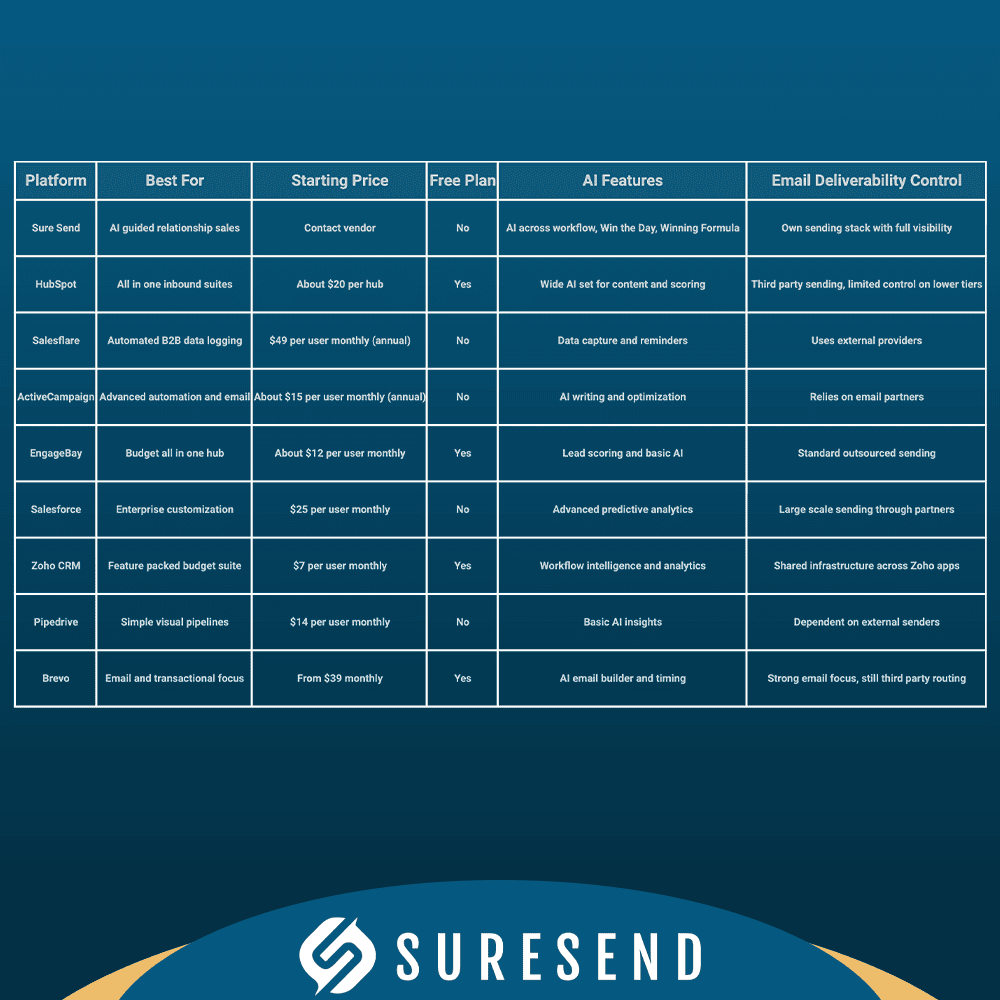
Sure Send stands apart because it owns the full email sending stack and attaches an active protection layer to your sender reputation. That gives sales and marketing leaders real levers to pull when open rates slide, instead of guessing what a background sender company is doing behind the curtain. For businesses that live on nurture sequences and newsletters, that control can protect a major revenue source.
The AI architecture in Sure Send is woven through contact prioritization, call prep, and coaching rather than sitting in a side tool. While HubSpot, ActiveCampaign, and Salesforce offer impressive AI features, they often feel like separate modules. Sure Send focuses on what reps should do right now, which is where AI can raise real productivity for lean teams.
Pricing structures differ sharply. HubSpot pushes many SMBs into four and five figure yearly contracts before they gain access to the automation they imagined. Alternatives like EngageBay, Zoho CRM, Brevo, and especially Sure Send keep entry points realistic for owners who need cash for headcount, ads, and product. That balance between cost and capability is exactly what many teams seek when they search for a HubSpot CRM alternative.
For teams that want a balanced mix of power and approachability, the short list usually comes down to Sure Send, ActiveCampaign, and Zoho CRM. Salesforce often wins at huge scale, while tools like Pipedrive and Brevo shine in specialized roles. The table should help you decide which group best matches your current stage and goals.
How To Switch From HubSpot Without Losing Momentum

Switching from HubSpot to another CRM feels risky, but a clear process keeps revenue moving. Treat the move as a set of steps rather than one giant leap:
Audit How You Use HubSpot Today
Export a list of reports, workflows, email templates, and properties that matter day to day. Many companies discover they pay for entire hubs they barely touch, which makes the decision to move easier.Export Clean, Structured Data
Pull contacts, companies, deals, tickets, and engagement history. A good HubSpot CRM alternative will accept standard CSVs and often offers import support or concierge services. Sure Send, for example, works with teams to load data and align custom fields so reps see familiar information from the first login.Map Your Integrations
List calendars, dialers, marketing tools, lead sources, and industry systems that currently connect to HubSpot. As you evaluate options like Sure Send, ActiveCampaign, or Zoho CRM, confirm which ones offer direct connections and which ones might use Zapier or native webhooks. This step avoids surprises after you have already signed a new agreement.Run A Parallel Pilot
Move a subset of reps into the new CRM for at least two weeks while HubSpot stays live. Compare activity levels, meeting volume, and pipeline quality. According to Brevo, customers often see performance shifts within the first thirty days of a tooling change. That kind of early signal can validate your switch before you move the entire team.Calculate Total Cost Of Ownership
Add license fees, onboarding services, admin time, integration work, and extra tools required to fill gaps. One team that moved to Sure Send trimmed about thirty nine thousand dollars from its yearly stack while gaining better adoption. When both the math and the field results line up, leadership and reps usually support the change.
Tip: Appoint a single owner for the migration who can coordinate between sales, marketing, operations, and finance. Shared responsibility often leads to stalled projects.
Conclusion
At this point, the main tradeoffs between HubSpot and its top alternatives should feel clearer. Cost, email deliverability, AI depth, and daily usability matter more than sheer feature count. Keeping those factors in view helps your team choose a platform that actually supports how you sell. For many relationship driven teams, that points toward an AI first CRM such as Sure Send.
The Bottom Line

The best HubSpot CRM alternative is not simply the tool with the largest feature grid. It is the platform your reps open every morning without a reminder because it makes their workday smoother and their paychecks bigger. For many relationship driven sales teams, that now means an AI native CRM that turns activity into clear dollar values and gives managers a reliable view of pipeline health.
Sure Send stands out on three fronts. First, its AI architecture runs across the full workflow, from Win the Day priorities to the Winning Formula that ties calls directly to expected revenue. Second, its proprietary email delivery platform keeps a close watch on inbox placement and sender reputation, which protects the campaigns that feed your funnel. Third, its pricing and onboarding model fit SMB realities, as shown by the roughly thirty nine thousand dollars in yearly savings documented for one team that moved off HubSpot.
If you are weighing another twelve month HubSpot contract against a change, this is the moment to review your options. Compare your current usage, costs, and results against what an AI native CRM like Sure Send can offer. Then visit Sure Send or book a demo to see your own sales workflow running inside the platform.
Frequently Asked Questions
Question 1: What Is The Best Free Alternative To HubSpot CRM?
The best free alternatives include EngageBay, Zoho CRM, and Brevo. EngageBay and Zoho CRM both offer no cost tiers with caps on users or contacts, while Brevo allows unlimited contacts and charges only for email volume. Free plans help early teams, but they usually limit automation and reporting. Sure Send focuses on teams ready to invest in a CRM that drives revenue, not just contact storage.
Question 2: Is Sure Send A Good HubSpot Alternative For Small Businesses?
Yes, Sure Send was designed specifically for small and midsize businesses rather than trimmed down from an enterprise suite. Teams usually become productive in days because the default workflow already matches common sales motions. There are no mandatory onboarding fees or hidden feature locks. One switching customer documented about thirty nine thousand dollars in yearly savings after moving from HubSpot, with better activity coaching through Win the Day.
Question 3: How Does HubSpot’s Pricing Compare To Its Alternatives?
HubSpot’s Marketing Hub Professional sits near eight hundred ninety dollars per month, with mandatory twelve month contracts and onboarding on higher tiers. Alternatives such as ActiveCampaign, EngageBay, and Zoho CRM start around fifteen, twelve, and seven dollars per user per month. Many companies discover they can get similar or better automation, plus useful reporting, at a fraction of that cost. Some even report over 31 percent revenue gains after switching, according to Salesforce research.
Question 4: What Should I Look For In A HubSpot CRM Alternative For My Sales Team?
Look for clear AI driven productivity tools, strong email deliverability reporting, and a layout that reps can use without an admin at their side. Pricing should grow predictably as you add people, without sudden jumps just to gain access to basic automation or reporting. Open APIs, webhooks, and solid integrations are also key. Sure Send’s Win the Day system reflects this design, guiding reps toward the most valuable actions each day.
Question 5: Does Sure Send Integrate With The Tools I Am Already Using?
Yes, Sure Send connects to more than thirty services through direct integrations that cover real estate platforms, transaction systems, marketing tools, lead sources, and messaging apps. A full REST API with webhooks and Zapier support lets your developers connect almost any other system. Because Sure Send also supports Model Context Protocol with forty five tools across eleven domains, AI assistants can work on your live CRM data without extra glue code.
Question 6: What Is The Easiest CRM To Switch To From HubSpot?
The easiest CRM to switch to is the one that handles migration help, offers familiar layouts, and gets reps producing quickly. Sure Send is built so teams can import contacts, set up key workflows, and start booking meetings within days instead of months. Its clean interface, AI guided daily views, and ready made coaching loop remove much of the complexity that makes large enterprise CRMs hard to adopt after HubSpot.

Kurt UhlirChief Marketing Officer
Kurt Uhlir is a recognized leader in marketing, growth, and innovation, having helped scale companies and technologies used by millions every day—including at brands like AGNT, Sideqik, Vitrue, Oracle, Garmin, Facebook, Meta, Apple, and more. He’s trained tens of thousands of professionals on how to build trust, lead with service, and help clients make wise, informed decisions. At ez Home Search and Sure Send, his focus is on helping high-performing business owners, team leaders, and individual sales leaders grow their businesses through exclusive market access, privacy-first lead systems, and conversion-focused enablement tools.