

Real Estate CRM IDX Integration: Complete Guide
A CRM where IDX search and contact data live in one platform almost always converts more leads than bolting a separate IDX plugin onto a generic system. When real estate CRM IDX integration is native, every property view, save, and alert ties back to a single live record, so follow‑up is faster and far more relevant. Split stacks with a separate IDX plugin and middleware miss that context and leak leads daily.
Agents and teams feel this as missed calls, generic emails, and buyers who quietly stop replying.
The fix is not another script. The fix is treating your IDX home search and your CRM as one operating system, with behavioral data flowing in real time, automation reacting to it, and email actually reaching the inbox. That is the standard Sure Send is built around for real estate teams and loan officers.
Keep reading to see how deep integration works, where most setups fail, and how to stop losing leads you already paid for.
Key Takeaways
Most connector‑heavy IDX setups look fine on paper but break in practice because the tools never share a live view of the customer. Over time, silent sync failures and field mismatches turn a growing database into a pile of stale records, so reps work hard but still call the wrong people at the wrong time.
Deep real estate CRM IDX integration means the CRM receives real‑time behavioral data, not only basic contact info. When search filters, property views, saves, and alert engagement all sit inside one record, reps can see intent at a glance and reach out with confident, specific conversations instead of generic check‑ins.
Behavioral IDX data changes lead prioritization more than any script change or new dialer. A buyer who has opened every alert and viewed the same listing four times should never sit behind a hundred cold internet leads, and an integrated system makes that obvious on every dashboard without manual sorting.
Every time a client has a clunky search experience, or cannot find a listing on an agent site, they drift to Zillow or Realtor.com. According to WAV Group, portals like Zillow and Trulia miss up to 20 percent of MLS listings and show about 36 percent as active when they are not, yet they still monetize your client relationship.
AI‑native CRMs are fast becoming the baseline because AI can now handle first contact, write context‑aware follow‑up, and keep pipelines organized. Sure Send was designed around AI from day one, so AI Calling, AI Texting, and AI Chat act directly on IDX activity instead of sitting on top as an isolated feature.
What Is IDX And Why Does It Matter For Real Estate Lead Generation?

IDX, or Internet Data Exchange, is the policy and technology framework that lets agents and brokers display live MLS listings on their own websites. Under the National Association of Realtors Broker Reciprocity rules, participating MLS members can show one another’s listings so buyers can search without leaving the agent’s site. How that IDX feed is implemented determines whether it becomes a steady lead engine or just a pretty catalog.
When IDX lives inside a smart site, every detail page, search result, and saved search becomes a conversion point. Instead of acting like a simple brochure, the site quietly turns visitors into contacts through:
Registration prompts on high‑value listing pages
Property alerts that follow each person’s saved searches
Market reports that speak to specific areas or price ranges
Each new contact arrives with real search behavior attached. That is the raw fuel a serious lead pipeline needs.
Portals tell a different story. Research from WAV Group found that Zillow and Trulia may miss around 20 percent of agent‑listed homes and show roughly 36 percent of displayed active listings as no longer available, a pattern consistent with findings on Information sharing across MLS platforms and how data gaps distort buyer decisions. According to Zillow Group, the company generated over a billion dollars in revenue mostly from selling advertising to agents. With a strong IDX experience on your own site, your database stays with you instead of becoming inventory for someone else to sell.
Why Most Real Estate CRM IDX Integrations Fail Before They Start
Most real estate CRM IDX integrations fail because they depend on tools that were never built to share a living data model. Middleware tools like Zapier and Real Synch are helpful for simple tasks, but they only pass the fields their schemas recognize. When either the CRM or IDX provider updates an API, the connection can quietly break while forms still collect leads.
That silent failure is the real problem. New registrations stop reaching Salesforce, HubSpot, Follow Up Boss, or whatever CRM you use, yet nobody notices until a dry month forces a painful audit. Even when the sync runs, many stacks only send name, email, and phone, leaving out the search behavior that turns a cold lead into a warm one — a problem documented in research on Strategic under-disclosure in online property platforms, where sparse listing data consistently reduces buyer engagement and agent credibility.
All‑in‑one platforms that bundle CRM, IDX, and website often repeat the same mistake inside their own product. Contact data may sync, but property views, saves, search filters, and alert engagement never show up on the contact record in a useful way. Managers think they bought a connected system, while reps are still working blind.
The stakes are high. National Association of Realtors research shows 76 percent of buyers would use their agent again, yet only 12 percent actually do. That gap comes from inconsistent, low‑context follow‑up, not customer dissatisfaction. When your system loses behavioral data or stops syncing altogether, you widen that gap without realizing it.
The Hidden Cost Of A Broken Integration

The hidden cost of a weak integration is not just one missed deal, it is a steady drip of underperformance that compounds month after month. When behavioral data never reaches the CRM, reps treat everyone the same, which means hot buyers get the same generic drips as cold leads. Conversion drops while activity looks busy on the surface.
Clients also feel the difference in their search experience. If your IDX pages are slow, incomplete, or awkward on mobile, they click over to Zillow or Realtor.com for better tools. Once they register there, the portal sells their attention to whoever pays, as Zillow Group explains in its advertising‑focused business model. Your original relationship turns into someone else’s opportunity.
Because connector failures rarely announce themselves, leaders blame scripts, coaching, or market conditions. Meanwhile, the real estate CRM IDX integration quietly keeps contacts stale, delays replies, and lets competitors win buyers you attracted in the first place.
The damage usually shows up in three ways:
Lower conversion rates even when lead volume looks strong
Shorter client loyalty, with past buyers and sellers drifting away
Misdiagnosed problems, where people are blamed for issues caused by tools
“What gets measured gets managed.” — Peter Drucker
When IDX activity never reaches the CRM in a reliable way, you cannot measure what matters, so you cannot manage it.
What Real Estate CRM IDX Integration Actually Looks Like When It Works
A healthy real estate CRM IDX integration feels less like two tools talking and more like one system seeing the whole customer. Every time a visitor searches, views a listing, saves a home, or tweaks a filter, that activity flows into the contact record in real time. The CRM does not just store contact info, it shows what the person cares about now.
In a deep setup, the CRM records search parameters such as price bands, neighborhoods, property types, and must‑have features. It tracks which listings a person opens repeatedly, which alerts they click, and how often they come back to your site. Modern platforms like Sure Send, along with IDX‑focused tools such as IDX Broker, Sierra Interactive, or Ylopo, can provide this activity stream when connected to a capable CRM through a native or strong API link.
Once that data lives in one place, the workflow changes:
New leads receive welcome texts and emails that reference their actual search criteria instead of generic market talk.
Drip campaigns adjust when someone narrows a price range or starts viewing a different school district.
Reporting no longer guesses at intent; it reads from clear click paths and alert histories.
Marketing research from HubSpot shows that most contacts are not ready to buy or sell immediately, which is why nurturing based on behavior matters so much, and why platforms that study Online real estate agencies consistently find that deeper consumer engagement tools produce measurably better housing market outcomes. When real estate CRM IDX integration works at this level, the system can support long buying cycles without constant manual effort. The database then feels alive, not like an archive of old inquiries.
How Sure Send Eliminates The Integration Gap Entirely
Sure Send was built so that agents never have to trust core revenue to a fragile connector. Sure Send Connect gives you branded IDX‑powered landing pages for listing details, open houses, city and neighborhood markets, home value offers, and more, all backed by the same home search infrastructure that serves millions of monthly visitors on ez Home Search. Leads from those pages land directly in Sure Send with full search context, without depending on Zapier or similar tools.
Because the IDX infrastructure and CRM share one proprietary platform, Sure Send automations can react to property views, saved searches, listing alerts, and AVM updates the moment they happen. There is no extra layer that can fall out of sync when an API changes. Sure Send’s Consumer Property Data Layer even adds mortgage balances, equity positions, and tax data to contacts across the United States.
On top of that data, Sure Send AI runs AI Calling, AI Texting, and AI Chat as true automation actions. The AI can respond to new IDX leads, move contacts between stages, and book appointments, all while managers keep full visibility inside one system.
“Treat IDX activity like a live conversation, not a website click.” — Sure Send coaching team
That is the mindset Sure Send is designed around.
The Four Lead Loss Scenarios Every Real Estate Team Needs To Fix
Most teams do not lose leads in one big event; they lose them in repeating patterns that happen daily — patterns that research on INNOVATION IN REAL ESTATE sales strategies identifies as systemic gaps in how agents manage and respond to digital lead flows. Those patterns hide inside the gaps between IDX, CRM, email, and human process. Real estate CRM IDX integration is the only place you can fix all of them at once, because that is where behavior, communication, and accountability meet.
Across hundreds of teams, four patterns show up over and over. The good news is that each one maps to a specific structural change, not just another pep talk for reps. When you solve these four, your pipeline feels very different within a quarter.
Scenario 1: The Slow Response That Costs The Lead

Scenario 1 is the new IDX registration that waits while your tools catch up. In a scattered stack, a person registers on a property page, the IDX emails someone, a connector builds a record in the CRM, and a manager eventually assigns the lead to a rep. This chain often takes hours in a busy shop.
Research summarized by Harvard Business Review shows that contacting a new lead within minutes can multiply qualification rates many times over compared with slower replies. Sure Send removes the delay by creating the contact instantly, tagging the source, routing it based on your rules, and dropping it into an automation. Sure Send AI can start a call, send a text, and answer chat questions right away so a human steps into a warm conversation instead of a cold introduction.
Tip: Aim to contact every new IDX registration within five minutes. Teams that build this habit often see dramatic jumps in appointment rates. — Sure Send coaching team
Scenario 2: The Past Client Who Went To A Competitor
Scenario 2 is the loyal past client who liked you, then listed with someone else two years later. This usually happens not because they were unhappy, but because months went by without relevant contact — a dynamic consistent with findings on Counting Lights to Measure vacant or underutilized properties, which highlights how gaps in visibility and outreach allow relationships and opportunities to go dark unnoticed. They went looking for information, found a portal or another agent, and started over. The original relationship fades in their memory.
According to National Association of Realtors, around 76 percent of buyers say they would work with their agent again, yet only about 12 percent actually do. Sure Send’s Consumer Property Data Layer uses home value shifts, equity changes, mortgage rate gaps, and even ARM reset dates to trigger outreach automatically. Past clients hear from you with meaningful, property‑specific updates, so they think of you first when their situation changes.
Scenario 3: The Lead Who Was Never Nurtured
Scenario 3 is the website or portal lead who was not ready yet and vanished. Most people who register through IDX searches are months away from making offers, and many teams only stick with them for a few weeks — a gap that AI-Enhanced CRM With Chatbots research demonstrates can be closed through automated, behavior-triggered nurture sequences that maintain engagement across long buying cycles. Once the obvious interest cools, the lead list makes room for newer names while the long‑term opportunity drifts away.
Marketing research compiled by HubSpot notes that a large share of leads need long‑term nurturing instead of quick closes. Sure Send’s Automations Engine lets you describe nurture plans in plain language, covering months of follow‑up with property alerts, market reports, and personal check‑ins. Because the real estate CRM IDX integration sits at the center, every new search or alert click can extend or change that plan without manual effort.
Scenario 4: The Email That Never Arrived
Scenario 4 is the campaign you thought was working that never reached most inboxes. Teams pour time into beautiful drips and property alerts, then send everything through a rented email service with weak authentication. Messages route to spam or updates folders, and open rates slide while nobody connects the dots.
A study from Return Path found that worldwide inbox placement for commercial email hovers below ninety percent, which means a meaningful share of messages never land where people see them. Sure Send operates its own email infrastructure, with DNS records, authentication, and reputation managed in house. Bulk sends carry predictable deliverability, while one‑to‑one emails and texts are free of per‑message fees, so your nurture plan actually has a chance to work.
How To Evaluate A Real Estate CRM IDX Integration: A Practical Framework
Evaluating real estate CRM IDX integration starts with one question about depth: does the CRM receive real‑time behavioral data from the IDX, or only contact details from a form? If all you see is name, email, and phone, you are looking at a fancy lead form, not a connected system.
Next comes the structure of the connection. Native API links between platforms such as Sure Send and IDX‑driven tools like IDX Broker, Sierra Interactive, or Ylopo keep both sides aware of changes as they evolve, an architectural advantage detailed in research on the Design and Implementation of a modern brokerage selling and rental management portal. Middleware connectors such as Zapier can be handy for edge cases, but they follow fixed recipes and often ignore new fields or events. When something breaks, you rely on error logs that few teams monitor regularly.
Automation is the next test. In a strong setup, IDX activity can start or adjust workflows inside the CRM. That might mean moving a lead into a hot list when they view a listing several times, or pausing outreach when someone goes dark. If reps must enroll every lead by hand, the system will lag behind reality whenever volume spikes.
Email and text delivery deserve just as much attention as slick features. A CRM that routes everything through generic shared servers may never deliver your carefully written sequences to primary inboxes. Proprietary infrastructure like Sure Send’s, managed by an internal deliverability team, gives you clearer inbox placement and support when providers tighten rules.
To make this easier, use a simple comparison grid when talking with vendors or auditing your own stack.
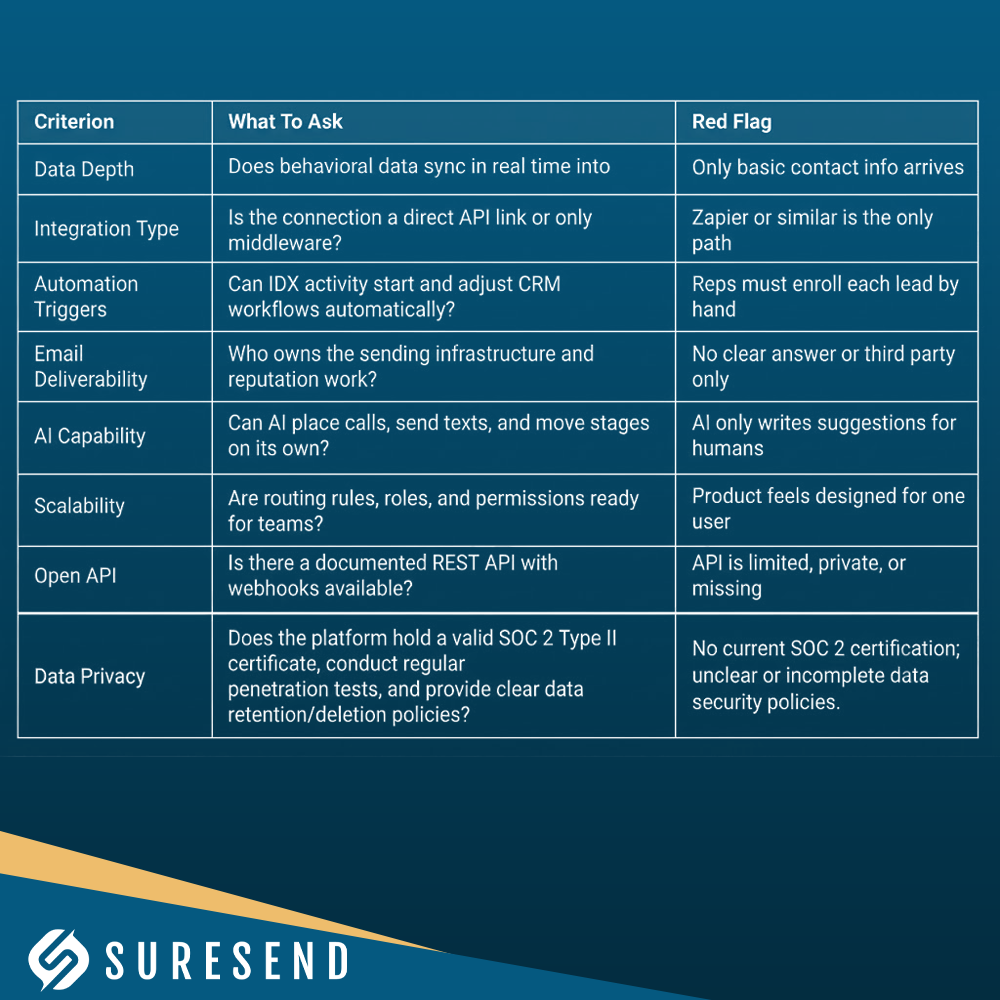
When you fill this table out for your current setup and for any new platform, the gaps behind slow response times and weak conversion usually stand out quickly.
For a quick self‑audit, ask yourself:
Can I see search behavior for every active lead inside my CRM?
Do automations change based on what people do on my site right now?
Are my emails and alerts consistently landing in primary inboxes?
If any answer is “no,” there is room to tighten your real estate CRM IDX integration.
Real Estate CRM IDX Integration For Teams And Brokerages: What Changes At Scale
For single agents, a weak real estate CRM IDX integration is frustrating. For teams and brokerages, it becomes expensive. When every new lead from your IDX pages, Sure Send Connect pages, or sources like Zillow or Realtor.com runs through the same brittle connector, a single failure touches all pipelines at once. Managers at firms from boutique independents to brands like Keller Williams or Compass feel this as sudden slowdowns with no simple cause.
Lead routing is the first pressure point at scale. Without rules tied to geography, price ranges, language, source, and capacity, some agents chase every new inquiry while others starve. A strong integration lets the CRM assign leads automatically the instant they arrive from IDX, while also logging source and behavior for reporting. That way, a new buyer searching condos in Austin never waits while a manager manually picks an agent.
Shared visibility is the next big shift. In a connected system, team leaders can open dashboards that show active searches, hot alerts, and aging leads across all agents. They can see that one person at the brokerage has three buyers hammering the same neighborhood, while another rep has not touched older leads in weeks. Coaching then centers on real data instead of guesswork.
Reporting also improves once IDX and CRM live together. According to McKinsey, data‑driven organizations frequently outpace peers on growth and profitability. When your CRM can show conversion by source, time to first reply, contact attempts per deal, and revenue per activity, you can make hiring, marketing, and routing decisions with confidence instead of intuition.
How Sure Send Supports Team Level Accountability

Sure Send approaches accountability as a built‑in rhythm rather than a one‑time training. The Win The Day system gives each rep a daily scoreboard that lists the contacts, tasks, and calls that matter most, based on live IDX and pipeline data. Reps no longer start the morning staring at an empty screen or messy list, because the system has already sorted their day.
The Winning Formula then assigns a real dollar value to each call or conversation based on that rep’s own six‑month conversion history. When someone sees that every completed call is worth a specific amount of future income to them, outreach stops feeling like busywork and starts feeling like a paycheck. Take Action Automation keeps the pressure steady by surfacing contacts who have been ignored too long, while Smart Lists let leaders and reps build targeted follow‑up lists in plain language.
Because Sure Send ties all of this back to its own IDX infrastructure and direct integrations, managers can trust that the scoreboard actually reflects what buyers and sellers are doing right now.
“Accountability works best when it is baked into the tools, not bolted on as a report at the end of the month.” — Sure Send coaching team
Frequently Asked Questions
Question 1 What Is The Difference Between IDX And MLS?
The MLS is the private database where licensed agents share and update property listings. IDX is the policy and technology layer that allows parts of that MLS data to appear on agent and broker websites for consumer search. In simple terms, MLS is the source, while IDX is the delivery method.
Question 2 Can I Integrate IDX With Any CRM I Already Use?
Many mainstream CRMs connect to IDX platforms through native integrations, open APIs, or middleware like Zapier. The deeper links usually come from native or API‑level connections with tools such as Sure Send, IDX Broker, or Sierra Interactive. Middleware often passes only basic contact data, so always check which fields and events sync before you commit.
Question 3 How Much Does A Real Estate CRM IDX Integration Typically Cost?
Costs depend on whether you buy separate tools or an all‑in‑one platform. Standalone IDX providers such as IDX Broker often run from tens to low hundreds of dollars per month, while CRMs add their own per‑user fees. Sure Send packages IDX, CRM, AI, and email infrastructure inside one platform, so pricing reflects the entire stack rather than one feature.
Question 4 Does IDX Integration Help With SEO?
It can, but only when the IDX creates indexable listing pages on your main domain instead of using frames or separate subdomains. Search engines can then read individual property pages and community searches, which helps you appear for location‑based queries. Low‑quality implementations that hide listings from indexing offer almost no search benefit.
Question 5 What Happens To IDX Leads When A Connector Breaks?
When a middleware connector fails, new registrations usually stop flowing into the CRM while forms still appear to work. Existing records also stop receiving updated activity, so your pipeline view slowly goes out of date. Agents keep calling and emailing based on old behavior, while fresh, active leads never even show up.
The Bottom Line
Real estate CRM IDX integration is not just another feature line on a checklist, it is the backbone of how your team wins or loses leads. When IDX behavior, contact data, automation, and email delivery sit in separate tools connected by fragile middleware, you pay for traffic and then hand the easiest deals to faster, cleaner systems.
The scenarios in this guide all trace back to the same structural issue. Slow responses happen when leads wait in queues, past clients drift away when property data never triggers contact, nurture fails when behavior stays outside the CRM, and campaigns flop when email never reaches primary inboxes. Fixing those problems with more coaching alone will always feel like pushing uphill.
A platform where real estate CRM IDX integration is native, AI is built into daily workflows, and email infrastructure is owned, not rented, gives you a different outcome. Sure Send was designed for that model, so leads flow from search to conversation without getting lost in connectors. When you are ready to see what that looks like in practice, book a live walkthrough with the Sure Send team at Sure Send.

Kurt UhlirChief Marketing Officer
Kurt Uhlir is a recognized leader in marketing, growth, and innovation, having helped scale companies and technologies used by millions every day—including at brands like AGNT, Sideqik, Vitrue, Oracle, Garmin, Facebook, Meta, Apple, and more. He’s trained tens of thousands of professionals on how to build trust, lead with service, and help clients make wise, informed decisions. At ez Home Search and Sure Send, his focus is on helping high-performing business owners, team leaders, and individual sales leaders grow their businesses through exclusive market access, privacy-first lead systems, and conversion-focused enablement tools.