Freight Broker Software: How to Know if It is Right for You.
Freight broker software is the operational backbone of every modern freight brokerage – a specialized transportation management system (TMS) that centralizes the load lifecycle in one system, from quoting and carrier sourcing through tracking, billing, and settlement. Choosing the right freight broker software determines how efficiently your team spends its time, how fast you can scale load volume, and whether you maintain the competitive edge that keeps shippers coming back. This article breaks down the key features that matter, compares the top options on the market, and explains why pairing your TMS with a strong customer relationship management platform – specifically Sure Send – gives freight brokers the complete stack they need for growth.
What Is Freight Broker Software?
Freight broker software – often referred to as a transportation management system TMS – is purpose-built technology that allows freight brokers to manage loads and shipments across the entire operation from a single platform. Instead of juggling spreadsheets, email threads, load boards, and separate systems for accounting and compliance, a TMS centralizes load management and automates paperwork generation, carrier onboarding, rate confirmation, invoicing, and document routing.
The core functions of freight broker software include:
- Load management: Creating, dispatching, and tracking shipments across modes (truckload, LTL, intermodal, drayage) from load creation through proof of delivery.
- Carrier sourcing and compliance: Verifying MC/DOT/FMCSA credentials, monitoring insurance expiration, and vetting carrier partners against safety ratings – all integrated directly into the workflow.
- Accounting and billing integration: Connecting carrier payments, shipper invoices, accounts payable/receivable, and general ledger systems like QuickBooks or Sage to eliminate double entry and data errors.
- Shipment tracking: Providing real time visibility into shipment status through GPS, telematics, or automated status updates – replacing the need for manual check calls.
- Automation and workflow tools: Handling rate confirmation, quote generation, invoice generation, document audits, and accessorial management without requiring manual data entry for each step.
From a technical standpoint, modern broker software is typically cloud-based for automatic updates and accessibility, with API and EDI integrations connecting load boards, GPS tracking providers like MacroPoint and trucker tools, carrier credentialing databases, and accounting software. The shift toward cloud-based TMS solutions has accelerated over the past decade as brokerage operations grew more complex and the volume of brokered freight demanded tools that could scale without proportional increases in overhead.
Software integration enhances operational efficiency in freight brokerage by eliminating disconnected systems and consolidating real time data into dashboards that support more informed decision making.
Why Freight Brokers Need Freight Broker Software
Running a freight brokerage without dedicated software means wrestling with manual processes that drain time, inflate error rates, and limit growth. Here’s what brokers face without the right tools:
Manual work compounds quickly. When brokers rely on spreadsheets, standalone email, and separate systems for load matching, compliance, and billing, the team spends hours on tasks that software handles in seconds. One case study of a twelve-person brokerage handling roughly 900 loads per month found that broker time per load dropped from 47 minutes to approximately 14 minutes after implementing AI triage alongside a TMS – with no additional headcount and a 38% increase in volume.
Fraud risk and compliance exposure grow. Without automated carrier compliance checks, brokers risk dispatching loads with non-compliant carriers – exposing the business to liability from invalid insurance, FMCSA safety violations, or domain-spoofing fraud schemes. Freight broker software can automate carrier onboarding processes and flag risks before they become costly problems.
Visibility gaps hurt customer satisfaction. Shippers increasingly expect real time tracking and proactive communication. Automated tracking provides real-time shipment visibility, eliminating the need for teams to make dozens of manual check calls per day. In ARK TMS’s case study with Bahr Transportation, adopting integrated visibility workflows led to 98% on-time delivery performance and 30–40% less time spent on load tracking.
Cash flow suffers from billing inefficiency. Missed accessorials, late proof-of-delivery collection, and manual invoicing slow down revenue recognition. A ClearLane case study with a large US freight broker handling approximately 4,000 loads per month showed that systematic audit and invoice verification recovered roughly $34,450 per month in missed revenue, reduced billing errors by 87%, and pushed invoice accuracy to 99.2%.
The bottom line: freight broker software reduces manual processes, saving time and money while providing the comprehensive visibility and compliance management that modern brokerage operations require to stay competitive.
Key Features to Look for in Freight Broker Software
Not every platform delivers equally across the features that drive a software’s effectiveness. Here’s what to prioritize when evaluating the best freight broker software for your brokerage:
Manage Loads and Shipments in One System
The foundation of any broker software is the ability to handle the full load lifecycle – from load creation and dispatch through carrier assignment, tracking, delivery confirmation, and invoicing – without switching between tools. A TMS centralizes the load lifecycle in one system, covering multiple freight modes (TL, LTL, intermodal, drayage). Tai Software’s implementation with LogisticsFox, for example, automated 40% of LTL operations and enabled the company to double capacity without adding headcount.
Integration Capabilities
Your TMS must seamlessly integrate with load boards (DAT, Truckstop), GPS and tracking providers, compliance databases, and accounting software. Integrated systems reduce double entry and data errors, and they prevent the inefficient workflows that emerge when brokers manage critical data across separate systems. Look for platforms offering API and EDI connections – ARK TMS, for instance, integrates with QuickBooks Online, MacroPoint, MyCarrierPortal, and major load boards out of the box.
Real-Time Tracking and Automated Check Calls
Real-time tracking provides visibility into shipment status without manual check calls. Platforms with event-driven automated status updates let operations teams focus on exceptions rather than routine status requests. Freight Scouts, for example, eliminated routine check calls across roughly 40 loads per day after adopting automated visibility workflows.
Driver App Support
Carrier-facing mobile apps and portals let drivers submit documents (POD, BOL), update status, and receive rate confirmations on the go. Shipper portals enable self-service rate quoting and tender. These features improve customer service and accelerate the flow of information across all parties.
AI and Automation
AI tools can automate repetitive tasks in freight brokerage – from email triage and rate confirmation to fraud detection and predictive ETA calculation. Automation reduces manual data entry by 80%, according to industry benchmarks, and users report a 90% reduction in weekly reconciliation time with TMS. The key is maintaining human oversight for judgment-heavy decisions while letting automation handle the volume.
Reporting and Analytics
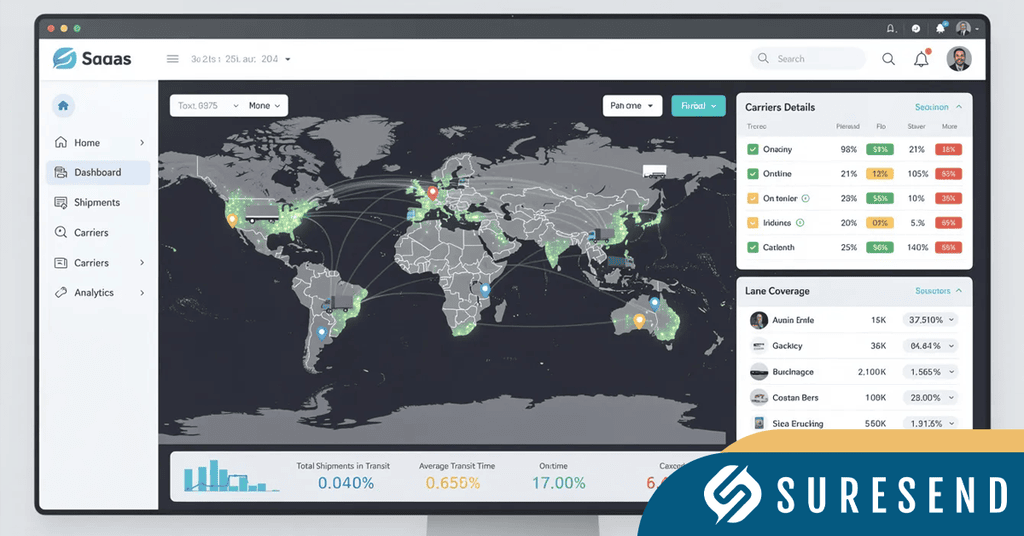
Data and analytics dashboards provide visibility into key performance indicators: lane history, margin analysis, carrier performance, sales aging, and dispute tracking. Tai Software’s LogisticsFox implementation delivered 50+ custom reports including sales aging and top-carrier analytics, providing the real time data teams need for strategic decisions.
User-Friendly Interface and Scalable Solutions
User-friendly interfaces improve adoption rates among staff – a critical factor, since even powerful tools fail if teams resist using them. Cloud-based systems allow businesses to scale without proportional increases in overhead, handling growth from 100 to 1,000+ loads per month without choking on volume. Customizable workflows improve administrative efficiency and governance, letting brokers tailor the system to their specific brokerage operations.
Top Freight Broker Software Options
1. Sure Send (Best CRM Option)
While TMS platforms handle the operational side of freight brokerage, the front end – shipper acquisition, customer interactions, pipeline management, and sales performance – demands a dedicated customer relationship management tool. Sure Send is the best CRM option for freight brokers, built specifically as an AI-native platform with features that directly address how brokerages grow revenue.
Sure Send’s standout capabilities include:
- Proprietary email intelligence that maximizes deliverability and ensures outreach actually reaches shipper inboxes
- Built-in dialer with transcription for tracking call outcomes and coaching sales reps
- Smart lists via natural language that let brokers segment leads without complex queries
- Trigger-based outreach automation tied to real-world data signals – so follow-ups happen at the right moment
- Pipeline and contract lifecycle management for tracking every deal from first contact through signed contract
- Visual automation builder that lets teams design multi-step sequences without engineering support
- Performance and coaching loops that show the dollar value of daily sales activities
Sure Send integrates with TMS platforms and other logistics tools, creating a unified stack where CRM handles customer relationships and sales productivity while the TMS manages load execution, carrier sourcing, and billing. This eliminates data silos between sales and operations – when a shipment exception occurs in the TMS, that information can feed back to the sales team for proactive customer communication. For brokers looking to consolidate sales and marketing tools into one CRM, Sure Send’s open ecosystem and AI-native architecture make it the strongest choice on the market.
2. Alvys
Alvys is a cloud-based TMS designed for freight brokers who want fast deployment and predictable costs. With 120+ integrations, unlimited users, and smart workflows, Alvys positions itself as a streamline operations platform for small-to-midsize brokerages looking to reduce manual entry and scale without complexity.
Key highlights:
- Competitive pricing: Alvys pricing starts at $514 with no long-term contracts, making it accessible for growing brokerages evaluating freight broker software cost
- Quick implementation: Cloud-native architecture means teams can go live rapidly
- Workflow automation: Reduces manual entry by 80% according to platform claims
- Revenue impact: Freight broker software can increase monthly revenue by 9% on average, and Alvys is designed around that efficiency-to-revenue pipeline
Alvys is a strong fit for brokerages that need to get operational quickly with a subscription based model and want unlimited user seats without per-user cost escalation.
3. Tai Software
Tai software delivers a comprehensive, one-screen operation approach with AI automation and multi-modal freight support. It’s built for brokerages that handle complex operations across TL, LTL, and intermodal lanes and need instant quoting alongside deep reporting.
Key highlights:
- Instant quoting and load management: Real-time rate quoting, dispatch, and load matching from a single dashboard
- 100+ integrations: Connections to load boards, GPS providers, accounting systems, and carrier compliance databases
- Proven results: LogisticsFox automated 40% of its LTL operations using Tai, with real-time quoting and booking, POD/BOL update automation, and vendor invoice audits all running within one platform
- Pricing tiers: Range from approximately $995/month to $7,925/month depending on staff logins and shipment volume limits – reflecting the range in freight broker software costs from hundreds to thousands monthly
A TMS can help book loads up to 15 times faster than manual sourcing, and Tai’s automation capabilities are designed to deliver those significant time savings across multi-modal brokerage operations.
4. Truckstop Broker Platform
Truckstop offers an integrated platform combining its established load board with carrier monitoring, factoring services, and TMS functionality. For brokers who already rely on Truckstop’s load board for carrier sourcing and load matching, the integrated platform eliminates the friction of moving between separate systems.
Key highlights:
- Integrated load board and TMS: Load posting, carrier discovery, and load management live on one platform
- AI tools: Features like Ask Pat automate routine tasks and surface insights
- Fraud risk detection: Strong carrier compliance and fraud monitoring built into the workflow, reducing fraud risk during carrier onboarding
- Carrier monitoring: Ongoing compliance management with automated alerts for insurance expiration, safety rating changes, and MC/DOT verification
Truckstop is particularly compelling for brokerages whose carrier sourcing workflow is already centered on Truckstop’s marketplace and who want to save time by consolidating tools they already use.
5. Descartes Aljex
Descartes Aljex is a TMS tailored for freight brokers and 3PLs who need strong reporting, carrier compliance, and accounting integration without the overhead of enterprise-scale implementations.
Key highlights:
- Real-time tracking: Automated tracking and visibility into shipment status to track shipments without manual intervention
- Carrier compliance: Automated carrier compliance checks reduce risks of using non-compliant carriers
- Accounting integration: Seamless connections to accounting software for invoice generation, carrier payments, and financial reporting
- Reporting: Detailed lane history, carrier performance, and operational analytics that support informed decision making
Descartes Aljex suits mid-market brokerages and 3PLs that prioritize compliance management and financial rigor alongside core load management.

Pricing models vary based on features and brokerage size. Custom TMS development costs start at $30,000 or more, making off-the-shelf platforms far more accessible for most brokers.
How to Choose the Right Freight Broker Software
Selecting the right freight broker software requires matching your brokerage’s specific needs to the platform’s strengths. Here’s a practical framework:
Evaluate your brokerage size, load volume, and complexity. A brokerage handling 200 TL loads per month has very different needs from one managing 2,000 multi-modal shipments. Define your modes (TL, LTL, intermodal), special services (reefer, flatbed), geographic markets, and billing complexity. These parameters directly determine which features are essential versus nice-to-have.
Prioritize integration capabilities. Your TMS must connect with the load boards, GPS providers, carrier credentialing services, and accounting software you already use. Platforms that seamlessly integrate with your existing tools eliminate the double entry and disconnected systems that create inefficient workflows. If your team already relies on Truckstop or DAT for carrier sourcing, verify that the TMS has native or API-level integration.
Look for automation features that reduce manual entry and errors. Automation reduces manual data entry by 80%, and a TMS can save brokers hours each week on dispatching tasks. Test whether automation features – rate confirmation, carrier onboarding, invoice audits – actually work reliably in your workflow. Build in human oversight for exceptions, particularly for fraud detection and rate anomalies.
Consider pricing models and contract terms. Freight broker software costs range from hundreds to thousands monthly. Some platforms charge per user, others per shipment, and many layer in fees for implementation, data migration, and third-party integrations. Prioritize platforms with published, transparent pricing – and calculate total cost over a 12- and 24-month horizon, including all subscription based fees, setup costs, and add-ons.
Assess implementation speed and user interface ease. Cloud-based TMS solutions allow for quick updates and accessibility, and some platforms go live within days. WSI, for instance, integrated Cargo Chief’s TMS in a single day and was fully operational within a week, with 64% of loads booked digitally by the end of the quarter. A TMS can improve customer service and increase profitability, but only if the team actually adopts it – so user-friendly design matters.
Don’t overlook modern CRMs. A TMS handles the operational side, but revenue growth depends on customer relationships, lead conversion, and proactive outreach. Freight brokers who pair their TMS with a dedicated CRM like Sure Send gain visibility into the sales pipeline, improve customer interactions, and ensure that sales team accountability doesn’t fall through the cracks.
Request demos and pilot tests. The best way to evaluate a software’s effectiveness is hands-on testing with your actual data and workflows. Run a pilot with a subset of loads before committing. Seek case studies from brokerages similar in size and complexity to yours – platforms that show growth without proportional hiring are strong signals of operational leverage.

Frequently Asked Questions
Can I integrate freight broker software with existing load boards and accounting tools?
Yes. Most modern TMS platforms offer API and EDI integrations with major load boards like DAT and Truckstop, GPS tracking providers like MacroPoint, and accounting software including QuickBooks and Sage. Freight broker software integrates multiple tools into one platform, so you can manage loads, track shipments, handle carrier payments, and reconcile invoices without switching between separate systems. Before purchasing, confirm that the platform supports the specific tools your brokerage already uses – integration capabilities vary significantly between platforms.
What is the typical cost range for freight broker software?
Freight broker software costs range from hundreds to thousands monthly, depending on features, user count, and load volume. Alvys pricing starts at $514 with no long-term contracts, while Tai Software’s tiers range from approximately $995 to $7,925 per month. Enterprise platforms with custom integrations or multi-modal complexity may cost more. Custom TMS development costs start at $30,000 or more. Always factor in implementation, data migration, training, and ongoing support when calculating total cost.
Do I need CRM software alongside my TMS?
A TMS handles load management, carrier sourcing, compliance, and billing – the operational side of brokerage. But shipper acquisition, lead nurturing, pipeline management, and customer retention are sales functions that require a CRM. Freight brokers who want to enhance efficiency across both operations and sales benefit from pairing their TMS with a web-based CRM like Sure Send. Sure Send’s AI-native architecture, proprietary email intelligence, and pipeline management tools are built specifically for sales-driven businesses, making it the best CRM complement to any freight broker TMS.
What differentiates freight broker software from shipper TMS?
Shipper TMS platforms focus on optimizing routes, managing transportation spend, and tendering loads from the shipper’s perspective. Freight broker software, by contrast, is built specifically for intermediaries – handling carrier relationships, load matching, carrier compliance, rate confirmation, and the unique billing workflows (paying carriers, invoicing shippers) that define brokerage operations. Freight broker TMS solutions streamline operations for logistics intermediaries in ways that shipper-focused systems simply aren’t designed to address.
Conclusion
The right freight broker software transforms a brokerage from reactive and manual to proactive, automated, and scalable. Whether you’re handling 200 loads per month or 4,000, the platforms covered here – Alvys, Tai Software, Truckstop, and Descartes Aljex – each offer distinct strengths in load management, carrier compliance, automation, and reporting that can increase operational efficiency and protect margins.
But operational excellence is only half the equation. To grow revenue, improve customer service, and build lasting shipper relationships, freight brokers need a CRM that matches the sophistication of their TMS. Sure Send stands out as the best CRM for freight brokers: its AI-native architecture, trigger-based automation, email intelligence, and pipeline management tools give sales teams the adaptable solutions they need to convert more freight into covered load and revenue.
Evaluate your brokerage’s specific needs, request demos, pilot-test your top choices, and build a stack – TMS plus CRM – that positions your business for sustainable, scalable growth.

Written by