

Why Real Estate Agents Need a CRM Before One Missed Follow-Up Costs Them a Closing
It’s easy to get caught up in chasing new leads, but what happens to the contacts you’ve already worked so hard to connect with or helped with a past purchase/sale? If you’re not keeping in touch, you’re likely losing out on deals. This is where a good CRM comes into play, and by “good”, I mean one that you will actually use and want to use.
It’s not just about storing names; it’s about building relationships and staying top-of-mind, which is key to closing more sales. Let’s talk about why real estate agents need a CRM before a missed follow-up costs them.
Key Takeaways
- A CRM helps you stay in touch with past clients and potential leads, making sure you’re the first agent they think of when they’re ready to buy or sell.
- Traditional methods like spreadsheets and basic contact lists just don’t cut it anymore; they can’t automate follow-ups or track client interactions effectively.
- Automated follow-up plans within a CRM system ensure consistent communication, preventing leads from falling through the cracks.
- CRMs allow you to track client preferences and history, which helps you personalize your marketing and communication efforts.
- Building and maintaining a strong database through consistent follow-up is like building a retirement asset, generating referrals and long-term business.
The Unseen Cost of Missed Connections: Why Real Estate Agents Need a CRM
The Analogy of the Clothing Store: Why Availability Matters
Think about walking into a clothing store. A salesperson greets you, but you’re just browsing. Later, you want to try something on, and you can’t find anyone to help. You’ll likely look for the first available person, not the one who spoke to you first.
Real estate is similar. If you don’t stay in front of leads, they’ll find the first agent who can help them. Your past clients may love you, but this is what the research shows. You have to maintain the relationship to be included in their next transaction.
To get the sale, you must be the first face they see when they shift into active buying/selling mode. This means consistent contact and follow-up. A CRM helps you manage this by assigning automatic plans to remind you or even perform tasks for you. These reminders can be simple prompts to call or more complex automated emails and market reports. The goal is to create a system so leads don’t slip through the cracks. Without a system, potential business walks out the door. It’s estimated that missed opportunities can cost industries like real estate over $25,000 per lost prospect. A good real estate CRM benefits system prevents this by ensuring timely engagement.
Real Estate Follow-Up: The Key to Being Top-of-Mind
When a potential buyer or seller is actively looking, they’re not necessarily going to track you down later. They’ll go with the first agent who is available and responsive. This is why staying top-of-mind is so important. It’s not about being the first person they met; it’s about being the person they think of when they’re ready. Consistent communication is how you achieve this. A CRM allows you to set up automated follow-up sequences, ensuring you touch base regularly. This could involve sending market updates, new listing alerts, or neighborhood news. The key is to provide value and remain visible. Without a structured approach, follow-up often falls apart, especially after a transaction closes. This leads to a significant loss of repeat business and referrals. Many agents fail here because they lack a plan for post-closing engagement.
The Critical Role of Consistent Lead Nurturing
Lead nurturing isn’t just about sending a few emails; it’s about building a relationship over time.
For online leads, speed is critical.
Studies show that responding within minutes can dramatically increase contact rates.
If you miss that initial window, the lead’s interest fades quickly.
This is where a robust real estate contact management software becomes indispensable. It helps you manage multiple leads, track their interactions, and automate follow-up.
Basic tools like Outlook or spreadsheets simply can’t handle the volume or complexity required for effective lead nurturing. They lack the automated drip campaigns and tracking capabilities that are essential for modern real estate prospecting. A dedicated CRM for real estate agents ensures that every lead receives timely attention, preventing them from going cold and ultimately costing you a sale.
Beyond Spreadsheets: The Limitations of Traditional Contact Management
Many agents start their careers using basic tools like Gmail or even simple spreadsheets to keep track of contacts. While these might seem sufficient at first, they quickly become a bottleneck as your business grows. Outlook, for instance, is primarily a reminder and scheduler, not a system designed for robust lead nurturing. Relying on it means you’re likely missing opportunities because it can’t automate follow-ups or track interactions effectively.
The adoption numbers make the problem visible. According to the NAR Real Estate in a Digital Age report, only 27% of REALTORS® use their CRM daily, ranking it last among all business software categories, behind MLS (63%), e-contracts (39%), and e-signature (33%).
That gap between ownership and use is where most agents lose business. Many have a CRM, often one provided by their brokerage.
But having access to a tool and building a business with it are two different things. The agents who close consistently are not simply the ones who have a CRM. They are the ones who use one that is straightforward enough, and rewarding enough to use, that opening it each morning becomes part of how they work.
A brokerage-provided CRM that no one opens is no different from a spreadsheet.
Why Gmail and Basic Phone Contacts Fall Short
Think of your phone’s contact list or Gmail as a static old-style paper phonebook. It holds names and numbers, but it doesn’t tell you when you last spoke, what was discussed, or what the client’s specific needs are. This lack of detail means every follow-up requires you to start from scratch, trying to remember past conversations. This is inefficient and prone to errors.
Without a system that logs every interaction, you’re essentially flying blind.
The Inability of Spreadsheets to Automate and Track
Spreadsheets offer a bit more organization than a basic contact list, but they still fall short. You can manually input data, but automating tasks like sending follow-up emails or setting reminders is nearly impossible. Imagine trying to manage hundreds of contacts this way – it’s a recipe for missed follow-ups and lost business. You can’t easily segment your list for targeted marketing or track the journey of a lead from initial contact to closing.
This manual process is time-consuming and doesn’t scale.
Outgrowing Manual Systems in a Fast-Paced Market
The real estate market moves quickly. Buyers and sellers expect timely responses and personalized communication. Relying on manual systems means you can’t keep up with this pace. You might be juggling multiple spreadsheets, sticky notes, and email folders, leading to confusion and dropped leads. A dedicated CRM, on the other hand, centralizes all your contact information and automates key tasks, allowing you to focus on building relationships and closing deals. Investing in a real estate CRM is not just about organization; it’s about building a scalable business.
The sheer volume of leads generated online today makes manual tracking unsustainable. Without a system that can automatically log, categorize, and follow up, a significant portion of potential business will simply slip away. This isn’t about being overwhelmed; it’s about using the right tools for the job.
Here’s a quick look at why manual systems fail:
- Lack of Automation: No automatic reminders, email sequences, or task management.
- Poor Data Segmentation: Difficult to group contacts by interest, stage, or source.
- Limited Insight: No history of communication or client preferences readily available.
- Scalability Issues: Becomes unmanageable as your client base grows.
For agents serious about growing their business, moving beyond these basic tools is a necessity. A system like a real estate CRM is designed to handle the complexities of modern real estate transactions.
Automated Follow-Up: Your CRM as a Lead Nurturing Engine

Think of your CRM as your personal assistant, but one that never sleeps and never forgets. It’s the foundation of a solid real estate lead follow-up system. Without one, leads go cold before you realize they’ve stopped responding. They come in from open houses, online ads, and referrals, and if there is no system keeping them warm, they are gone.
This is where automated follow-up shines. It’s not about being lazy; it’s about being smart. You can set up automated plans, or ‘drip campaigns,’ that consistently touch your leads. These aren’t just simple reminders; they can be sophisticated sequences of emails, texts, and even market updates, all timed perfectly.
Here’s how it works:
- Initial Contact Automation: When a new lead comes in, your CRM can immediately trigger a welcome email or text. This shows you’re responsive, which is huge. Remember, the first agent to engage often wins.
- Nurturing Sequences: For leads not ready to buy or sell right away, automated plans keep them engaged. This could be weekly emails with new listings in their desired area, monthly market reports, or even just a friendly check-in. This consistent contact builds trust and keeps you top-of-mind.
- Task Reminders: Even with automation, you still need to step in. Your CRM will remind you when it’s time for a personal call, a follow-up on a specific property, or to send a personalized market analysis. This ensures no lead slips through the cracks.
The goal is to create a real estate follow up strategy that works for you, not the other way around. A good real estate lead management system turns your database into a predictable source of business.
The real estate lead nurturing process isn’t a one-time event; it’s an ongoing relationship. Automation allows you to maintain that relationship consistently, even when you’re busy with other clients or out showing properties. It’s about being present without being intrusive.
Consider this: a lead might inquire about a property today, but not be ready to buy for six months. If you only follow up once or twice, they’ll likely go with someone else when they are ready. But if you’ve been sending them valuable content and staying in touch through automated campaigns, you’ll be the agent they remember and call. This is the power of a CRM as your lead nurturing engine.

The Power of Data: How CRMs Enhance Client Understanding
Think about it: your database isn’t just a list of names and numbers. It’s a detailed record of relationships waiting to be activated. A good CRM lets you go well beyond basic contact details. You can track preferences, life stages, and even past experiences clients have had. This level of detail is what separates good agents from great ones.
Tracking Preferences, Life Stages, and Experiences
When you’re talking to a client, what are they really looking for? Are they first-time buyers, growing families, or downsizing seniors? Do they prefer modern homes or historic properties? A CRM allows you to log these details. You can note down their favorite neighborhoods, desired amenities, or even their budget range. This isn’t just busywork; it’s about building a clear picture of each individual.
- Client Preferences: Record specific needs like number of bedrooms, desired school districts, or proximity to public transport.
- Life Stages: Tag clients as ‘First-Time Buyer,’ ‘Growing Family,’ ‘Empty Nester,’ or ‘Retiree’ to tailor your approach.
- Past Experiences: Note down details from previous transactions or interactions, like what they liked or disliked about a property.
Utilizing Data for Targeted Marketing Efforts
Knowing your clients allows for smarter marketing. Instead of sending generic emails to everyone, you can segment your database. Send a market report on luxury condos to clients who expressed interest in that segment. Alert buyers about new listings that match their saved criteria. This targeted approach feels more personal and is far more effective than mass mailings. It shows you’re paying attention and understand their unique needs.
Sure Send’s Smart Lists let agents build dynamic, real-time contact segments by typing a plain-language request, so the right message reaches the right contact without manually sorting a database.
Predicting Real Estate Interest with Detailed Information
Beyond just preferences, a CRM can help you anticipate your clients’future needs.
By tracking life events or market trends, you can proactively reach out.
For example, if a client’s child is nearing college age, you might anticipate a need for a home near a university. If you know a client’s mortgage is nearing a refinance window, you can offer market insights.
This predictive capability turns your database into a proactive business-building tool, not just a passive record. It’s about being the agent they think of before they even start actively searching again.
Building a Gold Mine: Your Database as a Retirement Asset
Your client database is the most reliable asset you will ever build as a real estate agent. It’s not only a list of names; it’s the central source of your future income, and a core driver for long-term career stability. Unlike branding or ad spend, a truly curated, organized, and meticulously updated CRM becomes more valuable each year.
Agents earn, change careers, and retire on their databases. Top professionals have sold their contacts for significant sums, sometimes thousands, sometimes even millions, precisely because of the relationships and lead history they’ve documented. Consider it similar to a physician selling their patient base. The value lies in the trust and communication cadence established over time.
Adding to your database daily, with fresh contacts and rich, updated notes, is non-negotiable if you want steady referrals and future business. Make entering notes routine: after every call, text, or client meeting, log new intel, anniversaries, birthdays, and shifting preferences. The more complete the record, the more usable the asset.
A robust database is more than passive storage. It’s the system that powers repeat and referral business:
- Consistent follow-up generates top-of-mind awareness, making you the first call when real estate needs arise.
- Automated touch plans (emails, calls, market reports) keep the relationship active even during “quiet” months.
- Personal touches like birthday wishes, milestone recognitions, and tailored property searches build genuine connection.
- By tracking detailed interactions, agents can segment contacts for targeted campaigns, increasing both relevance and response rates.
Agents who lead the market systematically “touch” their past clients dozens of times per year, through value-driven outreach, not sales spam. This consistent system converts contacts into an ongoing referral engine, providing a buffer against market swings.
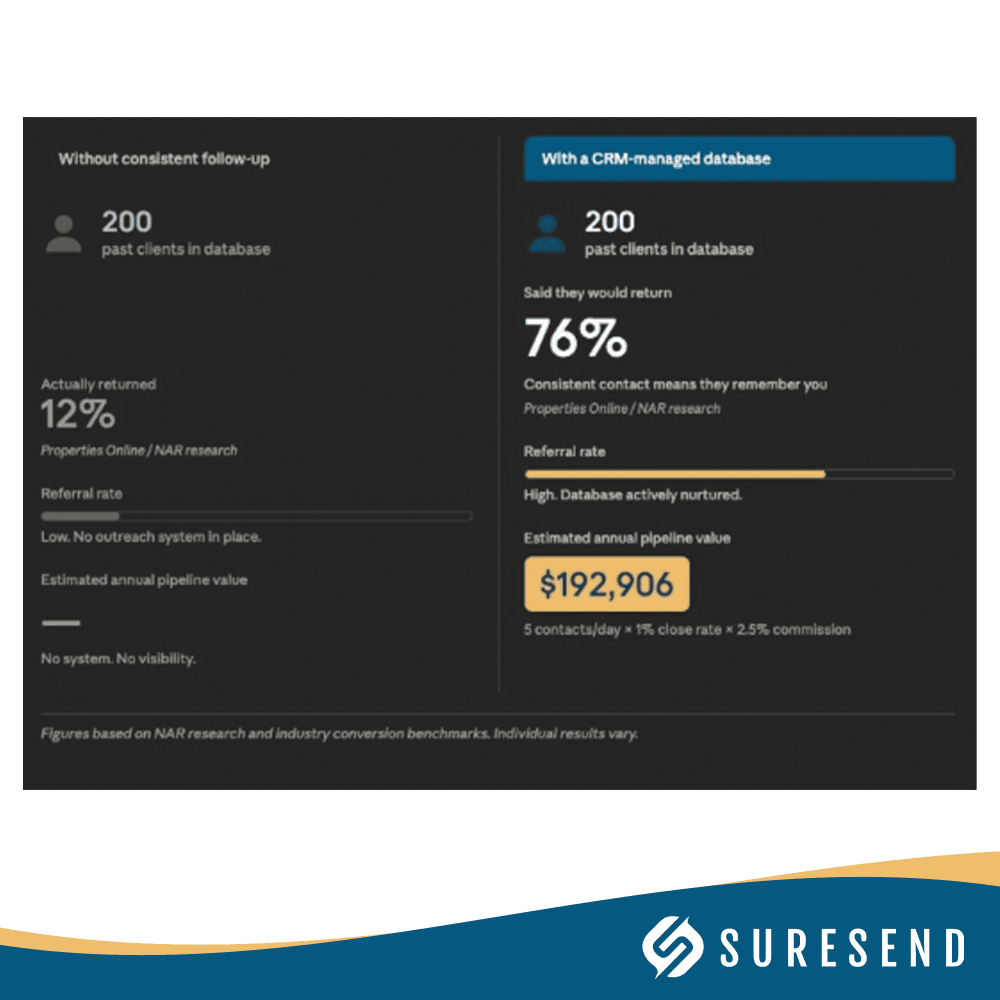
The cost of failing to stay in touch is measurable. The Properties Online Real Estate Tech Trends Report, citing NAR research, found that 76% of buyers say they would definitely use their agent again after a transaction closes. Only 12% actually do. That 64-point gap is not explained by dissatisfaction. It is explained by silence. The agent stopped showing up, and by the time the client was ready to buy or sell again, they could not remember who to call.
Here’s how a database directly equates to reliable income:
| Daily New Contacts | Annual Additions | Conservatively Estimated Closings (1%) | Avg Home Price | Gross Commission (2.5%) | Annual Gross Income |
| 5 | 1,825 | 18 | $428,700 | $10,717 | $192,906 |
Making five meaningful contacts a day can potentially add almost $200,000 a year in gross commissions, just from nurturing new relationships.
Database growth compounds. The more people you know and serve, the larger your footprint and sphere. Even if you only tap into this asset lightly after you retire, steady communication produces referrals for years. Some agents choose to transition their business to incoming generations for a payout or ongoing residuals, treating their database as a gold mine.
Given trends in seniors housing investment expansion (investor confidence is surging), leveraging your database to target shifting markets or demographics becomes even more powerful over time.
- Action List for Agents Seeking Long-Term Wealth:
- Add new contacts to your CRM every day (aim for 5).
- Update and organize client records with notes after every interaction.
- Segment your database for custom touch campaigns (anniversaries, birthdays, life events).
- Systematize follow-up with automated reminders, emails, and check-ins.
- Analyze database size and conversion rates each quarter; refine your outreach for better ROI.
To sum up: agents who treat their database as a serious business asset, not just a convenience, build sustainable wealth and lasting freedom. This approach doesn’t require complex technology or massive teams. It takes discipline, attention to detail, and a commitment to relationship-driven growth. That’s how you turn everyday contacts into the foundation for your retirement.
The ‘Always On’ Advantage: Meeting Client Expectations in the Digital Age

The Expectation of Near-Instant Responses
Today’s buyers and sellers expect immediate attention.
Think about it like walking into a store; if you need help and no one is around, you’ll likely leave and find someone who can assist you.
The same applies to real estate. If a potential client inquires about a property online, they expect a response within minutes, not hours. According to the NAR 2025 Home Buyers and Sellers Generational Trends Report, as reported by real estate lead generation research, 78% of homebuyers end up working with the first agent who responds to their inquiry. Speed is not a courtesy. It is the deciding factor in most transactions before the first real conversation even happens. Many consumers are browsing homes at all hours, and they expect someone to be available. This shift means real estate is no longer just a 9-to-5 business; it’s becoming a 24/7 service industry.
Why Speed of Contact is Crucial for Conversion
When a lead comes in, their interest is at its peak.
If you don’t respond quickly, that interest fades.
Imagine a potential buyer inquiring about a property at 10 PM. If they don’t hear back until the next morning, they might have already contacted another agent or moved on to other properties.
This is where a modern CRM becomes invaluable. It can help automate initial responses or set immediate tasks for you to follow up.
The first agent to engage often wins the client. Missing that initial window means losing out on potential business. It’s not just about answering; it’s about answering fast.
Adapting to a 24/7 Service Industry Mentality
Clients are online at all times of the day and night. They send inquiries at 6 AM or 11 PM. Your CRM can help you manage this by setting up automated responses or drip campaigns that keep leads engaged even when you’re not actively working. This ensures that no matter when a prospect reaches out, they receive some form of acknowledgment and feel that their inquiry is being handled. This constant availability, managed through your CRM, builds trust and keeps you top-of-mind. It’s about being present for your clients, even when you can’t physically be there.
Consider how services like Zillow offer 24/7 support; clients are getting used to this level of immediate service. To compete, agents need systems that mimic this ‘always on’ availability. You can explore top real estate CRM features for 2026 to see how technology can help you meet these demands.
From Lead Generation to Closing: The CRM’s Role in Every Stage
Capturing and Communicating with Online Prospects
Online leads come in fast. A potential buyer clicks an ad, visits your website, and fills out a form. If you don’t connect within minutes, they’re likely gone. A CRM acts as your first responder. It can automatically capture lead information from various online sources – your website, social media ads, or property portals.
This immediate capture is critical because a lead’s interest is highest right after they inquire.
Your CRM can then trigger an automated response, like a text or email, letting them know you’ve received their inquiry and will be in touch shortly. This keeps them engaged while you prepare for a more personal follow-up.
Tracking Property Views and Saved Favorites
Once a lead is in your system, a good CRM, often integrated with your website’s IDX feed, tracks their online behavior. Did they view a specific property multiple times? Did they save a few homes to their favorites list? This data is gold. It tells you what they’re really looking for, beyond what they might say in an initial conversation. You can use this insight to tailor your communication, sending them listings that closely match their saved properties or viewed areas. This personalized approach shows you’re paying attention and makes your follow-up far more relevant and effective.
Streamlining the Path from Inquiry to Representation Agreement
Every step from initial contact to a signed agreement needs a system. A CRM provides that structure. For online inquiries, it can initiate automated drip campaigns designed to nurture the lead over time. These campaigns can include market updates, new listing alerts, and helpful articles. For seller leads, it can prompt you to schedule a Comparative Market Analysis (CMA) and listing presentation. For buyers, it can guide you through connecting them with a lender and scheduling property viewings. By having these automated plans and task reminders, you ensure no lead falls through the cracks, moving them efficiently from a simple inquiry to a committed client ready to buy or sell.
The Cost of Inaction: When Missed Follow-Ups Lead to Lost Business

If you’re not diligently following up with the people you already know, especially your past clients, you’re losing business that is already in your pipeline. Think about it: a potential client reaches out, and if they don’t get a prompt, helpful response, they’ll simply find someone else who will. It’s about being available when your client is ready.
The High Percentage of Unanswered Inquiries and Calls
The scale of this problem is documented. According to Vulcan7’s 2024 analysis of real estate lead generation follow-up, only 25% of real estate agents ever make a second follow-up call to a lead. 48% never follow up after the first contact at all. Nearly half of every lead an agent works to generate is abandoned after one attempt. Even when agents do respond, the delay is often measured in hours, giving prospects time to connect with whoever replies next.
The Impact of Lead Decay on Conversion Rates
Interest from a lead isn’t static. It fades over time, especially if there’s no consistent engagement. This is often referred to as lead decay. The longer you wait to follow up, the colder the lead becomes, and the lower your chances of conversion. Imagine a potential buyer who inquired about a property; if they don’t hear back quickly, their initial enthusiasm wanes, and they might move on to another property or agent. A CRM helps combat this by automating reminders and follow-up sequences, keeping you in touch consistently.
Why Agents Must Prioritize Follow-Up Over New Lead Generation
While generating new leads is vital, it’s pointless if you can’t convert the ones you already have. Focusing on lead generation without a follow-up system means paying to fill a bucket with a hole in it. A well-maintained database, nurtured through consistent follow-up, becomes your most reliable source of closings. That’s where the real revenue is. Sure Send’s Take Action queue automatically surfaces contacts marked as buying within 0 to 3 months who have not been contacted in 7 days, so the follow-up priority is already decided when an agent opens the platform each morning.
Strategic Communication: Keeping Your Database Engaged and Informed
Your database isn’t just a list of names; it’s a documented record of relationships with real earning potential. To keep that mine producing, you need to stay in touch. This means more than just occasional emails. It’s about providing consistent value and staying top-of-mind.
The Importance of Regular Market Reports
Sending out market reports is a smart way to keep your contacts informed about their local real estate landscape. These reports can summarize sales activity, average prices, and days on market. They show your clients that you’re knowledgeable and actively watching the market for them. This information helps them gauge market trends and plan accordingly.
Providing Value Through Listing Alerts and Neighborhood Updates
Beyond general market data, personalized alerts are incredibly effective. If a contact is looking for a home in a specific neighborhood, sending them new listing alerts for that area is highly relevant. Similarly, updates on neighborhood sales or new developments can pique their interest. This shows you’re paying attention to their specific needs and preferences.
Maintaining Top-of-Mind Awareness with Consistent Touches
Think of your database like a garden. It needs regular watering to thrive. This means consistent, planned communication. A CRM can help you set up automated drip campaigns, reminders for personal calls, or even schedule birthday and anniversary messages. The goal is to have multiple touchpoints throughout the year, not just when someone is actively looking to buy or sell. The key is to be the agent they think of first when real estate needs arise.
Here’s a simple breakdown of how to structure your communication:
- Monthly Market Updates: Send a summary of local sales, price trends, and days on market.
- Bi-Weekly Listing Alerts: For active buyers, send notifications for new properties matching their criteria.
- Quarterly Neighborhood News: Share updates on local developments, new amenities, or significant sales in their area.
- Personalized Touches: Remember birthdays, anniversaries, or home purchase anniversaries with a personal message or card.
Consistent communication is about being present and relevant. When you provide value regularly, you build trust. When your contacts are ready to move, you are already the agent they have in mind.
The Business of Real Estate: Owning Your Success with a CRM

Shifting from a Job Mentality to Business Ownership
Real estate isn’t just a job; it’s a business you own. This distinction is critical. A job often comes with a set schedule and steady income, regardless of performance. Owning a business means your income is directly tied to your efforts and results. You’re responsible for every aspect, from finding clients to closing deals.
This requires a different mindset – one focused on growth, systems, and customer acquisition. A CRM is the cornerstone of this business-focused approach, acting as your central hub for all client interactions and business operations.
Taking Responsibility for Customer Acquisition and Service
Unlike traditional jobs where clients are often provided, in real estate, you must actively seek them out. This means mastering lead generation and nurturing. Your real estate database software is not just a list of names; it’s your most valuable asset for building relationships and securing future business. Implementing robust real estate business systems, like a CRM, allows you to manage this process effectively. It helps you track how to manage real estate leads, ensuring no one falls through the cracks. This proactive approach to customer acquisition and service is what separates successful business owners from those just working a job.
How a CRM Empowers Agents to Build and Scale
A CRM transforms how you operate. It moves you beyond manual tracking and basic contact lists. With features for real estate pipeline management and real estate automation tools, you can streamline your entire real estate sales process. This system allows you to nurture leads consistently, manage client relationships, and track your progress. Ultimately, a CRM provides the structure and efficiency needed to scale your business, handle more clients, and build a sustainable income stream. It’s the engine that drives your success.
| CRM Benefit | Description |
| Lead Nurturing | Automated follow-up plans keep leads engaged. |
| Client Management | Centralized contact information and interaction history. |
| Sales Tracking | Visibility into your pipeline and deal progress. |
| Efficiency | Automates repetitive tasks, saving time. |
| Scalability | Supports business growth by managing more contacts and deals. |
The right system turns follow-up from something you have to remember into something that happens. A good CRM keeps every contact, every conversation, and every next step in one place, so nothing falls through.
Don’t Let Another Deal Slip Away
Most agents know they need a better follow-up system.
The reason they don’t have one usually isn’t budget or time. It’s that their current tools have never made the problem visible enough to act on.
A spreadsheet doesn’t show you which lead went cold last week.
A calendar doesn’t tell you what that silence is costing you in pipeline value.
A reminder app doesn’t connect follow-up activity to the income it produces.
That is the gap a modern CRM closes. Not by adding more work, but by making the cost of inaction measurable and the next right action obvious.
The tradeoff is real: building the system takes discipline upfront, and it takes time before consistent follow-up compounds into closed business.
Most agents see meaningful improvement in lead conversion within the first two to three months of consistent use. The agents who treat their database as a business asset, not a contact list, are the ones who build income that doesn’t require starting from scratch every January.
Frequently Asked Questions
What is a CRM and why do real estate agents need one?
A CRM, or Customer Relationship Management system, is software that centralizes a real estate agent’s contacts, communication history, follow-up tasks, and pipeline activity in one place. Real estate agents need a CRM because the volume and timing demands of modern lead management exceed what manual tools can handle. Without a CRM, follow-ups get missed, leads go cold, and past clients stop hearing from the agent entirely. A CRM replaces memory and manual tracking with a system that logs every interaction, triggers timely outreach, and keeps the agent visible to contacts at every stage of the buying or selling process.
Can’t I just use my phone contacts or a spreadsheet to manage my leads?
Phone contacts and spreadsheets are static. They store information but do not act on it. They cannot send a follow-up email when a lead goes quiet, flag a contact who is ready to buy but hasn’t heard from you in two weeks, or track whether a past client opened your last message. As an agent’s database grows past a few dozen contacts, manual systems become a bottleneck. A CRM automates the tasks that fall through the cracks with manual tools and gives the agent a complete, searchable history of every relationship in their database.
How does a CRM help with follow-up?
A CRM supports follow-up in two ways. First, it automates outreach sequences so that new leads receive immediate responses and ongoing touches without the agent having to manually initiate each one. Second, it flags contacts who are due for personal outreach, including calls, check-ins, or market updates, so nothing is left to memory. The result is consistent contact across the entire database, not just the leads the agent happens to remember.
What happens if I forget to follow up with a lead?
When a follow-up is missed, lead interest decays. Research on real estate lead response consistently shows that contact rates drop sharply within the first hour of an inquiry and continue falling over time. A lead that does not hear from an agent will move on, and in most cases will work with whoever does respond first. Missed follow-up is not a minor inconvenience. For a single transaction, it can represent the loss of a commission that the agent had already earned through prior relationship-building.
Can a CRM help me get more referrals?
A CRM generates referrals by keeping an agent consistently present in their past clients’ lives long after a transaction closes. Agents who use automated touch campaigns, personalized check-ins, and value-driven outreach maintain top-of-mind presence with their database. When a past client’s neighbor, colleague, or family member needs an agent, the agent they remember and recommend is the one who stayed in contact. A well-maintained database is the primary driver of repeat and referral business in real estate.
Is a CRM only for big real estate teams?
A CRM is useful at every scale of real estate practice. Solo agents use CRMs to manage follow-up and keep their database organized without administrative support. Small teams use them to coordinate lead assignments, track shared pipelines, and maintain visibility across agent activity. Large brokerages use them for performance reporting, coaching infrastructure, and ensuring consistent follow-up standards across the organization. The need for a structured contact management system does not depend on team size. It depends on whether the agent or team has more contacts and follow-up obligations than they can manage manually.
How does a CRM help me understand my clients better?
A CRM builds a detailed profile for each contact over time, capturing preferences, life stage, communication history, property interests, and past transaction details. This information allows an agent to send targeted content that reflects each contact’s actual situation rather than generic outreach. An agent who knows a client’s neighborhood preference, target price range, and timeline can send a relevant listing alert rather than a mass email. That specificity is what separates relationship-driven agents from those their contacts quickly tune out.
What’s the biggest benefit of having a CRM for my real estate business?
The most significant benefit of a CRM for a real estate business is the conversion of an agent’s existing database into a reliable, ongoing source of business. Most agents have more potential revenue in their current contact list than they realize. The leads who went quiet, the past clients who have not heard from them in a year, the referrals who never got a follow-up call. A CRM surfaces that potential systematically and provides the structure to act on it, turning a passive list of names into an active pipeline of future closings.

Kurt UhlirChief Marketing Officer
Kurt Uhlir is a recognized leader in marketing, growth, and innovation, having helped scale companies and technologies used by millions every day—including at brands like AGNT, Sideqik, Vitrue, Oracle, Garmin, Facebook, Meta, Apple, and more. He’s trained tens of thousands of professionals on how to build trust, lead with service, and help clients make wise, informed decisions. At ez Home Search and Sure Send, his focus is on helping high-performing business owners, team leaders, and individual sales leaders grow their businesses through exclusive market access, privacy-first lead systems, and conversion-focused enablement tools.