

The Cheapest Pipeline Your Team Owns Is the One Nobody Is Calling: Randy Carroll at Ruuster
You run a team, and the records in your CRM outnumber anything your people could work by hand. Most were bought. Two campaigns have gone out to wake them up, and both stalled in the same spot: each waited on agents to log into something unfamiliar and keep at it before anything came back.
What killed them has a name, and it is not your agents. Call it the effort floor, the amount of new agent behavior a tool demands before it returns its first dollar. Reactivation software tends to carry a high one and gets sold as though it carries none.
The video below is Randy Carroll, Director of Strategic Partnerships at Ruuster, showing what a low one looks like, alongside Spencer Linquist of Ruuster and Jennifer Staats, Preston Guyton, and Travis Halverson of Sure Send™. The sharpest thing Randy says is the condition under which his own product stops paying.
What your team already paid for
Every quiet contact in your CRM arrived with a receipt attached. NAR’s 2025 REALTORS® Technology Survey puts 19% of REALTORS® above $500 a month on lead generation, with another 27% spending $50 to $250. Ask the same respondents about technology spend generally and 24% clear $500 a month there as well. A single contact can sit behind both bills: the money that acquired it, then the monthly cost of keeping it somewhere findable.
That money is spent. What it purchased is still on the premises, filed under a name and a phone number, waiting for a reason to hear from you. Short of a past client who reaches out first, the dormant portion of a database you own is about as cheap as new business gets, because the acquisition cost is behind you.
The video and Ruuster’s partner details live on the Sure Send Marketplace listing.
Why a database goes quiet
Randy Carroll gives the mismatch its shape early, and he is the one who ties the figure to NAR.
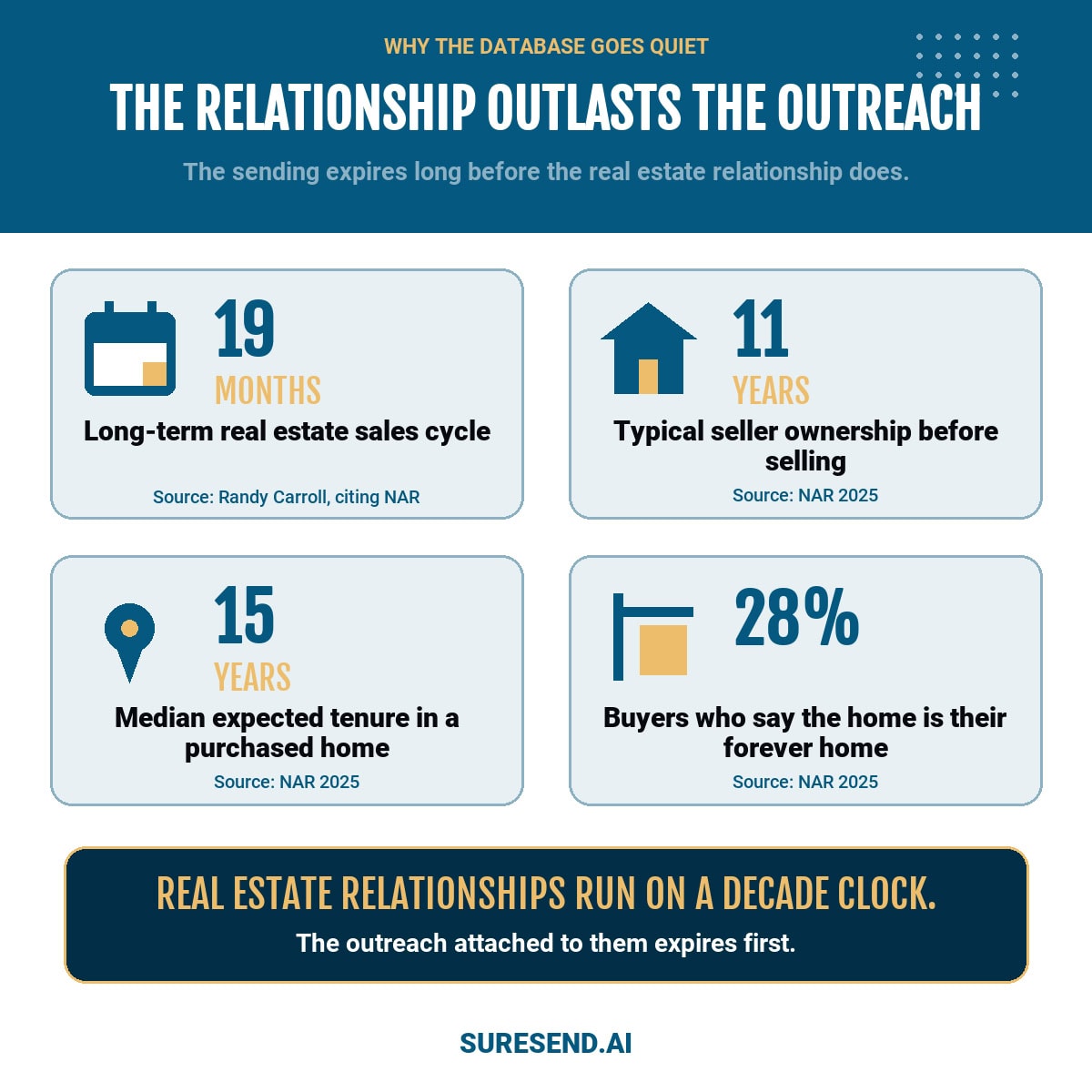
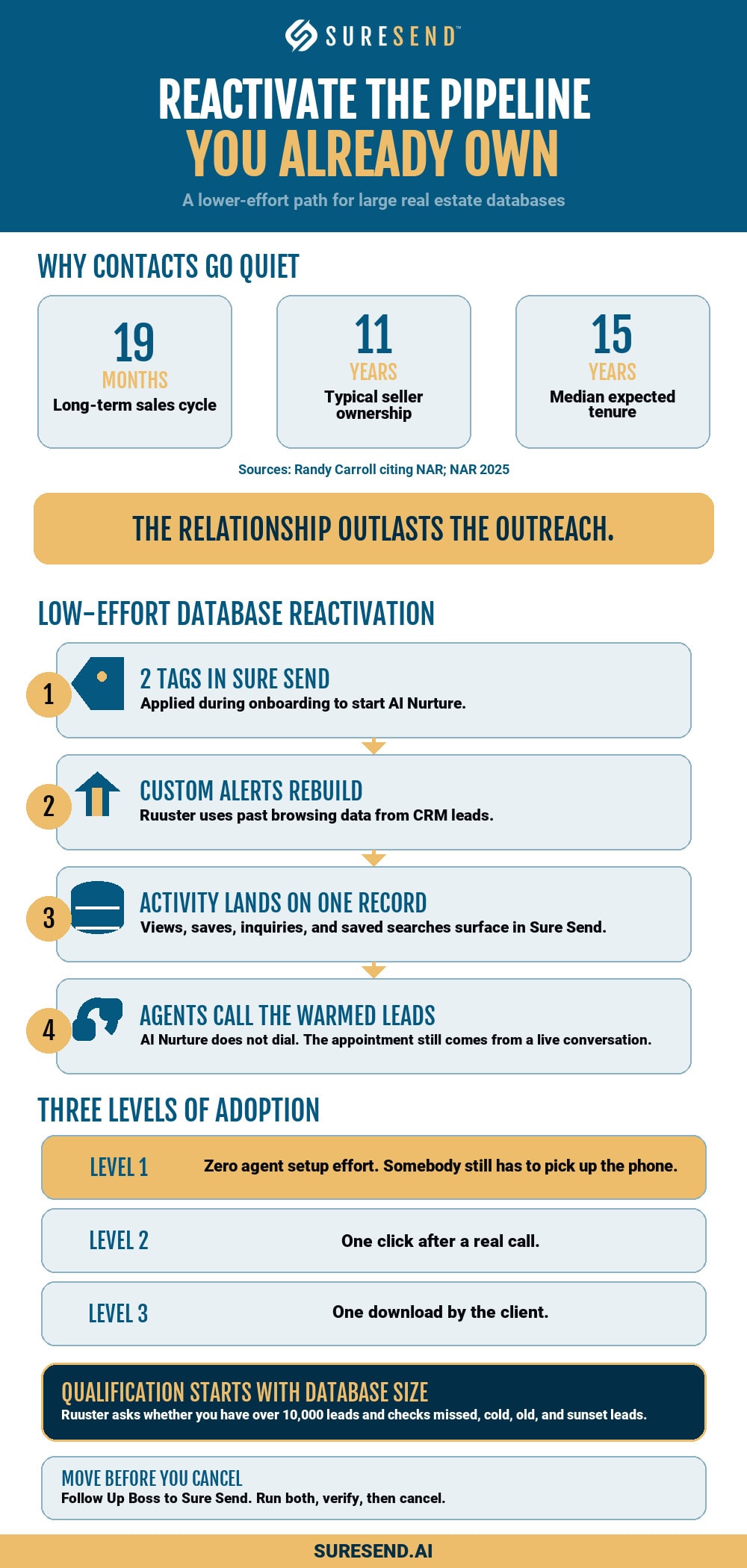
We know real estate is a very long-term sales cycle. NAR’s number for years and years and years has been 19 months, and most platforms out there stop sending the most important information long before we hit the 19-month mark.
Then the analogy.
People go to Nike’s website for shoes and Home Depot for screwdrivers, but then they go to real estate websites for homes. If you were to stop sending me homes, I would never need to go back to your website again.
That sunset is his own observation from building in this category, and he puts no clock on it.
Tenure data points the same direction on a different measure. NAR’s 2025 Profile of Home Buyers and Sellers puts the typical seller at a record 11 years of ownership before selling, against roughly six for sellers between 2000 and 2008. Median expected tenure in a purchased home is 15 years, and 28% of buyers say the place they just closed on is their forever home.
Real estate relationships run on a decade clock, and the outreach attached to them expires long before the clock does. Past clients and sphere relationships are the clearest case, and among the first to fall quiet. Their interest did not lapse. The sending did.
The effort floor
Across the CRM and martech rollouts I have specified as a marketing executive, the systems that survive contact with a sales organization share one property. They pay before they ask. Randy came up on the CRM side of this business, as did his Ruuster colleague Spencer Linquist, and he names the position a leader gets pushed into when a product runs that order backward.
Spencer and I, both of our backgrounds is actually working in the CRM side of the business, so we have a special place in our heart for team leaders who are pounding their agents over the head saying, use the CRM, use the CRM, use the CRM.
The same NAR technology survey prices this out. Only 21% of REALTORS® use a CRM with AI-powered insights, which counts one capability within the CRM and counts only that. Sure Send is a CRM, and its answer to that number is structural. Win the Day puts the whole day in the one view a rep opens anyway, and every signal about a person lands on a single contact record rather than behind a second login. Add nothing on top of that and you are ahead of where you started.
That survey also asks why members adopt anything new. Saving time leads at 66%, improving client experience follows at 64%, closing more deals at 51%, and reducing overhead trails at 16%. Plenty of good software wins its place by adding a step, because the step buys back one of those first three. Whether it gets far enough to try is decided by the effort floor, and the reasons a rep quietly stops opening the CRM are all versions of the same unpaid bill.
Sort every line on your invoice by what it demands of a person before it returns a dollar. The ones worth renewing are the ones you could switch on tonight without booking a meeting.
Ruuster’s three levels, ranked by what they ask of an agent
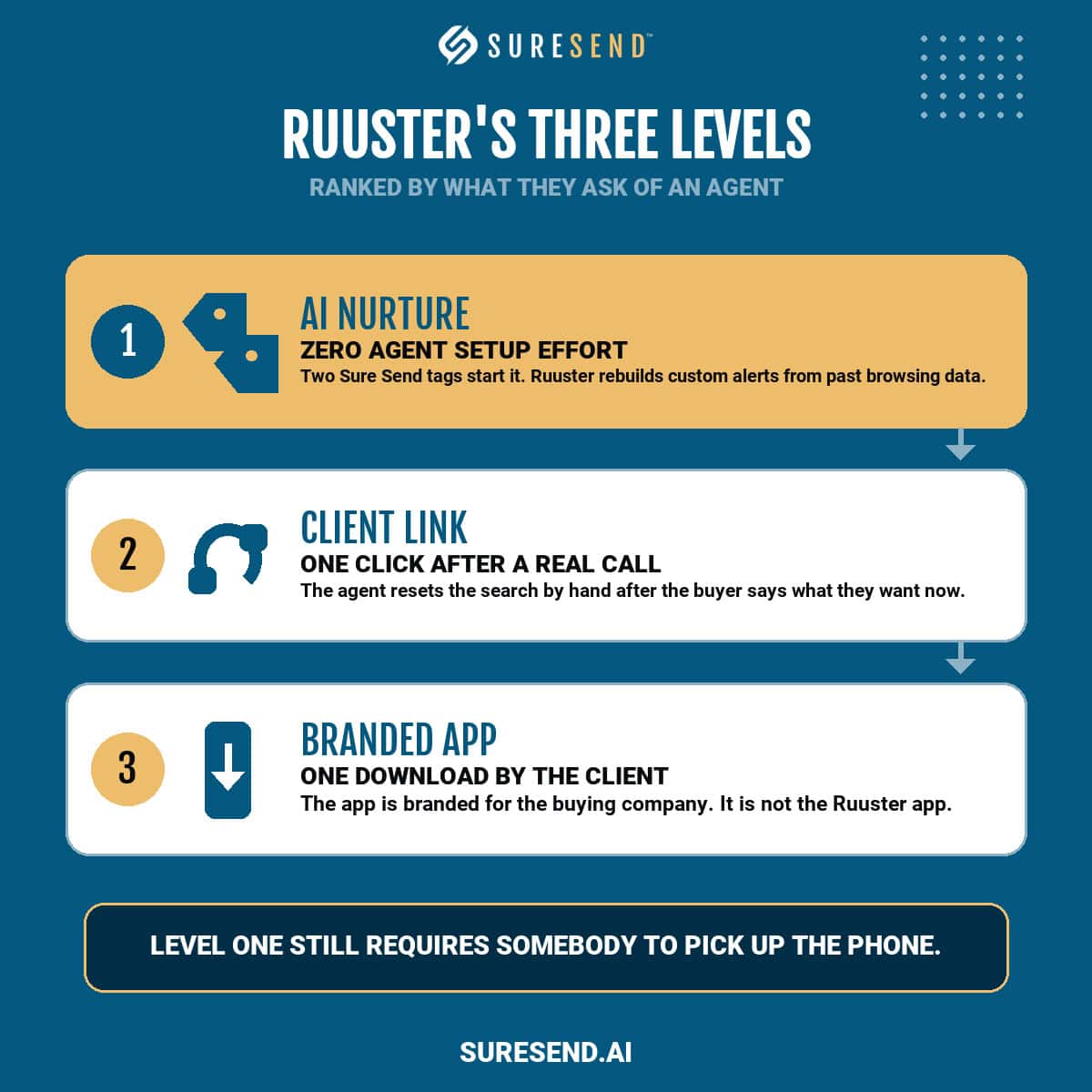
Ruuster arrives in three levels, and the order Randy puts them in is the ranking that matters.
Level one asks nothing. It works across everything sitting in the CRM, configured during onboarding.
Our big flagship feature, why 85% of people sign up for us, is a feature set called AI Nurture. And this is particularly valuable the larger your database is.
The switch is two tags.
You literally apply 2 tags inside of Sure Send and it will kick off AI Nurture. And what we do is systematically go through the thousands of leads in your database and rebuild for them custom alerts based off of the data they’ve looked at in the past.
Old browsing history becomes active alerts again, and nobody had to learn a screen for that to happen.
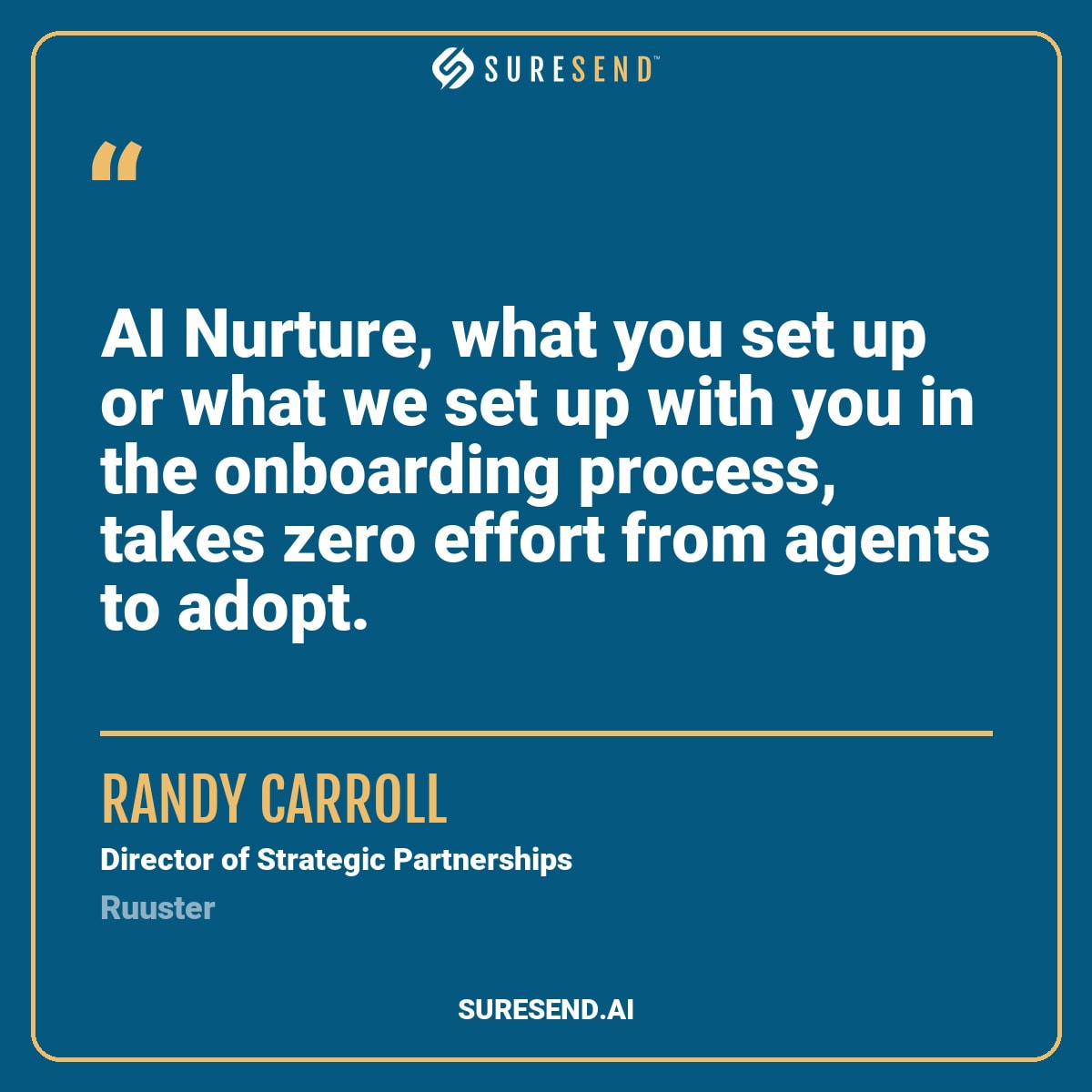
AI Nurture, what you set up or what we set up with you in the onboarding process, takes zero effort from agents to adopt.
The return claim arrives with its own limit attached.
So if all you ever did was use Ruuster and AI Nurture, and your agents called the leads, you’re almost certain to get a return on your investment with our product, assuming you have enough leads on AI Nurture. And we discussed that in the sales process, and you probably don’t even sign up for us if the numbers aren’t there.
A vendor who names the volume below which his own product fails to pay has handed you the grounds to disqualify him. Randy is equally plain about what level one still requires. Somebody has to pick up the phone.
Level two asks a single click, after a real call has happened. Once a lead has been reached and has said what they want, the client link on the Sure Send contact record opens Ruuster and the search gets reset by hand.
Now they’re getting more accurate information that will never sunset. This property alert that you create will go on forever and ever.
Level three asks one download, and the client is the one making it.
The third level of Ruuster adoption is downloading the app we build for you. It’s branded. It’s not the Ruuster app. It’s the Jenny Lynn app that people would download.
Jenny Lynn is the illustrative name on Randy’s demo screen, standing in for whatever the buying company is called. Line up every vendor in your stack against their own level one, then count how many have to start with training.
The second surface problem
Most additions to a stack arrive with a login, and a login is one more place activity can sit unseen. The integration question worth asking is whether a new product creates a destination or removes one.
Ruuster’s answer sits on the contact record open in front of the rep. Property views, saved properties, inquiries, and saved searches from within Ruuster land there, formatted the way they would look if the person had been browsing your own IDX site. For work that wants the full platform, a client link opens the individual inside Ruuster: a list of properties, an e-alert change, solds, comps.
Your agents aren’t necessarily having to check Sure Send for one bucket of their business and go into Ruuster separately for another bucket of their business. They can continue following up with the leads inside of Sure Send and let Ruuster work in the background.
Randy then paid Sure Send a compliment nobody asked for.
The easier you can make the agent’s day, the more likely they are to do whatever the daily expectations are, to hit the activity standards. And you guys have obviously nailed that with concepts like Win the Day, building the Sure Send mobile app.
Software that earns its place inside a working day leaves the shape of that day alone.
Readers weighing the CRM itself rather than the layer above it can book a Sure Send demo.
The data you already own, including the data in your last CRM
You may be reading this mid-move from another CRM, and the worry underneath it is behavioral history. Years of property views, saved searches, and inquiries sit on the far side of that migration.
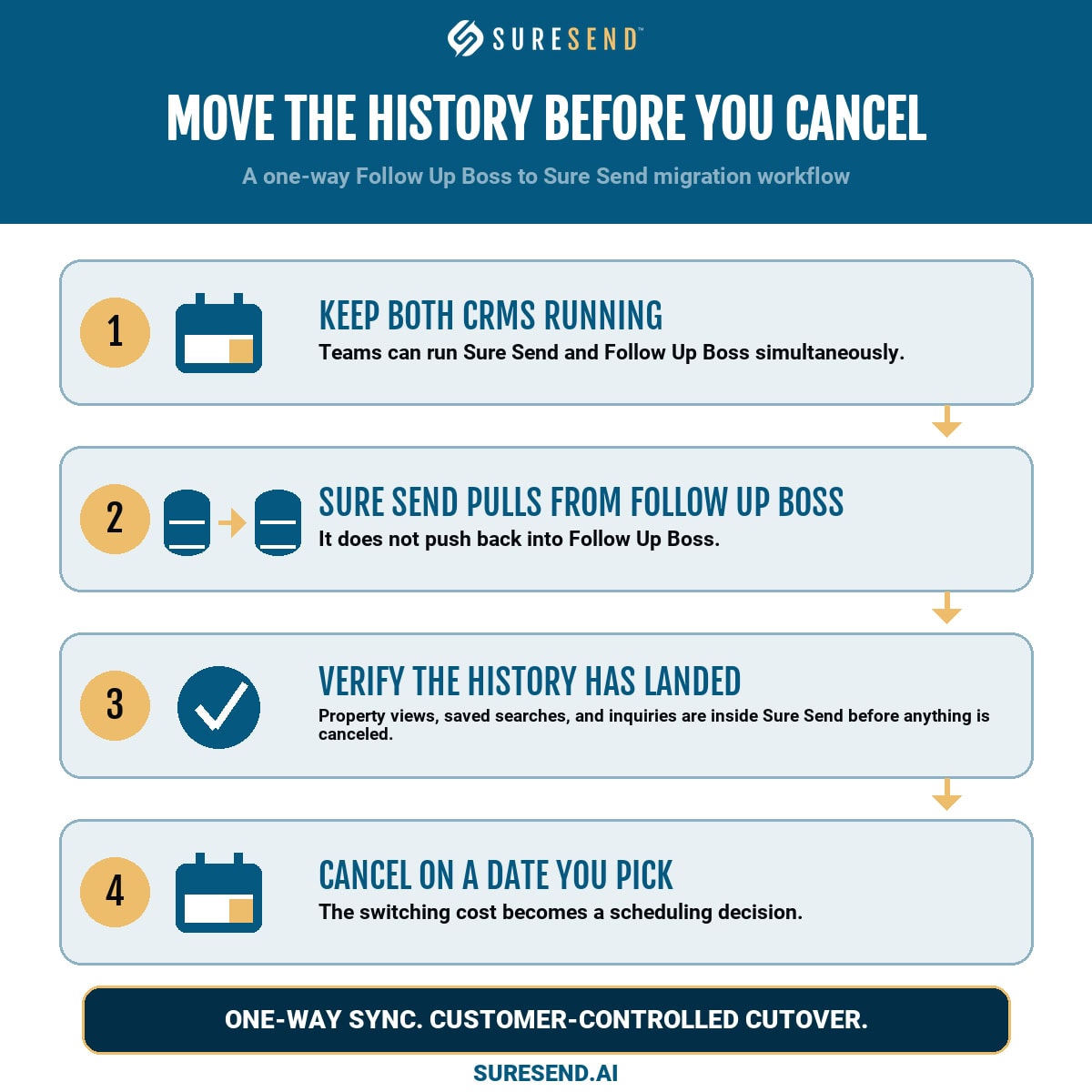
Sure Send integrates with Follow Up Boss, which everyone on the call shortens to FUB. Preston Guyton of Sure Send described how the sync behaves.
Some people run it simultaneously where they’ll run Sure Send and FUB as well, because Sure Send doesn’t push back into FUB, but it’ll pull everything from FUB.
Randy checked his own understanding out loud, asking whether a team leaving Follow Up Boss for Sure Send, worried about what had accumulated in there, could get it out. He had it right. A one-way sync lets both stay running during the changeover, so the history is inside Sure Send before you cancel anything. The migration steps are worth reading before you set a cutover date.
The switching cost you were bracing for turns out to be a scheduling decision.
What the vetting is actually for
A marketplace that leads with its partner count is quoting the one number that cost it nothing to earn. Sure Send publishes what its Marketplace screens for: insurance, operating background, and references before a listing goes up, then ongoing review, with removal for anyone who stops holding the standard.
Ruuster cleared that carrying proof of its own. The company’s site says it is trusted by over 20 of the top 100 real estate teams in North America, naming Jeremy Wilson of ChuckTown Homes Real Estate, a #15 RealTrends Mega Team, and Suneet Agarwal of Big Block Realty, a #4 RealTrends Mega Team. Travis Halverson of Sure Send put it to the Ruuster side directly.
You guys are a great, honestly great company, and you guys are great to work with. You guys know what you’re doing, which is great because a lot of people don’t.
If Ruuster stops clearing that bar the listing comes down, and no partner count has ever done that for a buyer.
Where to start
The first call Ruuster runs is a qualification. Its own site screens inbound by asking whether you have over 10,000 leads in the CRM, and it publishes no pricing for a solo operator. Randy says that conversation exists “to determine, is AI Nurture going to move the needle for your database?” He looks through the system for missed leads, cold leads, old leads, and sunset leads, checking whether the dormant portion of what you own is large enough to pay for the product.
The video and the contact form both sit on Ruuster’s listing in the Sure Send Marketplace.
Both stalled pushes ran into the same price of admission, and so will every line you renew next quarter.
Frequently asked questions
What is real estate database reactivation?
Restarting relevant contact with the names sitting in your CRM instead of paying for fresh ones. The phrase covers everything from a mass email blast to software that rebuilds each person’s property alerts on its own.
Those two behave nothing alike. A blast ends and its results end with it. The automatic kind keeps working long after anyone remembers switching it on.
Does Ruuster work with Sure Send?
Yes, natively. Ruuster carries the Native Integration badge in the Sure Send Marketplace, and Randy Carroll demonstrated it live in the video above.
Activity on the Ruuster side surfaces on the matching Sure Send contact record, so nobody opens a second window to learn that a long-silent buyer went looking at houses last night.
How big does a database have to be for this to pay?
Ruuster settles that before a demo. The gate on its own site is whether you have over 10,000 leads in your CRM, and there is no published price for a single agent.
Randy Carroll says the first sales call exists to answer exactly this. Ruuster would rather find out there that the volume is short than sell into it.
Do the people on the phones have to learn anything new?
At the first level, nothing. AI Nurture is configured during onboarding and works from there. All anyone is asked to do is phone the leads it warms up.
The second level is one click from within Sure Send after a live conversation reveals what a buyer wants now. The third is a download, and the client is the one doing it.
What happens to lead activity data if you switch CRMs?
It comes with you. Sure Send pulls from Follow Up Boss and writes nothing back the other direction, so both can stay running while you move.
Keep the old one going until everything has landed, then cancel on a date you pick rather than one a renewal picks for you. The migration guide walks through the order.
Is this a replacement for picking up the phone?
No. Nothing in it dials.
AI Nurture puts something worth opening back in front of a buyer who stopped hearing from you, which gives the outreach a reason to exist. The appointment still comes from a live conversation, and Randy Carroll says so plainly.

Written by


