


The Homes Your Buyers Save Aren’t the Homes They’re Shopping: James Call at RealtyCandy on IDX Data
The list you have been reading wrong
Before a showing, you open the client’s saved properties. Four homes, a price band, two neighborhoods. Reading it is the right instinct, and for years it was all your systems could give you.
The saved-properties list is the least useful thing your website knows about a buyer, and it is the only thing most agents ever see.
That person looked at dozens of homes to save those four, and the ones they lingered on often sit in a different price range or a different part of town. The view history has always existed. It stayed on the website while your team worked in the CRM, and no one built the road between them. Sure Send™ was built to be where behavior like that becomes something you can act on.
Your read was never wrong. It was working from the shortest list on the page.
What James Call actually sees in the data
James Call builds the pipe that carries search behavior from a website into a CRM. He works at RealtyCandy, an IDX software and integration company serving real estate professionals across the United States and Canada. RealtyCandy has been doing this work since 2012, and the company holds official Developer Partner status with IDX Broker. On a recent Sure Send Marketplace Spotlight, he described a pattern that keeps repeating.
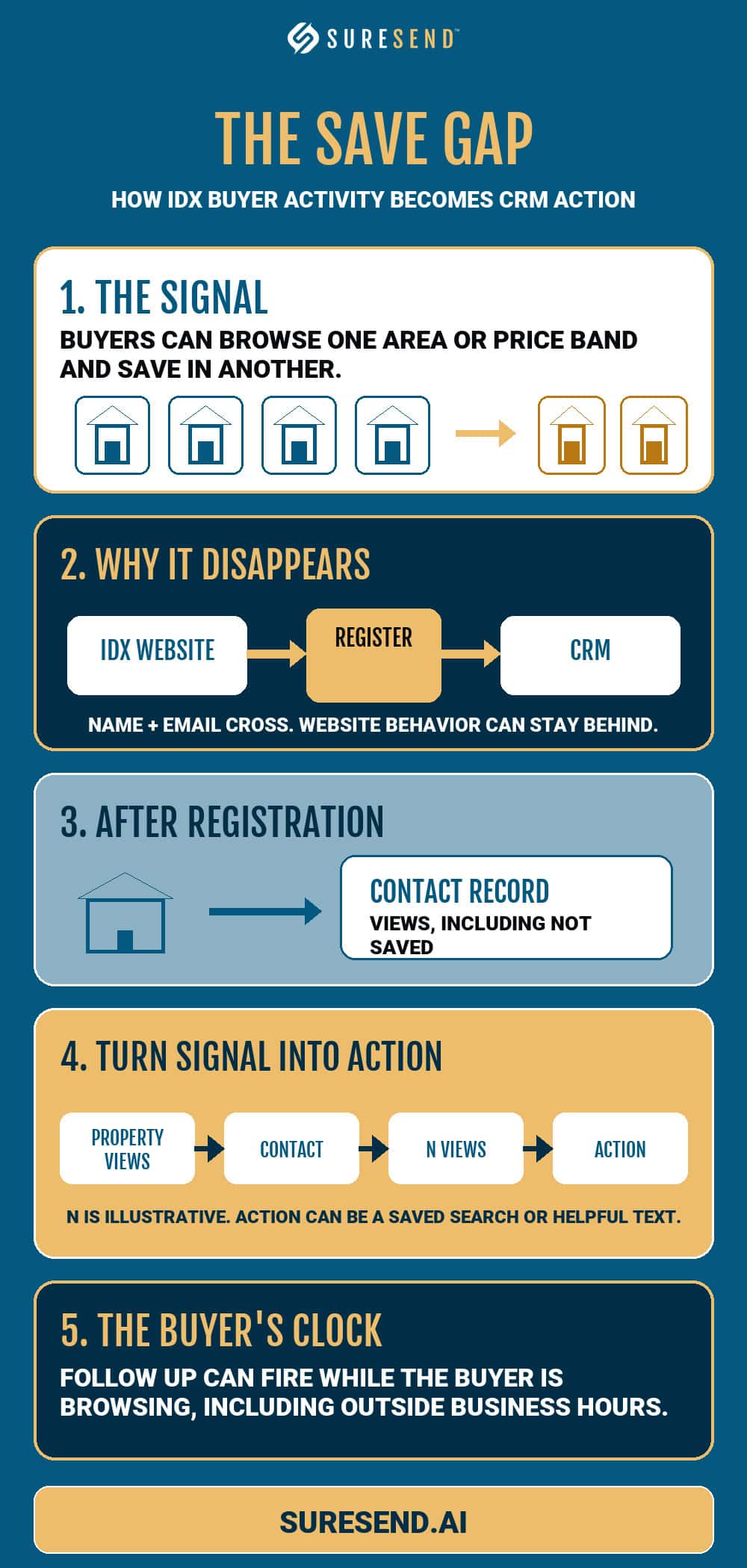
They’ll be looking at properties in one price range or in one area, and they’re actually saving properties in a different area.
James Call, RealtyCandy

That is one person behaving two ways on one website. James Call sees both halves because the record holds more than the shortlist: “I can see properties they viewed even that they didn’t save.”
Name it the save gap: the distance between where a client browses and where they bookmark. People browse where they want to live and bookmark where they think they can land, or the reverse once a lender moves their ceiling.

The distance between those two lists is where your client really stands, and it has been sitting on your website the whole time.
Why the gap stays invisible
Two systems hold one person between them. The searching happens on the site, on the person’s own time. The selling happens in the CRM, where your agent sees a name, an email, a phone number. Registration is the only handoff, so the contact crosses over and everything they did stays behind.

Nobody decided this. The tools were bought one at a time, from companies with no reason to talk. In the CRM rollouts I have led, systems stay separate when nobody asks them to connect.
The National Association of REALTORS® 2025 REALTOR® Technology Survey shows how separately agents already account for these tools. Social media ranked as the top lead-generating technology at 39%, the CRM second at 23%, the local MLS third at 17%. Agents count their lead sources one box at a time, and the website sits in a box of its own. Another piece covers the deeper mechanics of connecting IDX to a CRM.
Jennifer Staats, who runs the Marketplace Spotlight series at Sure Send, says the requests keep coming: “This is probably one of the hottest topics that we’ve been hearing all of our users asking for.” Teams want fewer, better-connected tools.
Send one email to your IDX vendor and your CRM vendor at the same time, and see which of them claims the ground in between.
See what a contact record looks like with the property activity on it.
Turning a signal into something that fires
Once that activity crosses into Sure Send, it stops being history and becomes an instruction. James Call described the shift in one line: “So we’re able to build automations, like I mentioned, based on that.”
His example from the live demo: “Once they’ve looked at 3 properties, I’m going to create a saved search or send them a text message asking if they want a saved search.” Three is the number he happened to use while showing the build, not a threshold anyone should copy. Yours depends on your price bands, your inventory, and how your team already handles compliant texting.

What changes is the clock the follow-up runs on. A buyer browses at 9:40 on a Sunday night, hits the third home, and the outreach goes out then. No rep has to be at a desk for that moment to count. The conversion benchmarks on what fast follow-up is worth make the case in numbers; this is the version of it that does not wait for Monday morning.
The honest limit sits right here. An automation like that opens a door and does not walk a client through it. A person on your team still has to read the activity and pick up the phone. A trigger pays for itself the first time it puts your best agent in front of the right contact on a Sunday night.
Where the data lands is the decision nobody makes
In my past roles as CMO for Showcase IDX and then head of go-to-market for all martech at eXp World Holdings (now AGNT), I helped coach thousands of agents across the country and was able to see the data from 200,000+ agents, teams, and brokers. One pattern held across all of them. The highest performers invested in their own IDX website. The vast majority needed a partner to build the site and keep growing it into something their clients would actually use.
Teams choose an IDX provider on two questions: how much of the MLS it shows and what it costs. The third question rarely comes up. What happens to everything a visitor does on the site after they leave it? That answer decides whether the save gap is ever visible.
RealtyCandy builds across AeroIDX, IDX Broker, and iHomeFinder, and states that all three work with any CRM. On the Sure Send contact record, the property sits at the center and the client’s activity gathers around it, which is the view James Call describes here:
It’s just really property-centric. So anything I want to know about this is coming right through here.
James Call, RealtyCandy
RealtyCandy builds on whatever CRM a team already runs, GoHighLevel included, and that neutrality is a real part of why teams stay with them. I keep seeing brokers, teams, and agents move from GoHighLevel to Sure Send, and the reasons sit in a separate piece on GoHighLevel alternatives. A team that changes CRMs keeps the same IDX partner.
RealtyCandy reports 6,086+ active real estate agents served and 440,000 leads generated per month across their client base, at a 98% customer satisfaction rate.
Teams that skip that third question keep paying for a website that stores years of client behavior they have no way to read.
See what Sure Send does with that activity once it arrives.
The setup, end to end
The whole setup ran live on the recording, and it came down to one field and one button. “You basically just put in your Sure Send API key here and push the connect button instead of disconnect, and all of a sudden all your leads are going to be flowing over.” RealtyCandy built the demo site on Lovable, the AI site builder. “It takes 10 minutes or something to build up a website like this.”
In its 2025 REALTOR® Technology Survey, the National Association of REALTORS® found that 66% of REALTORS® adopt new technology primarily to save time. That is the test worth applying here.
Three objections come up. This is one more connection to keep working, and that upkeep is real. Some of what comes across will turn out to mean nothing, and a low view threshold will catch people who were only curious. Outreach triggered that way will sometimes reach a client who is not ready to talk, which is why James Call’s example offers a service rather than a pitch.
The upkeep is real, and it is smaller than the cost of one warm lead going cold while nobody knew to call.
The decision in front of you
You will open that shortlist again before the next showing. Same four addresses, same price band. Nothing on it has changed. What changed is that you now know it is the smallest part of what your site recorded.
You are already making this call every week, by default. Either the rest of it reaches someone who can act on it, or it sits where no one looks.
The first client this changes will have no idea why that call landed as well as it did.
Somewhere in that record is a home your client opened and closed without saving, sitting there under their name, waiting for you to be the first person to bring it up.
See how it works at Sure Send.
Frequently asked questions
What is IDX and why does it need to connect to my CRM?
IDX is the feed that puts live MLS listings on your site, and the case for wiring it into your CRM is covered end to end in this guide to real estate CRM IDX integration.
Can I see what a lead looked at if they never filled out a form?
No. Viewing history attaches to a contact, and a contact exists only after a visitor registers or sends an inquiry. Everything before that moment is anonymous traffic.
Does this work with my existing website?
For the common platforms, yes. RealtyCandy reports they work with WordPress, Wix, Squarespace, Duda, and Showit, and they state a 48-hour window for adding IDX to a site you already have.
Do I need to switch IDX providers to make this work?
No. RealtyCandy works across AeroIDX, IDX Broker, and iHomeFinder, and states that all three connect with any CRM. The open question is where the behavior goes after the feed renders, not who supplies the feed.
Will automated texts about property activity annoy my buyers?
Not if the message earns its place. A text offering to set up a saved search for a client who has been working through the same price band all week is a service, and it reaches them while they are still thinking about those homes. Sure Send handles TCPA and DNC compliance through ezVerify.ai integration, with real-time flagging and timestamped consent, so consent status travels with the contact instead of living in an agent’s memory.
Is RealtyCandy available outside the United States?
Canada, yes. The Sure Send Marketplace listing names the United States and Canada, while RealtyCandy’s own site also lists Mexico. A team working outside the US should confirm coverage with them directly.

Written by


